


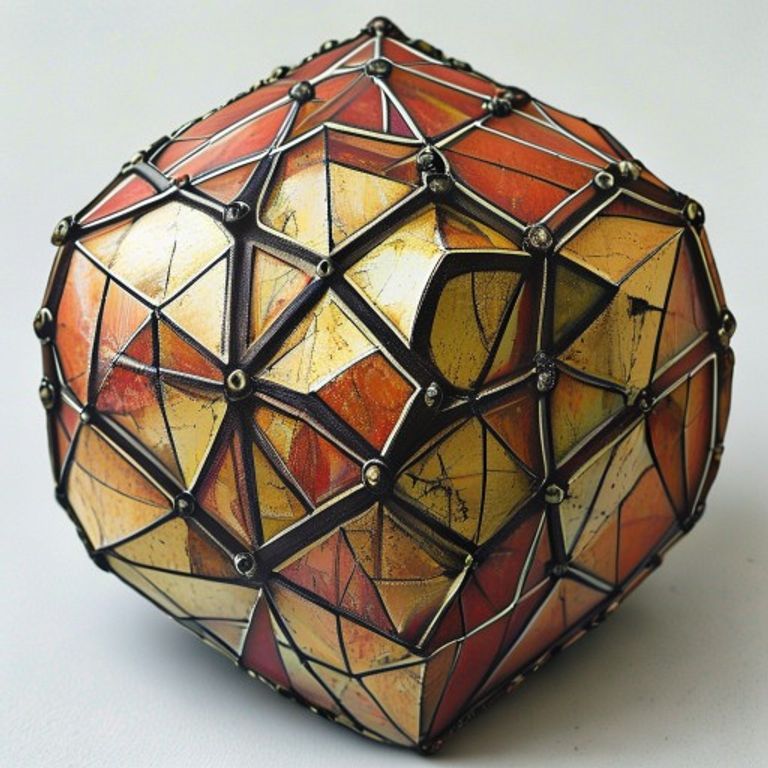
Small hollow bronze objects with twelve pentagonal faces found throughout Europe dating back to the Roman Empire, but whose purpose—whether tool, game, or ritual item—remains an absolute enigma.
⚠️ Research elaborated with the aid of Deep Research is subject to referential ambiguity.
🖥️Clean HTML code using a proprietary tool.
👥 Research by Guilherme Felipe, Curation by Sílvio Lôbo
The Enigma of the Roman Dodecahedron: A Thousand-Year-Old Unresolved Mystery
In 1739, in the fertile lands of the Allier region, France, a peculiar object emerged from the soil, unearthed by a peasant who, by a twist of fate, would become the first witness to one of history's most persistent archaeological mysteries: the Roman Dodecahedron.
The Context and the Incident: The Emergence of the Inexplicable
During routine plowing, the peasant stumbled upon an unknown metallic artifact. It was neither a common agricultural tool nor an easily identifiable decorative object. It was a hollow object, made of bronze, with twelve regular pentagonal faces, each pierced by a hole of varying diameter. The vertices of each pentagon were adorned with small spheres.
The object, measuring about 4 to 11 centimeters in diameter, was initially considered a local curiosity. However, as more similar specimens began to be discovered in the region of Gaul and, subsequently, in other parts of the Roman Empire, the mysterious nature of the dodecahedron intensified. The lack of clear historical context, inscriptions, or any contemporary record explaining its function gave rise to an enigma that persists to this day.
Timeline of Events
- 3rd/4th Century AD: Estimated period of creation and use of Roman dodecahedra, based on archaeological dating and associated finds.
- 1739: Discovery of the first Roman dodecahedron in Allier, France, by a local peasant.
- 18th - 19th Century: Several other discoveries in France, Germany, Switzerland, and the Netherlands, fueling interest and speculation about the artifact.
- 20th Century: Intensification of archaeological and scientific studies, with expert analyses and the proposal of various theories.
- 2000s onwards: Continuation of research, incorporating new technologies and re-evaluating evidence, but without a definitive conclusion.
Main Theories: Unraveling the Puzzle
Over the centuries, numerous hypotheses have been proposed to explain the origin and purpose of the Roman Dodecahedron. Each attempts to fit the object into a comprehensible context, but none has, so far, managed to completely dispel the doubts.
Scientific and Forensic Theories (Most Probable):
- Agricultural Measurement Instrument: The most accepted theory among archaeologists suggests that the dodecahedron was an instrument used to measure distances or angles in agricultural tasks, such as land leveling or area determination. The variation in hole diameters could have been used to calibrate measurements on different scales.
- Craftsmanship Tool: Another hypothesis suggests that the object was used by artisans, possibly for working with leather, weaving, or metallurgy, perhaps as a mold or a template for creating objects with specific shapes.
- Game Object: Some researchers point to its similarity to modern dice, suggesting that the dodecahedron could have been used in games of chance or board games, where each numbered face (or face with symbols) would have a specific outcome.
- Calibration Instrument: There are those who believe it was a calibration device for engineering or navigation instruments, used to ensure accuracy in measurements.
Alternative, Conspiracy, or Paranormal Theories:
- Divination/Astrology Instrument: Given its geometric shape and lack of obvious practical use, some speculate that the dodecahedron had an esoteric or mystical function, possibly linked to divination rituals, astrology, or religious beliefs.
- Advanced Technological Device (Extraterrestrial/Atlantean Hypothesis): A more speculative theory, without any proven scientific basis, suggests that the object was a remnant of a technologically advanced civilization, possibly extraterrestrial or Atlantean, whose functionalities transcended Roman knowledge.
- Key/Opening Device: There is the idea that the dodecahedron was a type of complex key, designed to open unknown mechanisms, perhaps chests or access doors to secret locations.
- Ritualistic/Ornamental Object: Although the lack of extravagant adornments makes the purely ornamental hypothesis less likely, the possibility of it being an object with ritualistic significance, but without direct practical utility, is still considered.
Controversies and Blind Spots: The Gaps in the Investigation
The main controversy surrounding the Roman Dodecahedron lies in the **total absence of historical documentation** describing its use or manufacture. Unlike other well-understood Roman artifacts, the dodecahedron seems to have emerged "from nowhere," with no clear predecessors or direct descendants.
- Lack of Consistent Archaeological Context: Although many dodecahedra have been found in Roman contexts, few have been discovered in stratified excavations with precise dating or associated with other artifacts that could provide clues about their purpose.
- Conflicting or Non-existent Testimonies: There are no accounts from Roman historians, such as Pliny the Elder or Vitruvius, that make any mention of objects with similar characteristics.
- Missing Usage Evidence: The absence of significant wear marks or residues that could indicate a specific use has been a point of frustration for researchers.
- Unusual Standardization: The general uniformity in shape, but with variations in hole sizes and details, raises questions about whether different "models" existed or if the variation was intentional for different applications.
Curiosities and Legacy: An Icon of Mystery
The Roman Dodecahedron has transcended the realm of archaeology to become a cultural icon of mystery and the inexplicable. Its intrinsically geometric shape and unknown function captivate the popular imagination, inspiring fiction, art, and various speculations.
- Presence in Museums: Examples of Roman dodecahedra can be found in various museums around the world, such as the National Museum of Cluny in France and the Berlin History Museum in Germany.
- Inspiration for Fiction and Theories: The object is frequently cited in historical novels, video games, and documentaries about archaeological mysteries, fueling theories about lost knowledge and forgotten civilizations.
- Current Status: The case of the Roman Dodecahedron remains open. There is no definitive scientific consensus on its function, and new discoveries or analyses could, at any time, shed new light on this millennia-old enigma.
Until irrefutable evidence comes to light, the Roman Dodecahedron will continue to be one of the most fascinating enigmas of antiquity, a silent reminder that, even in the ruins of known civilizations, profound secrets still await discovery.



