


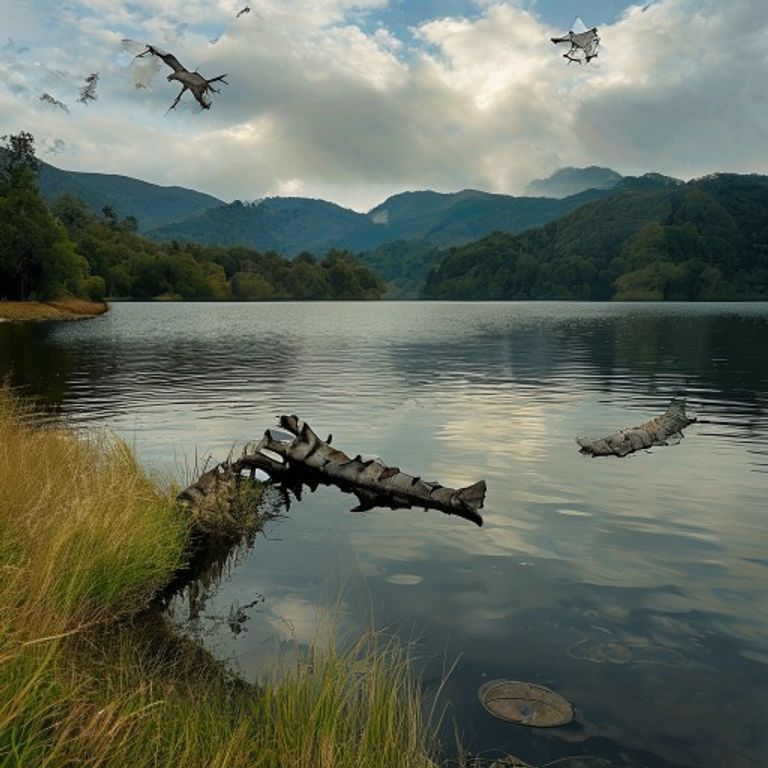
Hundreds of ancient human skeletons with bizarre and similar cranial injuries were found scattered on the frozen shores of Roopkund Lake in India.
⚠️ Research elaborated with the aid of Deep Research is subject to referential ambiguity.
🖥️Clean HTML code using a proprietary tool.
👥 Research by Guilherme Felipe, Curation by Sílvio Lôbo
The Skeleton Lake: An Icy Enigma in Roopkund
Amidst the stunning and treacherous landscapes of the Indian Himalayas, in Uttarakhand, lies a crystal-clear lake that hides one of history's most macabre and persistent mysteries: Skeleton Lake, or Roopkund, as it is known locally. Thousands of human bones, body fragments, and even traces of flesh and hair, all frozen by altitude and time, emerge when the ice melts seasonally. A surreal scene that defies simple explanations and has fueled speculation and investigation for decades.
1. The Context and the Incident: The Awakening of the Mystery
Roopkund Lake, situated at an altitude of approximately 5,020 meters in the foothills of the Himalayas, is a place of austere beauty but extremely difficult access. The mystery began to surface in 1942, when a local forest ranger, H.K. Madhwal, discovered, during a patrol, the shocking sight of hundreds of human skeletons scattered along the lake's shores and in its bed. Initially, it was thought that the remains might belong to Japanese soldiers who had gotten lost during World War II and died of cold or hunger. However, later analyses would dismiss this hypothesis, paving the way for a much older and more complex enigma.
2. Timeline of Events: A Fragmented Chronology
- 9th Century AD (Estimated): The cataclysmic event that led to the death of over 800 people, according to the most accepted theories.
- 1942: Official discovery of the human remains by H.K. Madhwal.
- 1950s: First scientific investigations, including anthropological examinations and radiocarbon dating. Early analyses suggested a European origin for some individuals.
- 1960s: An official report, based on initial findings, was released, without, however, offering a definitive conclusion.
- 1990s and 2000s: New expeditions and in-depth genetic analyses began to be conducted.
- 2004: A television documentary reignited public interest in the case, presenting new evidence and theories.
- 2013: The most comprehensive expedition to date collected over 30 skeletons and samples for DNA analysis, including isotopic analysis to determine diet and geographical origin.
- 2019: Publication of the DNA analysis results, revealing the Indian origin of at least 38 out of 38 analyzed individuals, revolutionizing previous theories.
3. The Main Theories: Unraveling the Enigma
Over the years, several theories have emerged to explain the massive presence of human remains in Roopkund. They range from the scientific to the fantastical:
- Theory of the Fatal Pilgrimage (Scientific/Historical): The strongest hypothesis, corroborated by recent DNA analyses, suggests that the individuals were a group of Indian pilgrims who, in the 9th century AD, were on their way to a sacred temple in the Himalayas. A sudden and violent hailstorm, possibly combined with intense snowfall, caught the group unprepared, leading to their deaths. The size of the hailstones, described in local accounts as "the size of cricket balls," could have been devastating. This theory explains the concentration of bodies and the lack of signs of struggle. Logic: Emphasizes natural disasters in remote and dangerous locations. The dating and Indian origin reinforce this explanation.
- Theory of the Epidemic (Scientific): An infectious disease swept through the group of pilgrims, leading to their mass death. However, the absence of signs of disease on the bones and the distribution of the bodies suggest this is less likely. Logic: Diseases can decimate isolated groups, but it doesn't explain the evidence of physical impact.
- Theory of the Travel Group Tragedy (Historical/Forensic): A larger group of people, possibly a caravan or a retreating army, was caught in an ambush or a natural disaster. The older dating and the diversity of remains (including wood and metal fragments) could support this idea, although the new DNA analysis points to a more homogeneous group. Logic: Considers large-scale conflicts or accidents.
- Alternative and Paranormal Theories:
- Ritual Sacrifice: Some suggest that the individuals were sacrificed in an ancient religious ritual. There is no concrete evidence to support this hypothesis, and the absence of religious artifacts or a sacrificial site points against it.
- Alien Discovery/Supernatural Intervention: More esoteric theories point to inexplicable events, such as alien abductions or divine interventions. These lack any scientific or empirical basis.
- Victims of a Curse: Local myths mention a curse associated with the lake, often linked to the goddess Nanda Devi. These narratives, while fascinating, are folkloric and not scientific.
4. Controversies and Blind Spots: The Flaws in the Investigation
The long and winding investigation of Skeleton Lake is fraught with controversies and blind spots that have hindered the resolution of the mystery:
- Initial Dating and Origin: Early analyses, particularly in the 1950s and 1960s, suggested that the remains might be of European origin, possibly from individuals attempting to cross the Himalayas. This led to misguided conclusions and investigations that followed erroneous paths.
- Fragmentation of Evidence: The nature of the site, with ice and snow covering the remains for long periods and seasonal melting exposing and burying the bones, led to the fragmentation and dispersal of evidence over time. Many bones and artifacts were taken by tourists or local residents.
- Incomplete Official Reports: Initial reports were criticized for their lack of conclusiveness and for not addressing all possibilities. Investigations were often interrupted by the difficulty of access and extreme weather conditions.
- Mystery of the Genetic Discrepancy: The major turnaround occurred in 2019, when extensive genetic analyses revealed that the remains were, in fact, predominantly of Indian origin, belonging to at least two distinct genetic groups that seemed to have lived at different times. This contradicted previous theories based on artifacts (such as rings and spears) that appeared to be of European or Central Asian origin, leading to questions about the interpretation of these artifacts and the possibility of multiple tragedies at the site over the centuries.
- Lost or Ignored Evidence: It is likely that much important evidence has been lost or never discovered due to the difficulty of research and the time elapsed. The interpretation of isolated artifacts without a complete archaeological context also contributed to the confusion.
5. Curiosities and Legacy: The Enduring Fascination
Skeleton Lake has transcended its origin as an archaeological mystery to become a cultural icon, inspiring books, documentaries, and legends. Its remoteness and the shocking nature of the discovery ensure its place in the popular imagination.
- Cultural Impact: The site is now a popular destination for adventurous trekkers, although it is strictly regulated to preserve the environment and human remains. The lake's story is told and retold, with each new expedition bringing more questions than answers.
- Current Status: Although the 2019 genetic analyses have offered the most plausible explanation to date for the origin of most of the remains – a group of Indian pilgrims killed by a hailstorm – the full mystery has not yet been completely unraveled. Questions about the presence of other genetic groups and the exact chronology of events still remain. The case, although not formally reopened by criminal police, continues to be the subject of intense scientific research and historical speculation.
- The Legend of Goddess Nanda Devi: The lake is sacred to the local inhabitants, and many stories about its origin are linked to legends of the goddess Nanda Devi, who allegedly cursed those who dared to desecrate her region.
Skeleton Lake, or Roopkund, remains a silent testament to past tragedies, a reminder of human fragility in the face of nature's relentless forces, and one of the most persistent and fascinating enigmas that the Himalayas hold in their icy embrace.



