


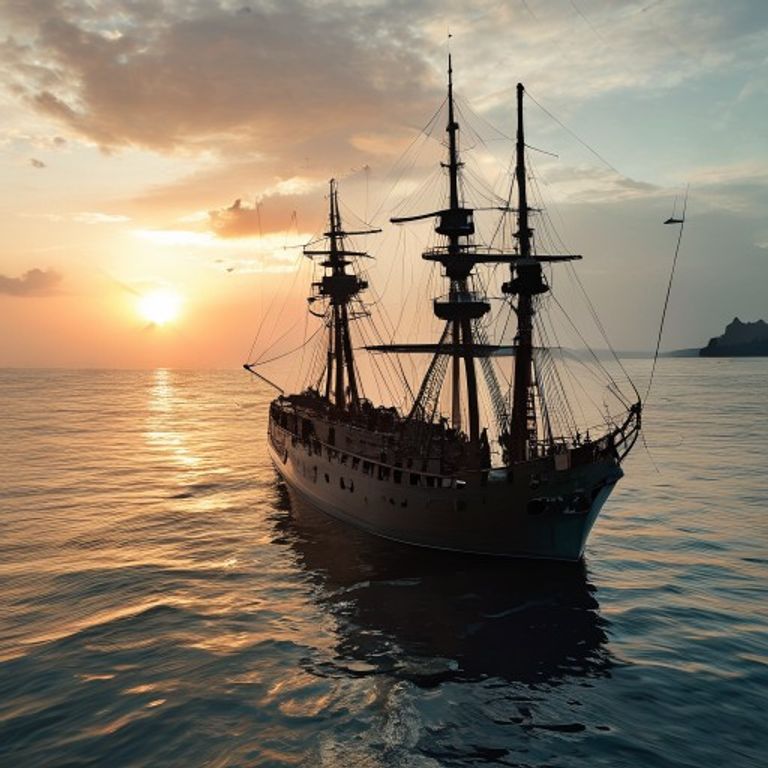
Castro Alves' poem and the historical fact of the transatlantic slave trade, denouncing the inhumane conditions of the voyages that fueled slavery.
⚠️ Research conducted with the aid of Deep Research is subject to referential ambiguity.
🖥️ Clean HTML code using a proprietary tool.
👥 Research by Guilherme Felipe, Curation by Sílvio Lôbo
The Enigma of the "Slave Ship": A Mystery Submerged in the Depths of the Atlantic
The ocean holds secrets. Vast, unfathomable, and some of them, eternally silent. Among the enigmas that haunt maritime history, few are as laden with mystery and tragedy as the one surrounding the disappearance of the slave ship La Amistad in 1839. But this is not the historical case of the slave rebellion that became famous for its fight for freedom. This is the account of another ship, a name that echoes in whispers in dusty archives and fragmented reports: a ship that, in some versions, became a ghost "Slave Ship," a stage for indescribable horrors and, more disturbingly, a disappearance that defies explanation. The investigation of this case is a journey through enigmatic documents, contradictory testimonies, and a fog of uncertainty that, to this day, obscures the truth.
The Context and the Incident: The Shadow of Human Trafficking
The transatlantic slave trade, a brutal and inhumane practice that claimed millions of lives, was the dark backdrop for the incident in question. Although the exact details of the specific ship and the event itself are scarce and often mixed with other narratives, the essence of the mystery lies in the disappearance of a vessel dedicated to the forced transport of Africans to the Americas. The exact location and date of the incident are the first points of ambiguity, but most reconstructions point to the late 19th century, somewhere along the shipping routes between Africa and the Caribbean, or even off the Brazilian coast, where the trade was intense. The "incident" does not refer to a single, well-documented event, but rather to a set of reports about a ship that, after setting sail loaded with enslaved human beings, never reached its destination. The stories vary: some speak of bloody mutinies, others of devastating diseases, and still others of more sinister and inexplicable events.
Timeline of Events (Fragmented and Speculative)
The absence of detailed official records regarding a specific "Slave Ship" with a mysterious end makes it difficult to create a precise timeline. What exists are fragments of reports, maritime legends, and inferences based on navigation patterns and ship disappearances of the era. However, a possible reconstruction, based on recurring elements in different narratives, could be as follows:
- 1860s-1880s: An unidentified ship, presumably under a European or American flag, departs from a port on the African coast with hundreds of Africans kidnapped and chained in its hold. The ship's name, its exact route, and the captain are unknown or inconsistent in the reports.
- Days or Weeks after Departure: Rumors and fragmented reports begin to circulate about the vessel. Anonymous testimonies from sailors in ports of call or fishermen who spotted the vessel indicate precarious conditions on board, signs of extreme suffering of the captives, and, in some cases, strange behavior by the crew.
- Indeterminate Period: The ship disappears. There are no records of a shipwreck, nor signs of debris found on known shipping routes. The vessel, along with everyone on board, seems to have been swallowed by the ocean.
- Subsequent Decades: Stories and legends about the "Slave Ship" begin to spread, fueled by the atmosphere of mystery and horror associated with human trafficking. Reports of ghostly apparitions, strange lights at sea, and inexplicable sounds emerge in areas where the ship supposedly disappeared.
The Main Theories: From Tragedy to Fantasy
The lack of concrete evidence opens up a wide range of theories, ranging from the plausible to the paranormal. Critical analysis is essential to separate the wheat from the chaff.
Probable Scientific and Investigative Theories:
- Accidental Shipwreck: The most direct theory is that the ship, like so many others at the time, was a victim of the elements. Violent storms, structural failures of the ship, or navigation errors could have led to its rapid sinking without leaving a trace. The precariousness of slave ships and the dangerous conditions of maritime routes make this hypothesis highly plausible.
- Disease and Starvation on Board: The unsanitary conditions and overcrowding on slave ships were conducive to the proliferation of contagious diseases such as cholera, smallpox, and dysentery. A devastating outbreak could have decimated the crew and the enslaved, leading to a loss of control and, eventually, the sinking or abandonment of the vessel on the high seas.
- Piracy or Attacks: Although less common on long-distance slave trade routes, attacks by pirates or rival ships could have resulted in the sinking or seizure of the ship. However, the lack of reports of such an event, even fragmented ones, makes this theory less likely as the primary cause of the complete disappearance.
Alternative, Conspiracy, or Paranormal Theories:
- Mutiny and Sabotage: The hypothesis of a mutiny on board, perpetrated by the enslaved in desperation, is a possibility. If the mutiny were violent enough, it could have led to the incapacitation of the crew and the destruction of the ship, culminating in its sinking. Alternatively, the crew, in panic or desperation, could have sabotaged the vessel.
- Conspiracy to Disappear: A more conspiratorial theory suggests that the ship could have been deliberately "sunk" or dismantled to avoid investigations into illegal practices, smuggling, or slave escapes. The crew could have been instructed to disappear with the vessel and everyone on board to cover up irregularities.
- Paranormal Phenomena and Curses: This is the most speculative strand. Reports of apparitions, strange lights, sounds of lamentation, and the feeling of a "presence" in certain maritime areas have led to theories about curses linked to the suffering of the enslaved. In some narratives, the ship is described as a "ghost ship," condemned to wander the oceans. These theories lack any factual or scientific basis but fuel maritime folklore.
- The Mystery of Triangulations: A more modern theory, though still speculative, suggests that the ship could have been involved in some form of "triangulation" of illegal activities, where its purposeful disappearance would serve some greater purpose within criminal or espionage networks of the time, although the exact nature of this remains obscure.
Controversies and Blind Spots: Lost Traces at Sea
The elusive nature of the "Slave Ship Case" is intrinsically linked to its controversies and blind spots, legacies of the very nature of human trafficking:
- Incomplete and Fraudulent Records: The slave trade was a largely clandestine activity. Ships often operated under false flags, with falsified cargo and crew records. This inherent opacity makes the precise identification of vessels and the reconstruction of routes extremely difficult.
- Anonymous Testimonies and Orality: Many reports about the ship's disappearance are based on anonymous testimonies from sailors or fishermen, often told in distant ports and passed down from generation to generation. The lack of precise names, dates, and locations, and the probability of distortions in oral narrative, are significant sources of uncertainty.
- Ignorance and Disinterest of Authorities: For the authorities of the time, the disappearance of a slave ship, however tragic, could have been considered a routine incident, especially if there were no direct commercial or political interests involved. The search for wreckage or the in-depth investigation of a ship with such a vulnerable human cargo may have been neglected.
- Disappeared Evidence: It is plausible that any shipboard records, navigation logs, or crucial clues that might have existed were lost with the shipwreck, or that they were intentionally destroyed before or after the event.
- Confusion with Other Cases: The lack of a specific name for the ship and the generalized nature of human trafficking can lead to confusion with other tragic maritime incidents. Stories and legends may have merged, creating a hybrid enigma that makes it difficult to disentangle the facts.
Curiosities and Legacy: A Ghost on the Waves
The "Slave Ship Case" may not have an official name in "cold case" files, but its legacy lies in the atmosphere of mystery and horror it evokes. The very idea of a ship disappearing with hundreds of souls, in a context of extreme cruelty, fuels the imagination and fascination with unresolved enigmas.
- Inspiration for Maritime Folklore: The enigma of the Slave Ship fits into the rich tapestry of maritime folklore, joining legends like the "Flying Dutchman." These stories serve as metaphors for the dangers of the sea, human cruelty, and the fear of the unknown.
- Cultural Representation of Tragedy: Although a specific case is not easily traceable, the idea of slave ships disappearing without a trace is a cultural representation of the inhumanity and immeasurable losses of the slave trade, many of which were never documented.
- Current Status: The "Slave Ship Case" has not been reopened in formal terms, as its existence as an isolated and well-defined case is, in itself, a subject of debate. However, research into the slave trade and maritime disappearances continues, and perhaps one day, fragments of evidence will come to light to shed some light on the fate of one of these dark vessels. Until then, the Slave Ship remains a ghost on the waves, a grim reminder of the depths of human tragedy and the secrets that the ocean refuses to reveal.



