


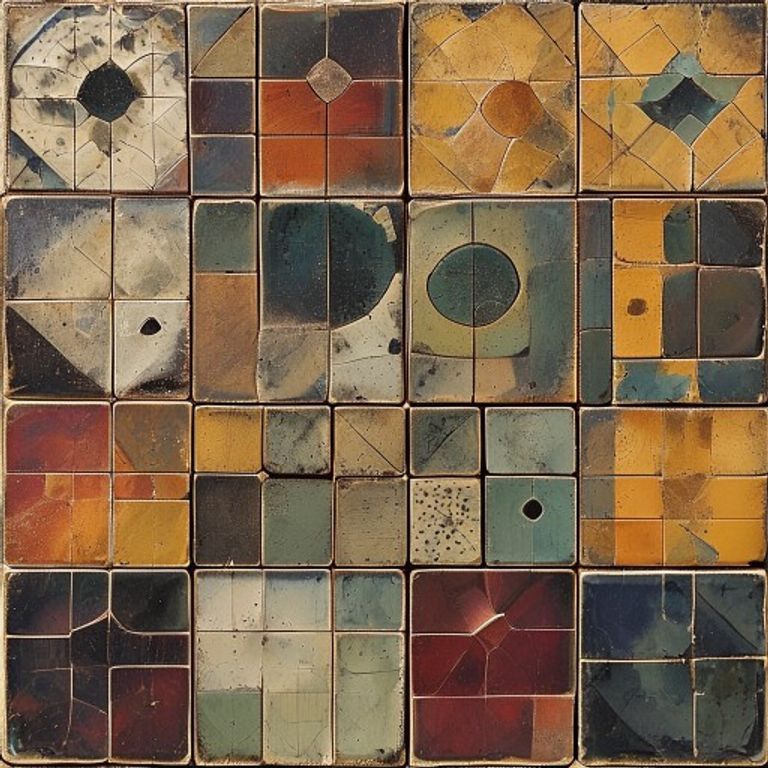
Hundreds of enigmatic messages about the colonization of Jupiter embedded in the asphalt of major cities, the authorship of which remained an urban mystery for decades.
⚠️ Research conducted with the aid of Deep Research is subject to referential ambiguity.
🖥️ Clean HTML code using a proprietary tool.
👥 Research by Guilherme Felipe, Curation by Sílvio Lôbo
The Unfinished Enigma: Unraveling the Toynbee Tiles Case
For decades, an intricate pattern of abstract art, accompanied by an enigmatic phrase, has intrigued urban planners, police, and mystery enthusiasts around the world. Known as "Toynbee Tiles," these ceramic objects, discreetly embedded in the asphalt of streets and sidewalks in various cities, represent one of the most persistent unsolved enigmas of contemporary urban culture. This documentary article seeks to delve deep into the case, separating facts from speculation and presenting the most varied hypotheses surrounding this mysterious artistic manifestation.
1. The Context and the Incident: A Seed of Mystery Scattered on the Asphalt
The emergence of the Toynbee Tiles dates back, it is believed, to the late 1970s or early 1980s. The first documented appearance occurred in the city of Philadelphia, Pennsylvania, in the United States. The objects are circular or rectangular ceramic pieces with embossed inscriptions. The art varies considerably, but the most recurring and distinctive message is:
"The Toynbee Convector"
Below this phrase, another, more enigmatic one often appears:
"Isaiah 47:5"
A biblical reference that translates to "Sit in silence, and go into darkness, O daughter of the Chaldeans: for thou shalt no more be called, The lady of kingdoms." The combination of abstract art, the reference to the mythology of a "Toynbee Convector," and the biblical verse of condemnation sparked a frenzy of speculation.
The distribution of the tiles was not limited to Philadelphia. Over the years, they have been found in cities such as New York, Washington D.C., Boston, Chicago, and, surprisingly, even in cities in Argentina, such as Buenos Aires, and in the United Kingdom.
2. Timeline of Events: A Trail of Ceramic and Uncertainty
Reconstructing the timeline of the Toynbee Tiles is challenging due to the unofficial and widespread nature of their appearance. However, some milestones are crucial:
- Late 1970s / Early 1980s: First documented appearances of Toynbee Tiles in Philadelphia.
- 1980s and 1990s: The phenomenon spreads to other cities in the United States. Local media attention begins to grow.
- Late 1990s: Reports of Toynbee Tiles in Argentina, fueling theories about an international network of "artists."
- Early 2000s: The case gains international notoriety with the dissemination of information via the internet. Documentaries and articles begin to be produced.
- 2002: The artist and musician Steve Powers, also known as "ESPO," admits to having produced some of the Toynbee Tiles in Philadelphia during his youth, but denies being the original creator or the sole person responsible. This statement is a crucial point, but it does not end the mystery.
- 2010s: Continued dissemination and documentation of the tiles, with online communities dedicated to mapping them and discussing the theories.
- Present Day: Although production seems to have slowed down, the tiles continue to be discovered, and the mystery persists.
3. The Main Theories: From Conspiracy to Probable Reality
The absence of an official and concrete explanation has given rise to a myriad of theories, ranging from plausible explanations to scenarios worthy of science fiction:
3.1. Scientific and Police Hypotheses (Most Likely):
- Action of one or a few individuals: This is the most widely accepted theory among researchers and the police. The idea is that an individual or a small group of people, driven by artistic, philosophical motivations, or even a peculiar sense of humor, dedicated themselves to spreading the tiles. The similarity in the inscriptions and style suggests a common denominator. The difficulty lies in identifying the author(s) and the logistics of production and distribution.
- Long-term art project: Powers, in his admission, suggested that some tiles were part of a larger art project. The theory is that an artist or collective, at different stages of their lives and in different cities, continued the work. The biblical reference and the term "Convector" could allude to a plan to "convert" people's consciousness or to a future event.
- Protest or demonstration: Some believe that the tiles may have been a form of protest against urbanization, the depersonalization of cities, or some other social issue. The message of condemnation ("go into darkness") could be interpreted as a warning or a critique.
3.2. Alternative, Conspiracy, or Paranormal Theories:
- Media stunt or propaganda: A less substantial but present theory suggests that the Toynbee Tiles could be a form of propaganda for an unknown organization, or even a large-scale social experiment to study human behavior in the face of the unknown.
- Extraterrestrial or interdimensional message: In more esoteric circles, it is speculated that the tiles are messages from beings from another world or another dimension, with the "Toynbee Convector" being a technology or cosmic event. The enigmatic nature of the messages fuels these views.
- Global conspiracy: Some more elaborate conspiracy theories suggest that the tiles are part of a secret network, possibly linked to occult societies, that is preparing the world for a cataclysmic event or a new world order. The international distribution would be an indication of this organization.
- Fiction or niche "performance art": A more cynical but plausible explanation is that the mystery surrounding the tiles was intentionally cultivated by someone to create an urban myth, attracting attention and theories, turning the enigma itself into a form of art.
4. Controversies and Blind Spots: Gaps in the Investigation's Asphalt
The investigation of the Toynbee Tiles is marked by a series of controversies and gaps that make resolution even more elusive:
- Lack of conclusive official reports: Although the police in various cities have dealt with the subject, there are no declassified official reports that point to a definitive solution or that detail an in-depth investigation. The main reason is the lack of a concrete crime to be investigated, unless it is vandalism of public property, which is often of low priority.
- Ignored or misinterpreted clues: The fragmented nature of the appearances and the lack of a central point of investigation may have led to the ignoring of crucial clues. The difficulty in connecting the dots between different cities and countries is a significant obstacle.
- Conflicting and evasive testimonies: Steve Powers' admission, while important, did not fully clarify the origin of all the tiles. Other people who may have knowledge of the subject remain anonymous or evasive, fueling the mystery.
- Missing or deteriorated evidence: Over time, the tiles themselves deteriorate with traffic and weather conditions. The lack of systematic photographic documentation and preservation of specimens may have led to the loss of valuable evidence.
- The "Toynbee factor": The very concept of "Toynbee Convector" is ambiguous. It could be a fictional name, a reference to an obscure artist, or something deeper and metaphorical. The lack of clarity about its specific origin adds another layer of complexity.
5. Curiosities and Legacy: An Enigma that Shapes Urban Culture
The Toynbee Tiles case has transcended the realm of police work and local curiosities, becoming a significant cultural phenomenon:
- Impact on urban culture: The tiles have become an icon of urban culture, representing mystery, anonymous art, and the creativity that flourishes in cities. They have inspired artists, musicians, and filmmakers.
- Dedicated online communities: The internet has allowed for the formation of communities dedicated to mapping, photographing, and discussing the Toynbee Tiles. These collaborative groups contribute to the documentation and dissemination of the mystery.
- The documentary "Resurrecting the Toynbee Tiles": A 2011 documentary, directed by Jon Foy, explored the case and the search for the creator(s), further increasing the visibility of the enigma.
- Current status: The Toynbee Tiles case has never been officially reopened or concluded. It remains in a limbo of unsolved mystery. Although the production of new tiles seems to have slowed down, existing ones continue to appear in new cities, and the fascination with their meaning and origin endures.
The Toynbee Tiles case is a testament to the power of the unknown and our intrinsic need to seek answers, even when clues are scarce and explanations are difficult to find. It is an invitation to reflect on art, communication, and the mysteries that hide beneath our feet, in the very fabric of our cities.



