


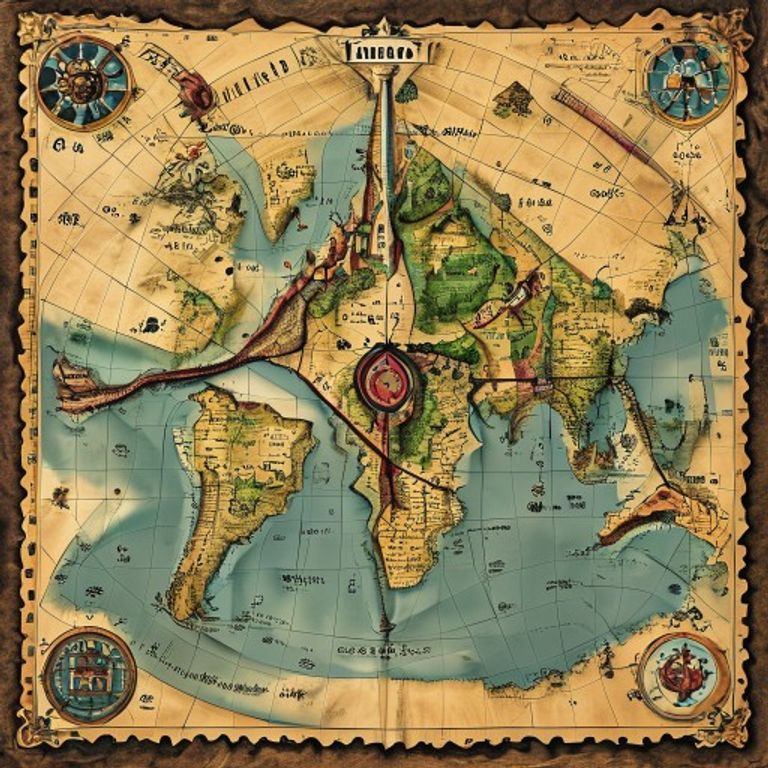
A fifteenth-century parchment supposedly depicts the coast of North America before Columbus, but its authenticity divides experts.
⚠️ Research conducted with the assistance of Deep Research is subject to referential ambiguity.
🖥️Clean HTML code using a proprietary tool.
👥 Research by Guilherme Felipe, Curation by Sílvio Lôbo
The Vinland Map Enigma: Between Legend and the Reality of a Troubled Discovery
In the intricate labyrinth of historical mysteries and controversial discoveries, the Vinland Map Case emerges as a persistent enigma, weaving a narrative of ambition, fraud, and an incessant quest for truth. This cartographic artifact, supposedly dating back to the 15th century, claims to detail the coast of North America centuries before the arrival of Christopher Columbus. However, its authenticity and the story of its appearance are shrouded in shadows, fueling a heated debate that has spanned decades.
1. The Context and the Incident: Where, When, and How the Mystery Began
The mystery of the Vinland Map gained prominence in 1965 when the renowned magnate and rare book collector Lawrence V. Bennett acquired the parchment at an auction sale in New York. The map's origin was obscure, attributed to a Swiss dealer of antique books who had allegedly obtained it from an anonymous informant. The scientific discovery that catapulted the map into the spotlight occurred in 1965 when Professor Arthur A. Houghton Jr., then president of the Bibliographical Society of America, revealed its existence and submitted it for scientific analysis.
The promise of a map depicting the eastern coast of North America, including a region named "Vinland" by Norse explorers, generated academic and media frenzy. The possibility of evidencing Viking exploration of America before 1000 AD, a fact already corroborated by archaeological discoveries at L'Anse aux Meadows in Canada, made the map an invaluable treasure. However, from the outset, an aura of doubt hung over its provenance and authenticity, initiating one of the longest and most complex debates in the history of cartography and archaeology.
2. Timeline of Events: A Chronological Reconstruction of Key Facts
- 15th Century: Supposed dating of the Vinland Map. The exact origin and circumstances of its creation remain unknown.
- Unknown Period: The map circulates in private collections, its origin lost in fragmented and unreliable accounts.
- 1950s/1960s: The map is allegedly acquired by the Swiss book dealer, from whom Lawrence V. Bennett purchases it.
- 1965: Lawrence V. Bennett sells the map to Arthur A. Houghton Jr.. The discovery is publicly announced, and the map is submitted for scientific analysis.
- 1965-1970: Various scientific analyses are conducted. Radiocarbon dating tests on the parchment indicate a date consistent with the 15th century. However, ink analyses raise doubts about its composition and the possibility of it being a later forgery.
- 1974: Yale University acquires the Vinland Map, along with other historical documents from Houghton Jr.. The university pledges to keep the map accessible for study.
- 1990s-2000s: New analytical methods and advances in forensic technology bring new perspectives. Research intensifies, focusing on the chemical details of the ink and the cartographic style.
- 2020: A new analysis published in the journal Analytical Chemistry suggests that the ink contains significant amounts of titanium, an element not widely used in ink manufacturing in the 15th century.
- Current Status: The Vinland Map continues to be an object of fascination and controversy. Although Yale University keeps it in its collection, the question of its authenticity remains open, with the scales increasingly tipping towards forgery.
3. Main Theories: An Analysis of Possible Explanations
The persistence of the Vinland Map mystery is due to the multiplicity of theories attempting to explain it, ranging from the most skeptical to the most speculative.
Theory of Modern Forgery
This is the hypothesis most widely accepted by the scientific and academic community today. The logic lies in the inconsistency of some map components with the techniques and materials available in the 15th century. The presence of titanium in the ink, an element with significant industrial use from the 20th century onwards, is one of the main arguments. Furthermore, the writing style (calligraphy) and some cartographic details bear similarities to maps produced in the 20th century, raising suspicions that the map is a meticulous forgery created to deceive collectors and academics.
Theory of Authenticity with Reservations
Some researchers, while acknowledging the anomalies, argue that the map may be authentic in its essence but possibly retouched or restored in later periods. From this perspective, the parchment itself would be medieval, but the cartographic lines and inscriptions could have been enhanced or added by a more recent forger to make it more "sellable" or understandable. The difficulty lies in determining the extent and period of such interventions.
Theory of Unknown Origin and Authenticity
A minority insists on the possibility that the map is genuine and that the detected anomalies are explainable by factors unknown to modern science or by less documented ink production techniques. This theory often appeals to "historical mystery," arguing that our knowledge of medieval practices is incomplete. However, it lacks concrete evidence to support this claim against contemporary chemical analyses.
Alternative and Conspiracy Theories (Less Scientifically Grounded)
Although less supported by factual evidence, the fascination with the Vinland Map also fuels more fanciful theories. These include the idea that the map was created by an advanced pre-Columbian civilization, by travelers from unknown ancient civilizations, or that its existence was intentionally suppressed by governments or secret organizations to protect established historical narratives. These theories lack any solid empirical basis and reside in the realm of pure speculation.
4. Controversies and Blind Spots: Inconsistencies in Investigations and Ignored Evidence
The path to unraveling the Vinland Map mystery is paved with controversies and blind spots that obscure the truth.
- Obscure Origin: The main investigative gap lies in the lack of reliable documentation regarding the map's provenance before its appearance on the rare book market. The story of the Swiss dealer and his anonymous informant is fragile and difficult to verify.
- Inconsistent Test Results: Although radiocarbon dating tests on the parchment pointed to a medieval date, subsequent ink analyses yielded conflicting results. The presence of titanium, discovered later, challenged the initial conclusions about authenticity.
- Divergent Interpretations: Even in the face of chemical evidence, some scholars continue to interpret the data in a way that supports the possibility of authenticity, questioning the methodology of the analyses or proposing alternative explanations for the presence of certain compounds.
- Role of Collectors and Institutions: The way the map was traded and acquired has raised questions about the possible influence of financial and academic interests in interpreting its authenticity. Possession by prestigious institutions like Yale University lends an aura of legitimacy that may mask uncertainty.
- Lost or Undisclosed Evidence: It is impossible to dismiss the possibility that documents, testimonies, or physical evidence exist that could shed more light on the case but have been lost over time or never properly investigated or disclosed.
5. Curiosities and Legacy: Cultural Impact and Current Status of the Case
The Vinland Map, regardless of its authenticity, has left an indelible mark on the culture and history of cartography. It has catalyzed renewed interest in Viking and pre-Columbian exploration of America, driving academic research and debates.
Cultural Legacy: The map has inspired books, documentaries, and countless discussions about the nature of historical truth and the fragility of evidence. It has become a symbol of the quest for the origin of the discovery of the Americas and the challenges inherent in verifying ancient artifacts.
Current Status: Officially, the Vinland Map remains in the possession of Yale University. The institution exhibits it periodically but accompanies it with a cautious discourse about its authenticity. The vast majority of experts, based on the most recent chemical analyses, consider the map a 20th-century forgery. However, the mystery persists, and the case continues to be a fascinating case study on the intersection of history, forensic science, and the elusive nature of truth.
The enigma of the Vinland Map reminds us that, in the field of historical investigation, the line between fact and fiction can be thin. It is a poignant reminder that, even with scientific advancements, some mysteries may remain, enduring as silent invitations to reflection and continued investigation.



