


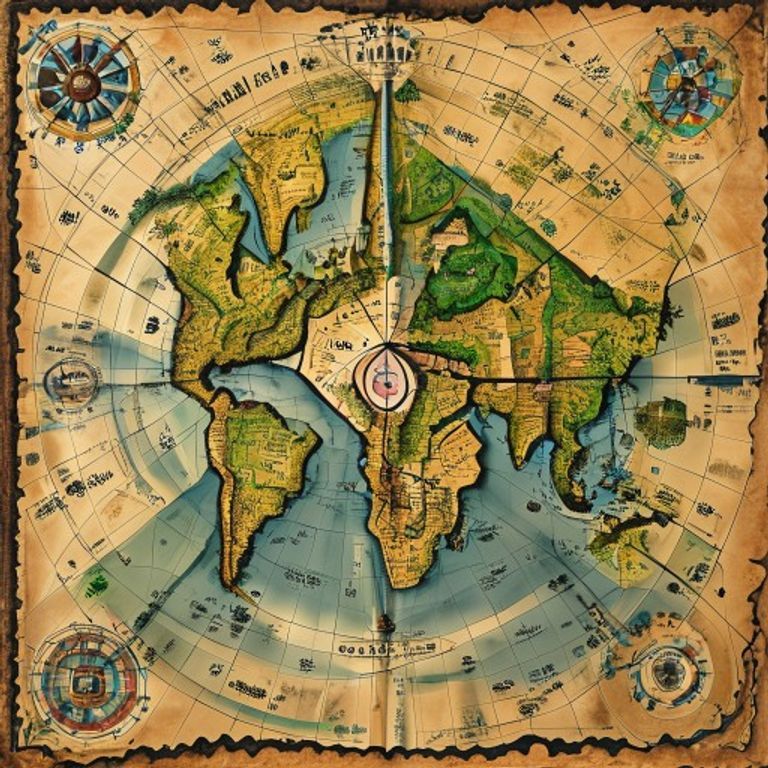
The 1507 document that was the first to use the name 'America' and that shows the Pacific Ocean years before it was officially discovered by Balboa.
⚠️ Research prepared with the aid of Deep Research is subject to referential ambiguity.
🖥️ Clean HTML code using a proprietary tool.
👥 Research by Guilherme Felipe, Curation by Sílvio Lôbo
The Enigma of the Name: Unraveling the Waldseemüller Map Case
In an increasingly mapped and understood world, the origin of a name can become an enigma. The Waldseemüller Map Case, a mystery that unfolded in the first decades of the 16th century, does not involve a brutal crime or a mysterious disappearance, but rather an act of cartography with lasting consequences and debates that echo to this day. The fundamental question lies in who gave the name "America" to a newly discovered continent, and why. This article investigates the depths of this intricate historical puzzle, separating proven facts from speculation and unraveling the controversies surrounding this cartographic landmark.
1. The Context and the Incident: Where, When, and How the Mystery Began
The setting is Renaissance Europe, a period of intense exploration and geographical discovery. In 1507, in Saint-Dié-des-Vosges (modern-day France), a group of scholars and cartographers, led by Martin Waldseemüller, worked on the production of an ambitious new world map. Waldseemüller, a German geographer and humanist, was a prominent member of the intellectual circle known as the "Gymnasium Vosagense."
The motivation was clear: to document the new lands that were beginning to be explored in the "West Indies." The discovery of the "New World" by navigator Christopher Columbus in 1492 and subsequent expeditions, notably those of Amerigo Vespucci, provided crucial information. The incident in question is not a single, isolated event, but rather the process of creating and publishing the map known as "Universalis Cosmographia secundum Ptholomaei Traditionem et Americi Vespucii aliorumque lustrationes" (Universal Cosmography according to the tradition of Ptolemy and the explorations of Amerigo Vespucci and others). It is on this map that the name "America" is applied to the South American continent for the first time.
2. Timeline of Events
The chronological reconstruction of the main facts sheds light on the evolution of this mystery:
- 1492: Christopher Columbus arrives in the Americas, believing he has reached the Indies.
- 1497-1504: Amerigo Vespucci carries out several exploratory voyages to the "New World," whose accounts gain wide circulation in Europe.
- Early 16th Century: Martin Waldseemüller and the Gymnasium Vosagense in Saint-Dié-des-Vosges dedicate themselves to producing a new world map.
- 1507: Publication of the "Universalis Cosmographia." On this map, the southern portion of the newly discovered continent is labeled "America."
- 1513: Waldseemüller publishes a new atlas, the "Ptolemaeus," where in his maps he names the same region "Terra Incognita" or simply omits the name "America," which generates further doubts.
3. The Main Theories
The attribution of the name "America" is the core of the debate, with several theories attempting to explain the origin and dissemination of the term:
3.1. The Official Theory: Homage to Amerigo Vespucci
This is the most widely accepted explanation and the one that seems to have the most documentary support. The logic lies in the conviction at the time that Vespucci was the first to recognize the "New World" as a continent distinct from Asia, rather than just an eastern extension of Europe or Asia. Waldseemüller, in his treatise "Cosmographiae Introductio," published together with the 1507 map, explicitly explains his intention:
"I do not see any reason why anyone would object to calling this part [of the earth] Amerige, the land of Amerigo, or America, after its discoverer Amerigo, a man of great skill."
The theory suggests that Waldseemüller, impressed by Vespucci's accounts and possibly influenced by the intellectual climate of the time that valued naming new lands in honor of their explorers, chose to christen the continent in his honor. The joint publication of the map and the treatise reinforces this narrative.
3.2. The Theory of Collaboration and Mutual Influence
This theory posits that the decision to name the continent was not exclusively Waldseemüller's, but rather the result of discussions and decisions within the Gymnasium Vosagense. The influence of other members, such as Matthias Ringmann, co-author of "Cosmographiae Introductio," is considered. Ringmann, in particular, may have been a strong advocate for the idea of honoring Vespucci. This hypothesis suggests a collective effort in interpreting and naming the new lands.
3.3. Theory of Vespucci's Influence (Authorship or Direct Suggestion)
Some researchers speculate that Vespucci may have had a more direct role in the naming, possibly suggesting the idea or even influencing Waldseemüller more explicitly. However, there is a lack of concrete evidence to prove direct communication or a formal request from Vespucci in this regard.
3.4. Alternative and Speculative Theories
Although less supported by historical evidence, some alternative theories have emerged:
- Indigenous or Pre-Columbian Origin: The idea that "America" could have a root in pre-existing indigenous languages or names. However, the lack of linguistic similarities and the absence of direct evidence make this hypothesis unlikely.
- Translation or Interpretation Error: The possibility that the name arose from a translation error of some document or report, which Waldseemüller and his team misinterpreted as a reference to a proper name.
- Conspiracy or Secret: More elaborate conspiracy theories suggest that the name "America" could have been chosen for hidden reasons, possibly linked to secret societies or prior knowledge of the continent's existence, which needed to be disguised or legitimized. These theories lack any factual basis.
4. Controversies and Blind Spots
The Waldseemüller Map Case is not free from inconsistencies and blind spots that fuel the debate:
- Waldseemüller's Retraction: The most significant controversy is Waldseemüller's apparent retraction in his later work. In 1513, he published a new atlas where he renamed the region "Terra Incognita" or simply left it unnamed, without mentioning "America." This raises the question: why did he change his mind? The reasons remain obscure. Could it have been pressure from other powers? Doubts about the veracity of Vespucci's accounts? Or a change in academic opinion? Official reports from the time do not offer a clear explanation for this change.
- The Speed of Adoption of the Name: Despite Waldseemüller's retraction, the name "America" caught on quickly and became widely used. This suggests that the strength of the 1507 publication and its popularity were sufficient to consolidate the name, even against the wishes of its creator.
- The Veracity of Vespucci's Accounts: There are historical debates about the accuracy and even the authorship of some of the accounts attributed to Amerigo Vespucci. Some expeditions were credited to him that may have been carried out by others, or whose accounts were exaggerated to gain prestige.
- Missing Evidence: The lack of direct and detailed correspondence between Waldseemüller and Vespucci, or between Waldseemüller and other cartographers or rulers of the time, leaves gaps in the complete reconstruction of the decision-making process.
5. Curiosities and Legacy
The cultural impact of the Waldseemüller Map Case is immeasurable. The name "America" does not refer only to the continent, but has become synonymous with an ideal, a "new beginning," and a history of exploration and colonization that shaped the modern world.
- The Original Map: Only one copy of the 1507 "Universalis Cosmographia" has survived and is preserved in the United States Library of Congress.
- The Controversy over the Name: The debate over the origin of the name "America" continues to fascinate historians and geographers, raising questions about authorship, influence, and the nature of discovery.
- Vespucci's Legacy: Amerigo Vespucci, despite the controversies over his accounts, is remembered primarily for the honor of having a continent named after him.
- Current Status: The case, in terms of a formal investigation, has been closed for centuries. However, as a historical and academic debate, it remains alive, being constantly revisited and reanalyzed in light of new discoveries and interpretations. There are no plans for a formal reopening, but the curiosity and mystery surrounding the origin of the name "America" guarantee its place in the pantheon of great historical enigmas.
The Waldseemüller Map Case reminds us that even in the most seemingly simple acts, such as naming a new territory, there can lie historical complexities and debates that endure through the centuries, challenging our understanding of the past and reminding us that history is often a narrative under construction, full of gaps and mysteries to be unraveled.



