


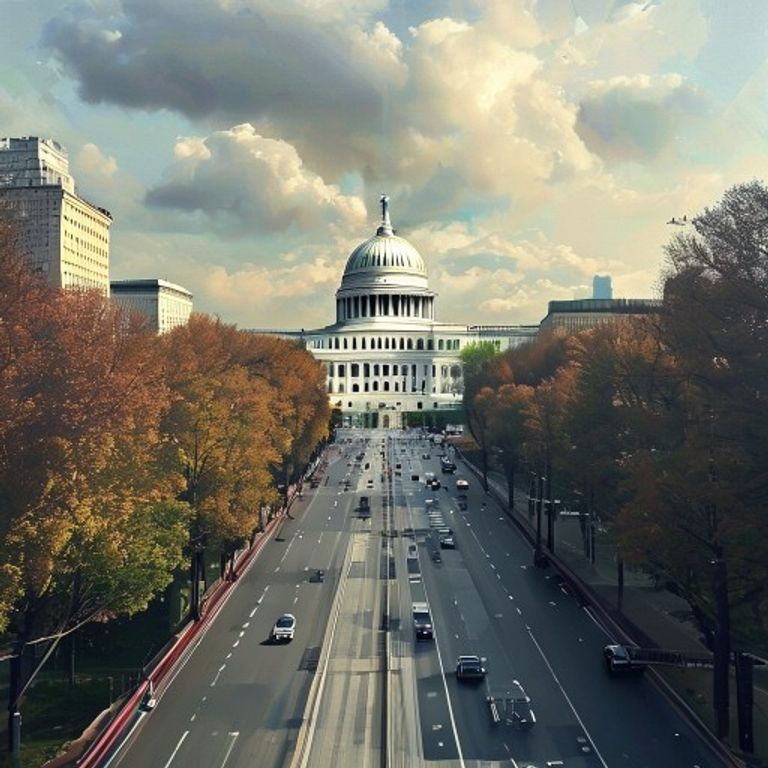
A series of UFO sightings on radar and in the skies over the American capital forced the takeoff of military fighter jets for interception.
⚠️ Research elaborated with the aid of Deep Research is subject to referential ambiguity.
🖥️Clean HTML code using a proprietary tool.
👥 Research by Guilherme Felipe, Curation by Sílvio Lôbo
The Unbroken Silence: Unraveling the Washington Incident
For decades, shadows have loomed over the United States capital, fueling a mystery that defies logical explanations and ignites the imagination. The Washington Incident, an event that silenced the atmosphere of one of the most monitored cities in the world, remains one of the most persistent enigmas of the 20th century. An intricate web of contradictory reports, hasty investigations, and inexplicable gaps keeps this case far from an epilogue, forcing us to question the limits of what we know and what we are told.
1. The Context and the Incident: Where, When, and How the Mystery Began
The stage for the mystery was set on the night of July 19, 1952, in Washington D.C., the bustling capital of the United States. On that occasion, multiple observers, including airline pilots, air traffic controllers, and civilians on the ground, reported sightings of unidentified flying objects (UFOs) of anomalous proportions and behaviors. The main focus of the reports centered on the area of Andrews Air Force Base and the city itself, including flyovers near the White House and the Capitol.
What sets this incident apart from other UFO sightings is its magnitude and the nature of the observers involved. Experienced commercial flight pilots, with rigorous training and reputations to uphold, described objects that defied known laws of physics: high-speed maneuvers, abrupt stops, and changes in direction that no aircraft of the era could perform. Air traffic controllers confirmed the presence of multiple contacts on their radar, intensifying the mystery.
2. Timeline of Events
An accurate reconstruction of the events is hindered by varied testimonies and the fleeting nature of the sightings. However, reports and declassified files allow for a chronological outline:
- Night of July 19, 1952, around 11:00 PM: The first reports of unidentified flying objects begin to emerge, concentrated around Andrews Air Force Base.
- Following hours: The number of sightings increases dramatically. Airline pilots, including a Capital Airlines flight, report luminous objects with unusual maneuvers.
- Early morning of July 20, 1952: Air traffic controllers at Washington National Airport (now Reagan National Airport) detect multiple contacts on their radar, which appeared to track or interact with the visually sighted objects.
- Morning of July 20, 1952: The United States Air Force (USAF) initiates a formal investigation. The incident gains national media attention.
- Following week: The USAF issues official statements, initially attributing the sightings to natural phenomena and radar interference, but the explanation does not satisfy most observers and the public.
- August 1952: Project Blue Book, the USAF's official program to investigate UFOs, becomes involved in the case. Reports are compiled, but much information remains classified for years.
3. The Main Theories
The Washington Incident, like so many other mysteries, has given rise to a range of theories, each with its own logic and basis of evidence, or lack thereof.
3.1. Scientific and Official (and Probable) Hypotheses
- Atmospheric Phenomena and Optical Illusions: The USAF's initial official explanation, which evolved over time. It suggests that the sightings may have been caused by lenticular clouds, light reflections, or even the conjunction of poorly understood natural phenomena. Radar interference is also considered, especially at a time when the technology was under development.
- Secret Aircraft or Military Prototypes: The possibility that the objects were experimental aircraft under development by the USAF itself or another government agency. The Cold War was in full swing, and secrecy surrounding new technologies was absolute.
- Weather Balloons or Other Devices: Some investigations have suggested that high-altitude weather balloons, especially under unusual wind conditions, could have created the illusion of rapid movement or an unknown object.
3.2. Alternative, Conspiracy, or Paranormal Theories
- Extraterrestrial Visit: The most popular and persistent theory. It proposes that the sighted objects were spacecraft piloted by beings from other planets. The speed, maneuverability, and inexplicable behavior of the objects reinforce this hypothesis for many.
- Mass Psychological Experiments or False Flags: A branch of the conspiracy theory suggests that the incident may have been orchestrated to test public reaction to UFOs or to divert attention from other government events.
- Paranormal or Energetic Phenomena: Some more esoteric theories suggest that the sightings may be linked to manifestations of unknown energy, interdimensional portals, or other phenomena of a non-physical nature.
4. Controversies and Blind Spots
The official investigation of the Washington Incident was marked by inconsistencies and questionable decisions, which fueled skepticism and distrust.
- Conflicting USAF Reports: The Air Force's official explanations changed over time. Initially, they attempted to downplay the events, but the quantity and quality of testimonies forced a more in-depth investigation, which, paradoxically, did not yield definitive conclusions.
- Lost or Ignored Evidence: There are allegations that some crucial evidence, such as radar tapes or photographs, may have been lost, destroyed, or kept secret. The testimony of pilots and air traffic controllers, although corroborated by many, was not enough to dispel doubts.
- Political Pressure and Media: The incident occurred at a time of high tension in the Cold War, and the possibility of a foreign threat was taken very seriously. This may have influenced how information was handled and disseminated. The media, in turn, exploited the mystery, generating public frenzy that hindered a cool-headed analysis of the facts.
- The Condon Report: Years later, the Condon Report (1968), which investigated the UFO phenomenon on behalf of the Air Force, attempted to re-analyze the Washington Incident, but its conclusions were considered unsatisfactory by many independent researchers, who pointed out flaws in the methodology and interpretation of the data.
5. Curiosities and Legacy
The Washington Incident transcended headlines and became a landmark in popular culture and ufology.
- Panic in the Capital: The event generated a climate of apprehension and fear in the nation's capital. The idea that the most protected city in the country was being flown over by unknown objects generated palpable fear.
- Influence on Pop Culture: The incident has inspired countless works of science fiction, films, books, and documentaries, solidifying the image of UFOs as a persistent mystery of modern society.
- The Investigation Pattern: The case is frequently cited as an example of the pattern of UFO investigations by government bodies: initially denied or minimized, then reluctantly investigated, and finally concluded with unsatisfactory explanations that leave more questions than answers.
- Current Status: Officially, the Washington Incident was classified as "unresolved" by the United States Air Force, although many later analyses have attempted to provide more terrestrial explanations. However, the mystery persists, and the case continues to be a subject of study and debate among enthusiasts and researchers, perhaps awaiting the full revelation of its secrets one day.



