


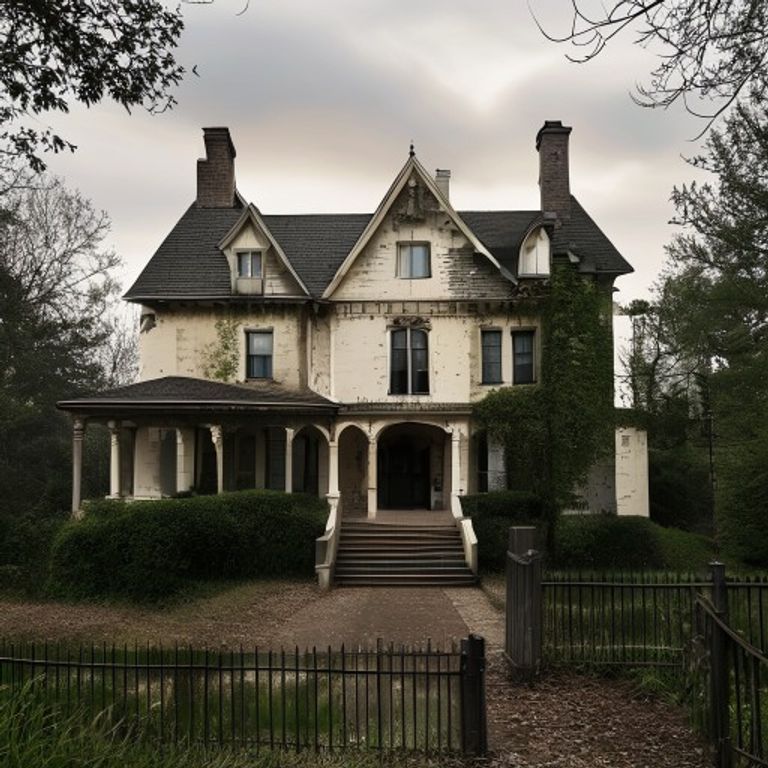
An heiress continuously built a gigantic, labyrinthine mansion to supposedly house the spirits of the victims of her family's rifles.
⚠️ Research elaborated with the aid of Deep Research is subject to referential ambiguity.
🖥️Clean HTML code using a proprietary tool.
👥 Research by Guilherme Felipe, Curation by Sílvio Lôbo
The Labyrinth of Sorrow: Unraveling the Enigma of the Winchester Mansion
By [Your Journalist Name], Senior Investigative Journalist
The story of the Winchester Mansion, in San Jose, California, is a dark tale of wealth, tragedy, and hauntingly anomalous architecture that defies simple explanations. What began as the residence of a solitary heiress evolved into an architectural maze and one of the United States' most enduring mysteries. This article aims to dissect the facts, theories, and gaps surrounding this peculiar property, separating the real from the imaginary with the rigor that an unresolved decades-long case demands.
1. The Context and the Incident: Where, When, and How the Mystery Began
The mystery of the Winchester Mansion is not, strictly speaking, an isolated "incident" of crime. It is the very existence and peculiar construction of the house. The story dates back to 1884, when Sarah Winchester, widow of William Wirt Winchester (heir to the Winchester Repeating Arms Company fortune), purchased an eight-room farmhouse in San Jose. Widowed of her only daughter, Annie, in 1866, and her husband in 1881, Sarah was immersed in deep grief and, according to reports, in a state of despair.
What turned the property into an enigma was Sarah's decision to begin continuous, uninterrupted construction on the house. For 38 years, day and night, construction proceeded. The house grew organically, chaotically, and without conventional architectural plans. Doors that lead nowhere, stairs that end at the ceiling, winding corridors, windows inside closets – these are the features that transformed the residence into a true labyrinth, fueling speculation about its owner's motives.
2. Timeline of Key Events
- 1837: Birth of Sarah Lockwood Pardee in New Haven, Connecticut.
- 1862: Marriage of Sarah Pardee to William Wirt Winchester.
- 1866: Death of the couple's daughter, Annie Pardee Winchester, at only 1 month old.
- 1881: Death of William Wirt Winchester, victim of tuberculosis. Sarah inherits a fortune estimated at over 20 million dollars (equivalent to hundreds of millions today) and nearly 50% of the shares in the Winchester Repeating Arms Company.
- 1884: Sarah Winchester purchases the farmhouse property in San Jose, California, and begins the extensive, uninterrupted construction work.
- 1906: The Great San Francisco Earthquake causes significant damage to the mansion. Sarah is temporarily trapped in a room by the collapsed structure but manages to free herself. After the earthquake, she seals off parts of the house that were damaged.
- 1922: Death of Sarah Winchester in her sleep at the age of 83. Construction ceases immediately.
- 1923: The house is sold to a group of investors.
- 1930s: The Winchester Mansion is opened to the public as a tourist attraction, solidifying its fame as a "haunted mansion" and a place of mystery.
3. Main Theories: Unraveling the Labyrinth of Motivations
The unusual nature of the Winchester Mansion has given rise to a myriad of theories, some based on evidence and others purely speculative. It is crucial to distinguish between pragmatic logic and folklore.
3.1. The Theory of Grief and Compensation (Psychological Focus)
This is perhaps the most popular and plausible theory, although not conclusively proven in official reports. After the loss of her husband and daughter, Sarah Winchester is said to have sought solace and guidance in spiritual practices. Accounts from the time, often from family circles and employees, suggest she consulted a medium in Boston.
The most recurring story claims that the medium diagnosed Sarah with the curse of the spirits of those killed by Winchester weapons. To appease these spirits and find redemption, she was instructed to move west and build a house for them, never ceasing construction, so the spirits could not find her. The labyrinthine architecture would be an attempt to confuse them, to create traps so they could not reach her.
Arguments in favor: Sarah's immense wealth allowed for continuous construction. Her profound grief and personal trials are proven facts. The unusual and confusing nature of the house aligns with the idea of a refuge or an escape from invisible "pursuers."
Points of questioning: There are no official records or transcripts of such a consultation with a medium. The narrative may have been dramatized over time.
3.2. Theory of Architectural Innovation and Desire for Control (Pragmatic Focus)
A less mystical perspective suggests that Sarah Winchester, being a woman in a position of immense fortune and control after losing male influence in her life, might have sought to express her autonomy through architecture. The endless construction and complexity of the house could be a manifestation of her power and independence.
Some argue that Sarah was an intelligent and eccentric woman who enjoyed puzzles and challenges. Building an architectural labyrinth would be a fascinating personal project, perhaps even a form of continuous intellectual entertainment. The anomalies could be the result of her own unconventional creativity and a desire to push the boundaries of traditional architecture.
Arguments in favor: Sarah was known to be a strong and independent woman. Her fortune gave her the freedom to experiment. She personally supervised the works.
Points of questioning: This theory does not explain the need for so many "false" doors and stairs or the apparent absence of a cohesive plan.
3.3. Theory of Insecurity and Constant Change (Focus on Human Nature)
Another explanation focuses on the possibility that Sarah Winchester, after so many losses, suffered from deep insecurity and a constant need to change and adapt her environment. The incessant construction would be an attempt to always have something new to focus on, a project to fill the void left by grief and loneliness.
The house would have become a reflection of her life: constantly expanding and transforming, never truly "finished," reflecting a restless state of mind.
Arguments in favor: Sarah's loneliness after her husband's death is a fact. The need for occupation in the face of grief is an understandable human behavior.
Points of questioning: Does not explain the deliberately confusing and non-functional nature of many architectural additions.
3.4. Paranormal and Supernatural Theories (Focus on Folklore and Popular Culture)
These theories, while widely disseminated and responsible for the mansion's fame, lack any concrete evidence and are based on reports of inexplicable phenomena witnessed by visitors and staff over the years.
- Hauntings: It is believed that the spirits of the victims of Winchester weapons still haunt the house, manifesting through strange sounds, apparitions, unexplained lights, and moving objects.
- "Sarah's Presence": Some believe that Sarah Winchester's own spirit still resides in the mansion, wandering its corridors.
Arguments in favor: Tales of hauntings are common in old, history-rich properties. The atmosphere of the house, with its secret passages and bizarre constructions, naturally evokes a sense of mystery and fear.
Points of questioning: Lack of objective and verifiable evidence. Phenomena can be attributed to natural factors (drafts, settling old structures) or suggestion.
4. Controversies and Blind Spots: The Gaps in the Narrative
Despite Sarah Winchester being a public figure for a time, the details of her private life and the motivations behind her actions remain shrouded in mystery. Several blind spots and controversies make a definitive resolution difficult:
- Lack of Detailed Records: Sarah Winchester was notoriously private. She did not leave a detailed diary or letters explaining her thoughts on the house's construction. Official records from the time are scarce and often focus more on her wealth than her psyche.
- Conflicting Testimonies: Accounts from employees and contemporaries about her spiritual consultations and mental state vary. Some portray her as tormented, others as eccentric but resilient.
- Missing or Unrecorded Evidence: It is possible that important documents that could clarify her intentions were lost or destroyed after her death, especially considering how quickly the property was sold and turned into an attraction.
- The Impact of the 1906 Earthquake: The San Francisco earthquake caused significant damage to the original structure. Sarah's decision to seal off certain areas and rebuild in an even more complex manner may have been influenced not only by superstition but also by actual structural damage. Expert reports on the specific damage and repairs are scarce.
- The Absence of a "Cromlech" or Logical Pattern: Critics argue that if there were a spiritual plan or underlying logic, the house should exhibit a more consistent pattern, even if complex. The apparent randomness of some additions is a point of contention for more mystical theories.
5. Curiosities and Legacy: The Mansion That Lives Beyond Sarah
The Winchester Mansion has transcended its original function as a residence and become a cultural icon, a symbol of mystery and the macabre.
- Tourist Attraction: Since 1930, the mansion has been one of California's most famous tourist attractions, drawing millions of curious visitors to explore its architectural labyrinth.
- Studies and Interpretations: The house has been the subject of studies by architects, historians, and psychologists, each attempting to unravel the layers of its complexity.
- Adaptations in Pop Culture: The story of the Winchester Mansion has inspired books, films (including the 2018 horror film "Winchester"), documentaries, and countless reports.
- Current Status: The Winchester Mansion remains standing and open to the public. The case itself is not a "criminal case" to be reopened or shelved, but rather a historical and architectural puzzle in constant reinterpretation.
Sarah Winchester's legacy is that of a woman whose life, marked by tragedy, transformed into a surreal and disturbing work of art. The Winchester Mansion is not just a house; it is a monument to sorrow, resilience, and the profound mysteries of the human psyche, a labyrinth of brick and mortar that continues to challenge us to find the way out of its intricate questions.



