


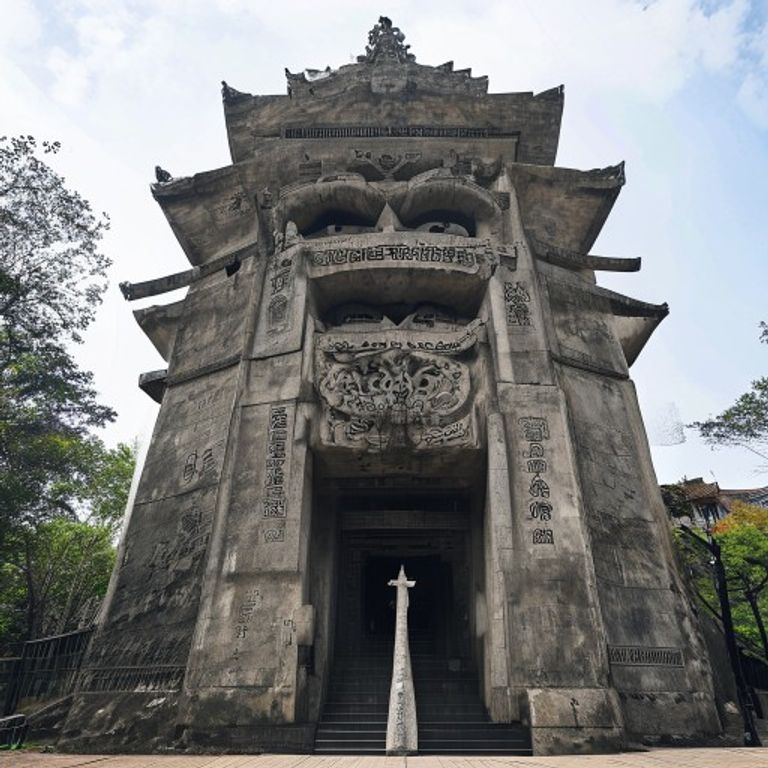
A gigantic and controversial submerged rock formation off the coast of Japan exhibits right angles and terraces that appear to have been sculpted by a forgotten civilization.
⚠️ Research elaborated with the aid of Deep Research is subject to referential ambiguity.
🖥️Clean HTML code using a proprietary tool.
👥 Research by Guilherme Felipe, Curation by Sílvio Lôbo
The Submerged Enigma: Unraveling the Yonaguni Monument Case
In the vast and mysterious Pacific Ocean lies a secret that defies logic and science: the Yonaguni Monument. Discovered in 1985 in the crystal-clear waters off the coast of the Japanese island of Yonaguni, this complex of submerged rock formations has been the scene of intense debate and speculation. Is it a natural geological wonder, shaped by millennia of aquatic forces, or the work of an ancient and forgotten civilization whose secrets lie at the bottom of the sea? This investigative article aims to dive into the depths of this enigma, separating proven facts from mere conjecture.
1. The Context and the Incident: Where, When, and How the Mystery Began
The Yonaguni Monument, also known as the Yonaguni Underwater Ruins, is located in the coastal waters of Yonaguni Island, Japan's westernmost island, about 110 km off the coast of Taiwan. The discovery occurred in 1985 when a group of local divers, led by Seiichi Yoshikawa, an experienced diving instructor, stumbled upon a colossal submerged structure with surprising geometric shapes. What initially appeared to be an unusual rock formation quickly revealed itself as a complex of terraces, steps, pillars, and walls that distinctly resembled human constructions.
The formations, which descend to depths ranging from 5 to 30 meters, feature right angles, flat surfaces, and a symmetry that defied purely natural explanations. The main structure, nicknamed "the pyramid," is a stone mass about 180 meters long and 60 meters wide, exhibiting carved steps that seem to lead to a higher point. The "turtle head," a stone pillar with a shape resembling a turtle's head, and the "cathedral," a large stone vault, are other elements that fuel fascination and controversy.
2. Timeline of Events
- 1985: Discovery of the Yonaguni Monument by Seiichi Yoshikawa and his team of divers. The first images and reports begin to circulate.
- Late 1980s: News of the submerged monument attracts the attention of archaeologists, geologists, and mystery enthusiasts. Researchers, such as geologist Masaaki Kimura, begin expeditions to study the formations.
- 1990s: Numerous dives and expeditions continue to document the structures. Masaaki Kimura becomes one of the main proponents of the artificial construction theory, publishing books and articles about his findings.
- 2000s: The discussion about the monument's origin intensifies, with heated debates between the scientific community and those who believe in ancient civilizations.
- Present Day: The Yonaguni Monument continues to be a popular destination for divers and a focus of interest for researchers, although no formal archaeological excavation has been carried out due to the site's submerged nature.
3. The Main Theories: A Spectrum of Possibilities
The debate over the origin of the Yonaguni Monument is divided into two main currents, each with its branches and nuances:
3.1. Scientific Hypotheses (Natural Origin)
- Geological Theory: The explanation most accepted by most geologists is that the monument is a natural rock formation, the result of complex geological processes over thousands of years. It is believed that the sandstone and conglomerate in the region, when subjected to marine erosion and tectonic movements, could have created patterns that, by coincidence, resemble artificial structures. The hypothesis suggests that the erosion of stratification joints and fractures in the rock could have sculpted the steps and flat surfaces.
- Erosion and Sedimentation: The continuous action of waves, currents, and marine sediments over geological eras is pointed to as the main sculptor of these formations. The theory argues that nature, given enough time, is capable of creating surprisingly regular patterns.
3.2. Alternative Theories (Artificial Origin)
- Theory of an Ancient Submerged Civilization: This is the most popular hypothesis among proponents of artificial origin. The idea is that the monument is a remnant of an advanced prehistoric civilization, possibly predating the last ice age. The resemblance to pyramids, temples, and ruined roads is seen as evidence of human engineering.
- Masaaki Kimura's Theory: Geologist Masaaki Kimura is one of the main proponents of this theory. He suggests that the formations are the work of an unknown civilization that flourished about 10,000 years ago, before rising sea levels submerged them. Kimura points to the presence of stone "tools" embedded in the rocks and cut marks that, according to him, could not be natural.
- Theory of Ancient Asian Cultures: Some researchers speculate that the monument could be linked to ancient Asian civilizations, such as the legendary Mu or Lemuria, lost continents that, according to some esoteric beliefs, sank into the Pacific.
- Conspiracy and Paranormal Theories: Less grounded in concrete evidence, these theories include the intervention of extraterrestrials in the construction of the structures or the existence of dimensional portals or unknown technologies linked to the monument.
4. Controversies and Blind Spots
Despite the fascination that the Yonaguni Monument exerts, the investigation and interpretation of its origins face several obstacles and controversies:
- Lack of Formal Archaeological Excavation: The submerged nature of the site prevents conventional archaeological excavations, which could provide crucial evidence such as artifacts, remains of human settlements, or inscriptions. Most research is based on visual and geological observations.
- Interpretation of Evidence: What for some is irrefutable proof of human construction, for others is merely an example of natural patterns. The cut marks, steps, and flat surfaces can be interpreted in radically different ways.
- Official Reports and Declassification: There are no extensive and widely publicized official reports that have definitively concluded on the monument's origin. Most academic studies questioning the natural origin are privately initiated or by independent researchers, such as Masaaki Kimura.
- Ignored or Underestimated Clues: Critics of the natural hypothesis point out that some features of the monument, such as the regularity of the joints and the presence of "stairs" that seem to connect different levels, are difficult to explain solely by erosion.
- Unknown Materials and Formations: Although the main material is sandstone, the possibility of inclusions or less common rock formations contributing to the monument's intriguing appearance has not been fully explored.
5. Curiosities and Legacy
The Yonaguni Monument has transcended the scientific realm to become a cultural icon and a catalyst for theories and fantasies.
- Tourism and Diving: The site has become a world-renowned tourist destination for divers, attracting thousands of visitors annually who seek to witness the enigmatic formations with their own eyes.
- Numerous Expeditions: Over the decades, the monument has been the subject of countless diving expeditions, television documentaries, and articles in specialized magazines on mysteries and archaeology.
- Focus of Continuous Debate: Despite decades of study, the debate over the origin of the Yonaguni monument remains heated. There is no definitive scientific consensus, which keeps the mystery alive.
- Legacy of Questioning: The case serves as a fascinating reminder that our planet still holds deep secrets and that, at times, the most intriguing answers lie beneath the surface, challenging our understanding of the past and the capabilities of nature and humanity.
The Yonaguni Monument remains a submerged testament to an enigmatic past. Whether it is the work of nature or of ancient hands, its grandeur and mystery continue to inspire admiration and fuel the incessant search for answers in the silent depths of the ocean.



