


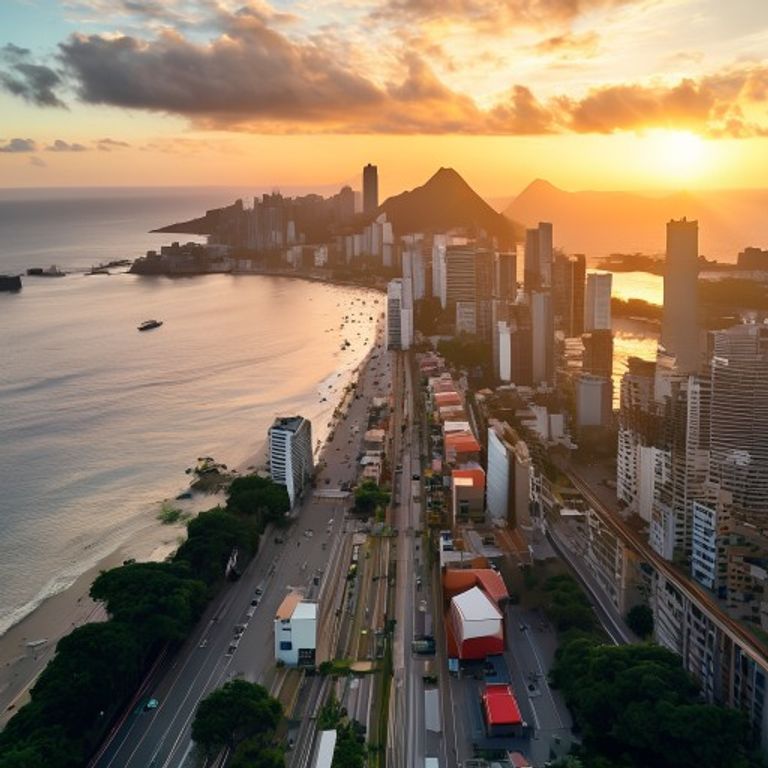
This municipality in the State of São Paulo is the heart of Brazilian Modernism, the birthplace of Mário de Andrade and Oswald de Andrade, and home to Lygia Fagundes Telles, who immortalized the capital in her short stories.
⚠️ Research conducted with the aid of Deep Research is subject to referential ambiguity.
🖥️Clean HTML code using a proprietary tool.
👥 Research by Guilherme Felipe, Curation by Sílvio Lôbo
The Metropolis in Words: The Literature of the City of São Paulo
The city of São Paulo, an urban colossus of multiple facets, has been, since its early days as a cultural hub, a vibrant epicenter for literary production and dissemination in Brazil. Far from being merely a passive backdrop, the capital of São Paulo bursts onto the pages of its authors as a complex character, a mirror of social contradictions, and a melting pot of identities. This essay aims to delve into the rich tapestry of São Paulo's literature, exploring its founding movements, its most prominent figures, the publications that shaped its thought, and the intrinsic relationship between the city and the written word.
Cradle of Modernism and Avant-Gardes
One cannot speak of São Paulo's literature without evoking the year 1922 and the
Modern Art Week
. Held at the Municipal Theater, the Week was not just a cultural event; it was a cry for aesthetic independence that reverberated throughout the country. São Paulo, then a rapidly industrializing and modernizing city with an emerging bourgeoisie eager for novelty, offered fertile ground for the outbreak of Brazilian modernism.
- Mário de Andrade and his
"Paulicéia Desvairada"
(1922) captured the fragmented, noisy, and multifaceted essence of the metropolis. The book is an impressionistic and dizzying portrait of the city, where lyricism blends with documentary records of urban life. Mário de Andrade, a central figure of the movement, masterfully translated São Paulo's chaos and effervescence into prose and verse. - Oswald de Andrade, with his anthropophagic proposal, advocated for cultural cannibalism to create something genuinely Brazilian and universal. His
"Memórias Sentimentais de João Miramar"
(1924) and"Serafim Ponte Grande"
(1933) are works that parody and deconstruct literary conventions, reflecting the speed and disorder of urban life. - Other important names from the period include
Menotti del Picchia
andAlcântara Machado
, the latter with"Brás, Bexiga e Barra Funda"
(1927), which fixed in literature the human landscape of working-class and immigrant neighborhoods, a São Paulo of multiple accents and daily struggles.
Magazines such as
"Klaxon"
(1922) and the
"Revista de Antropofagia"
(1928-1929) were crucial vehicles for the dissemination of modernist ideas, consolidating São Paulo as the epicenter of national aesthetic renewal.
Consolidation of the Urban Novel and New Trends
After the modernist effervescence, São Paulo's literature continued to develop, delving into denser and socially engaged narratives. The São Paulo of the 1930s and 1940s, still undergoing vertiginous expansion, demanded a perspective that went beyond formal experimentation.
- In prose, authors such as
Cyro dos Anjos
("O Amanuense Belmiro"
, 1937, although not strictly from São Paulo, his work reflects bureaucratic urbanity), and laterCornélio Penna
("A Menina Morta"
, 1954), with their complex psychological universes, contributed to the diversification of Brazilian novels, which often found resonance in the major centers. - In poetry,
Concrete Poetry
, which emerged in the 1950s, with the brothersHaroldos de Campos
andAugusto de Campos
, andDércio Pignatari
, represented a new avant-garde. The group, based in São Paulo, sought a visual and geometric poetry, detached from discursive linearity, which found echoes in modern architecture and the very visual complexity of the metropolis. The magazine"Noigandres"
was the main vehicle for this movement.
From the second half of the 20th century onwards, the capital of São Paulo consolidated itself as a publishing and academic hub, with the creation and expansion of important universities (notably
USP
) and publishing houses that would shape the Brazilian literary market.
The Metropolis in Contemporary Literature
The São Paulo of the second half of the 20th century and the beginning of the 21st continued to inspire a profusion of voices, each in its own way, reflecting the city's transformations, inequalities, and resilience. The metropolis became, more than ever, a multifaceted character, often dark and violent.
-
Rubem Fonseca
, although from Rio de Janeiro, lived and produced a significant part of his work in São Paulo, and his short stories and novels (such as"O Caso Morel"
and"Agosto"
) portray a São Paulo of crime, corruption, and urban cynicism, exposing the city's underbelly. -
Ignácio de Loyola Brandão
, with"Não Verás País Nenhum"
(1981), projected a dystopian São Paulo, suffocated by pollution and social decay, a scathing critique of the future that was unfolding. - From the 2000s onwards,
Marginal Literature
orPeripheral Literature
gained strength, giving voice to authors from the city's fringes.Ferréz
("Capão Pecado"
) andPaulo Lins
(although from Rio de Janeiro, his impact on urban literature from the peripheries is undeniable) brought to light the violent reality and cultural richness of favelas and distant neighborhoods, questioning the spatial and social divisions of the capital. TheSarau da Cooperifa
, led bySérgio Vaz
, became a cultural phenomenon, bringing poetry and literature to the peripheries and democratizing access to culture. -
Luiz Ruffato
, with his direct and impactful prose, in works such as"Eles eram muitos cavalos"
(2001), constructs a mosaic of voices and situations that intertwine in a single day in the capital of São Paulo, revealing the diversity and loneliness of urban life. - Contemporary authors such as
Daniel Galera
("Barba Ensopada de Sangue"
),Jeferson Tenório
("O Avesso da Pele"
),Veronica Stigger
("Opisanie Świata"
),Tatiana Salem Levy
("A Chave de Casa"
), andRicardo Lisias
("O Livro dos Heróis"
) continue to explore the city from diverse perspectives, whether in historical fiction, dystopia, psychological realism, or social critique, many of them based in the capital and contributing to its literary effervescence.
Publishing houses such as
Companhia das Letras
,
Editora 34
,
Ateliê Editorial
, and the late
Cosac Naify
(which revolutionized Brazilian editorial design), all based in the capital, have solidified São Paulo as the main center of the Brazilian publishing market, attracting and publishing talents from all over the country.
The Cultural Identity of São Paulo Reflected in Books
The literature of São Paulo is a multifaceted mirror of its cultural identity, often contradictory and always in flux:
- Cosmopolitanism and Chaos: The city is portrayed as a hub for cultural encounters, a destination for immigrants and migrants, which generates human richness but also an inherent chaos due to its disordered growth and population density.
- Loneliness in the Crowd: Many authors explore the feeling of anonymity and isolation that can affect individuals in a megalopolis, the paradoxical loneliness amidst millions of people.
- Social Critique: São Paulo's literature frequently exposes the deep social inequalities, urban violence, corruption, and racial and class tensions that mark the city, functioning as a critical thermometer of Brazilian society.
- Relationship with Space: The urban landscape – its overpasses, avenues, skyscrapers, peripheries, bars, and streets – is not just a setting but integrates into the narrative as a living element, shaping the characters' experiences and psychology.
- The Dynamics of Work: From the working-class neighborhoods of the early 20th century to the complex labor relations of today, toil and its social consequences are recurring themes, reflecting the city's industrial and service vocation.
Conclusion
The literature of the city of São Paulo is an eloquent testament to its incessant transformation. From the modernist outcry to the critical prose of contemporary times, through concrete experimentation and the voices from the periphery, the capital of São Paulo reveals itself as an unprecedented literary laboratory. Its authors, whether born there or based there, delve into the depths of the metropolis to extract stories that not only narrate São Paulo but also question and redefine Brazil. The city, in its constant reinvention, continues to be an inexhaustible source of inspiration, a universe of words where the pulse of urban life manifests in all its complexity, beauty, and, at times, brutality.



