


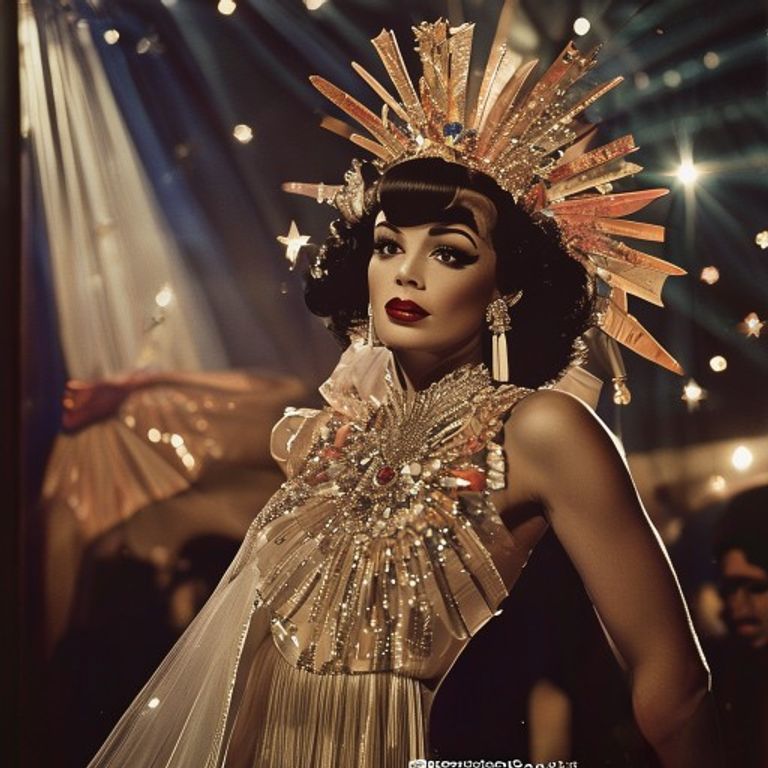
Released in 1936 by Metro-Goldwyn-Mayer, The Great Ziegfeld, directed by Robert Z. Leonard, redefines the boundaries of cinematic spectacle from Hollywood's Golden Age. Blending biographical drama with musical numbers of colossal proportions, the production not only immortalized the career of legendary Broadway impresario Florenz Ziegfeld Jr. (masterfully played by William Powell), but also established itself as a technological and aesthetic milestone, winning the Academy Award for Best Picture and setting the gold standard for the musical biopics that would follow.
Analysis and Plot
Watching The Great Ziegfeld is to be transported to an era when cinema was not afraid to be hyperbolic. With a runtime of nearly three hours, the film is a monument to escapism and the sheer scale of MGM under the aegis of legendary producers like Hunt Stromberg and the studio's all-powerful boss, Louis B. Mayer. The narrative follows, in a romanticized fashion, the meteoric rise, extravagant peak, and financial decline of Florenz "Flo" Ziegfeld Jr., a man whose life was guided by the maxim that beauty and artistic grandeur justified any financial debt.
The plot begins at the 1893 Chicago World's Fair, where Flo starts his career as an audacious promoter of popular entertainment attractions. His first major triumph is managing the career of Eugen Sandow, the "World's Strongest Man." From these early moments, the friendly yet fierce rivalry with Jack Billings (Frank Morgan) is established as the comedic and dramatic engine of his business journey. Through pure charm, indomitable elegance, and an enviable aesthetic intuition, Ziegfeld travels to Europe, where he meets French star Anna Held (Luise Rainer). He convinces her to come to America under his tutelage, generating instant publicity through bold marketing stunts—such as the famous rumor that Anna took daily baths in gallons of pure milk to keep her skin flawless.
Anna Held's success paves the way for Flo's great obsession: the Ziegfeld Follies. Inspired by the French cabaret Folies Bergère, the American Follies focused on the glorification of the "American Girl," mixing refined comedy, breathtaking geometric choreography, and unprecedented luxury costumes. As Ziegfeld grows wealthy and becomes the undisputed king of Broadway, his personal life begins to crumble due to his inability to separate his professional admiration for his stars from his personal affections. This leads to the painful divorce from Anna Held and, subsequently, his marriage to the charismatic actress Billie Burke (Myrna Loy). The 1929 New York Stock Market Crash and the resulting Great Depression serve as the tragic climax of his trajectory, wiping out his accumulated fortune, but not his passion for the art of spectacle.
The Ending and Its Hidden Meanings
The final third of the feature film is a melancholic descent, contrasting sharply with the blinding brilliance and colors (even in George J. Folsey's black-and-white cinematography) of his dance numbers. Ill, bankrupt, and isolated in a New York hotel room with a direct view of the theater that bears his name, Ziegfeld confronts the end of his earthly journey. The film's finale transcends simple biographical narrative to become an elegy on the mortality of the flesh versus the immortality of artistic creation.
In the iconic death scene, Ziegfeld deliriously hears the echoes of his greatest past successes. The camera performs fluid movements while the soundtrack overlaps voices, applause, and songs, culminating in the ghostly repetition of his aesthetic anthem, "A Pretty Girl Is Like a Melody." The hidden, subtextual meaning here lies in the paradox of "Show Business" itself: the showman who "created" so many stars dies in the shadows and financial loneliness, but the collective illusion he sold to the public remains intact, hovering in the air like an immaterial monument. Flo's transition from a bankrupt businessman to an immaterial myth is sealed when he murmurs his final words, demanding more lights and taller sets, proving that, to the mind of a creative genius, reality was always a mere imperfection to be corrected by the theater.
Cast and Notable Performances
The dramatic success of Ziegfeld is anchored by a trio of phenomenal performances. William Powell delivers an impeccable performance that perfectly balances the rogue charm, aristocratic sophistication, and obsessive vulnerability of the protagonist. Powell, known for his unmatched chemistry with Myrna Loy (a partnership cemented in The Thin Man comedy-mystery franchise), finds in Loy the perfect emotional anchor for the second half of the film. Loy plays Billie Burke with a sweet dignity and quiet strength, serving as the ideal counterpoint to her husband's sometimes childish extravagance.
However, the true dramatic hurricane of the film goes by the name of Luise Rainer. Her portrayal of Anna Held is of devastating intensity. The famous scene in which Anna calls Flo to congratulate him on his new marriage to Billie Burke—while trying to hold back tears and maintain a cheerful, nonchalant voice into the telephone receiver—is widely considered one of the most anthological moments in world cinema history. This single scene practically guaranteed Rainer the first of her two consecutive Academy Awards for Best Actress (she would win again the following year for The Good Earth), a historic feat that demonstrated the power of her visceral and naturalistic acting amidst a massive, highly stylized production.
Behind-the-Scenes Trivia and the Legendary Spiral Staircase
- The "A Pretty Girl Is Like a Melody" Sequence: This musical number is legendary in Hollywood history for its monumental scale. Set designer Cedric Gibbons created a rotating spiral structure over 20 meters high, weighing about 100 tons, covered by gigantic silk curtains and inhabited by hundreds of extras, singers, and dancers. The cost of this single sequence was estimated at $220,000 (an astronomical sum for 1936, equivalent to millions of dollars today), taking weeks to be properly lit and filmed under the award-winning choreography of Seymour Felix.
- Real Follies Alumni on Set: To bring authenticity to the film, MGM insisted on hiring real stars who were originally discovered and promoted by Ziegfeld, such as comedian Fanny Brice (playing herself with her usual comedic energy) and Ray Bolger (the future Scarecrow in The Wizard of Oz), in addition to composer Irving Berlin himself, who made appearances and collaborated on the musical curation.
- The Studio Switch: The project was originally developed by Universal Pictures. However, due to rising pre-production costs and Universal's extremely weak financial health at the time, the rights and already-produced material were sold to rival MGM, which was the only studio with enough financial liquidity to realize the project's megalomaniacal vision without budget cuts.
Controversies and Historical Inaccuracies
Like the overwhelming majority of biopics produced during the enforcement of the rigid Hays Code, The Great Ziegfeld takes extreme poetic liberties, operating almost as a piece of hagiography (the sanctification of the subject). The biggest controversy lies in the systematic "whitewashing" of Florenz Ziegfeld's character. In real life, the producer was known for his chronic marital infidelities, his explosive temper with employees, his ruthless coldness in behind-the-scenes negotiations, and a chronic financial irresponsibility that bordered on pathological recklessness.
Another point of behind-the-scenes friction involved Billie Burke herself. Ziegfeld's real-life widow and a successful Hollywood actress, Burke acted as an active technical consultant for the film, but could not play herself on screen because MGM executives considered that, at 50 years old, she was "too old" to play her younger self. The casting of Myrna Loy caused initial discomfort behind the scenes, although Burke eventually publicly praised the delicacy of Loy's performance. Furthermore, legendary dancer Marilyn Miller categorically refused to participate in the film or allow the use of her name due to historical financial disputes with the Ziegfeld estate, forcing the screenwriters to create the fictional character "Audrey Dane" (played by Virginia Bruce) as an amalgam of Miller and other self-destructive Follies dancers.
Critical Reception, Box Office, and Legacy
Upon its release in April 1936, the film was a resounding success with both audiences and critics. It grossed over $4.6 million worldwide, a colossal sum for the economic depression period, fully justifying MGM's high production investment. Critics of the time unanimously praised the visual grandeur and the film's ability to transpose the vibrant atmosphere of Broadway to the cinema screen in an organic way.
At the 9th Academy Awards, held in 1937, the film solidified its historical relevance by winning three major statuettes: Best Picture, Best Actress (Luise Rainer), and Best Dance Direction (Seymour Felix), in addition to being nominated in four other technical and screenplay categories. The lasting legacy of The Great Ziegfeld lies in the fact that it established the conventions of the Hollywood musical biopic subgenre: the rise-and-fall narrative structure, the marriage sacrificed for artistic obsession, the final redemption through spectacle, and the use of musical numbers not just as isolated entertainment, but as psychological mirrors of its characters' souls.
Research Sources
- American Film Institute Catalog: afi.com/catalog/catalog-of-feature-films
- Internet Movie Database: imdb.com/title/tt0027698
- Rotten Tomatoes: rottentomatoes.com/m/great_ziegfeld
- Academy of Motion Picture Arts and Sciences (Oscars Database): oscars.org/oscars/ceremonies/1937
- Filmsite by Tim Dirks: filmsite.org



