


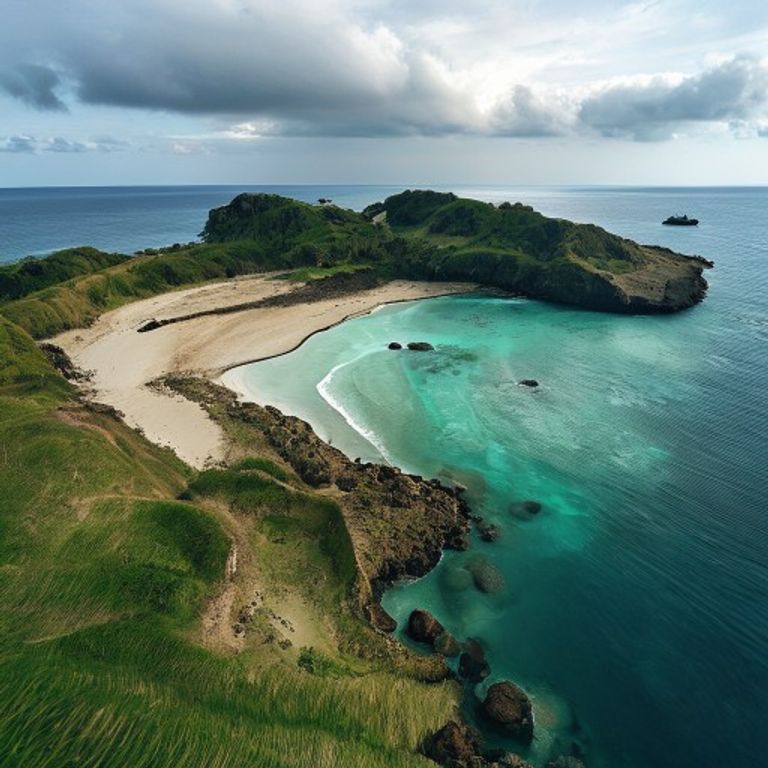
The Enigma of Hy-Brasil Island: A Portal to the Unknown
For a long time, whispered tales of phantom islands and lost lands have captivated the human imagination. Among them, the legend of Hy-Brasil, the "Hidden Island of America," shines with a mystery that transcends mere geography. What began as a cartographic myth blossomed into a complex mosaic of sightings, disappearances, and speculation, fueling a debate that has echoed for centuries. This article delves into the depths of the Case of Hy-Brasil Island, separating historical facts from the mists of legend and seeking, with analytical rigor, to unravel the contours of this persistent enigma.
1. The Context and the Incident: Where Land Disappears
The mystery of Hy-Brasil does not refer to a single incident with a defined location and date, but rather to a saga of appearances and disappearances of an island that, according to reports, existed in the Atlantic Ocean, west of Ireland.
Origin of the Legend: The first cartographic mention of an island named "Hy-Brasil" dates back to the 14th century. Genoese and Venetian maps, such as that of Angelino Dulcert (1339), already indicated a mysterious island in an approximate location where the Central Atlantic is today. This initial cartographic representation, in itself, establishes the context: a period when geographical knowledge of the world was incipient and cartography was often influenced by myths and travelers' tales.
The "Incident" as a Recurring Phenomenon: Over the centuries, Hy-Brasil island was not just a dot on a map. Various accounts, some more substantial than others, describe sightings of the island, often accompanied by unusual phenomena or a sense of inexplicability. These "incidents" multiplied, transforming the legend into a case for investigation, even if informal and scattered.
2. Timeline of Events: Traces of a Fugitive Continent
Reconstructing the timeline of the Hy-Brasil Island Case is complex, as the "events" are more sightings and descriptions than discrete, precisely dated incidents.
- 14th Century: First cartographic representations of "Hy-Brasil" (or variations like "Brasil," "Hy Breasil"), suggesting the existence of an island in the Western Atlantic.
- 15th Century: Portuguese explorer Duarte Pacheco Pereira, in his book "Esmeraldo de Situ Orbis" (written around 1505-1508), describes an island found at a latitude similar to Hy-Brasil, mentioning that "many fishermen say they have seen it." This is one of the few descriptions that approaches a testimonial account.
- 17th Century: Sailors' reports continue to emerge, describing the island with diverse characteristics, sometimes inhabited, sometimes deserted. The island appears on maps even in Joan Blaeu's Atlas Maior (1662).
- 19th Century Onward: The persistence of sightings, although less frequent and more speculative, keeps the myth alive. The demystification of other phantom islands (like Saint Brendan's Island) adds new layers of interpretation to the Hy-Brasil case.
3. Main Theories: Deciphering the Fog
The mystery of Hy-Brasil has given rise to a range of theories, from the most pragmatic to the most fantastic. A critical analysis of each is essential to understanding the complexity of the case.
3.1. Scientific and Geographical Hypotheses
- Lost or Submerged Islands: The most plausible theory is that the accounts refer to real islands that, through geological processes, have submerged or undergone significant erosion over time. The Azores Archipelago or smaller, ephemeral islands created by underwater volcanic activity are potential candidates. The problem is that none of them consistently fit the descriptions of Hy-Brasil in terms of location and time.
- Optical Illusions and Fata Morgana: At sea, specific atmospheric conditions can create mirages, such as Fata Morgana, which distort the image of distant objects. A distant landmass or clouds with unusual shapes could be interpreted as an island.
- Navigation and Cartography Errors: In the era of primitive navigation, latitude and longitude errors were common. Old maps often included land "tides," based on imprecise information or rumors. Hy-Brasil could be a persistent cartographic error, fueled by misinterpretations of reports.
3.2. Alternative and Paranormal Theories
- Ethereal Lands or Parallel Dimensions: Some theorists suggest that Hy-Brasil was not a physical island in our dimensional plane. It could be an "ethereal" land, accessible only under certain conditions, or a portal to another dimension. This line of thought is intrinsically linked to Celtic mythology and mysticism.
- Collective Memory and Archetypes: Jungian psychoanalysis could argue that Hy-Brasil is a manifestation of a universal archetype of "promised land" or "lost paradise" in the collective unconscious, which manifests in stories and dreams.
- Unexplained Underwater Phenomena: There are reports of "structures" or anomalies on the seabed that some associate with Hy-Brasil. However, most of this evidence lacks scientific rigor and can be attributed to natural formations.
3.3. Conspiracy Theories
- Governmental or Secret Concealment: A less common conspiracy theory suggests that Hy-Brasil may have been a secret base, an isolated colony, or an experimental site, whose existence is deliberately kept secret by governments or organizations. The lack of concrete evidence, however, makes this hypothesis difficult to sustain.
4. Controversies and Blind Spots: Where Truth Dissolves
The Case of Hy-Brasil Island is permeated by controversies and blind spots that make resolving the mystery difficult.
- Lack of Concrete Physical Evidence: The biggest blind spot is the complete absence of any physical artifact, ruin, or definitive geological trace that proves the past existence of Hy-Brasil in any known location. No modern map, no scientific expedition has succeeded in locating the island.
- Conflicting Testimonies: Accounts of sightings are often vague and contradictory in terms of the island's size, geography, population, and even stability. Some describe fertile land, others a desolate place, and some do not even mention inhabitants.
- The "Phantom Island" Phenomenon: The concept of "phantom islands" was common in ancient cartography. Many islands appeared and disappeared from maps and accounts, often based on rumors. Hy-Brasil may be just the most persistent and fascinating example of this category.
- Modern Interpretations of Ancient Myths: The influence of Celtic mythology, with its mystical lands like Tír na nÓg (Land of Eternal Youth), may have shaped expectations and interpretations of sightings, leading to more fantastic accounts than the facts would allow.
5. Curiosities and Legacy: The Whisper of Hy-Brasil
The cultural impact of Hy-Brasil is undeniable, even in the absence of concrete proof.
- Literary and Artistic Inspiration: The legend of Hy-Brasil has inspired countless works of fiction, poetry, and art, solidifying its place in the popular imagination as a symbol of mystery, adventure, and the unknown. The island is evoked as a lost paradise or a land of enchantment.
- The Name "Brasil": It is fascinating to note that the name of our country, Brazil, has a similar origin to the legend of the island. Both derive from the word "brasa" (ember), referring to the red color. The search for a land rich in "pau-brasil" (brazilwood) led Portuguese explorers to name the new land, and the search itself, in turn, echoed the yearnings for mysterious lands like Hy-Brasil.
- Current Status: The Case of Hy-Brasil Island remains, for the most part, in the realm of legend and speculation. There are no official investigations underway, nor any concerted scientific effort to "solve" the mystery of its existence as a physical entity. The island lives, primarily, in historical archives, old maps, and the rich tapestry of human imagination, a persistent reminder that not all the world's mysteries have been fully unveiled.
Ultimately, the Case of Hy-Brasil Island is not just about an island that may or may not have existed. It is about the nature of belief, the evolution of knowledge, and humanity's eternal fascination with what lies beyond the horizon, with what resides on the border between the real and the imaginary. The island may have disappeared from maps, but its enigma continues to sail the currents of history, challenging us to look beyond tangible evidence and contemplate the veils of the unknown.



