


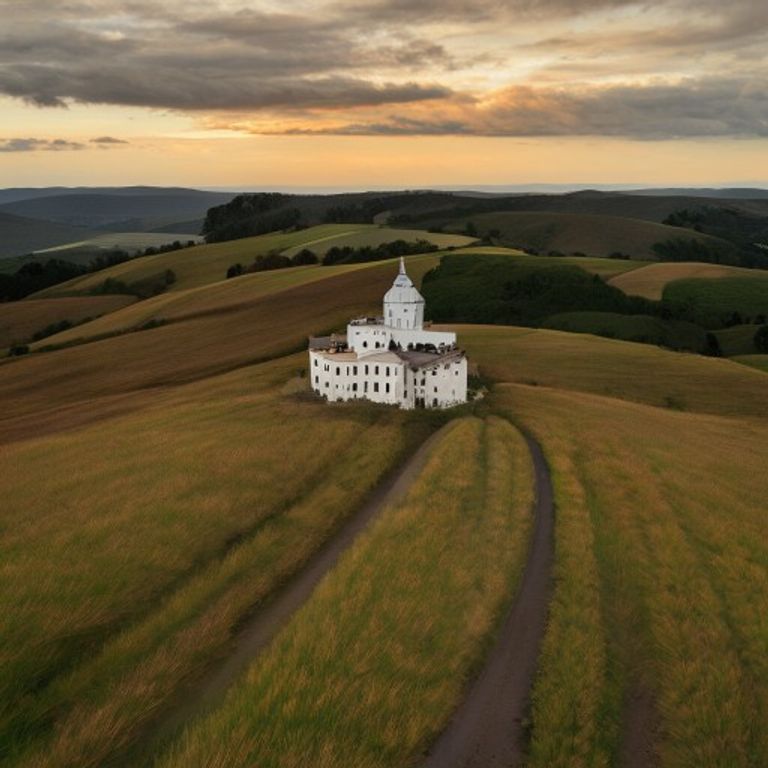
A mysterious and supposedly warm island in the icy Arctic Ocean was reported by Russian explorers in the nineteenth century, but has never been confirmed by modern expeditions.
⚠️ Research elaborated with the aid of Deep Research is subject to referential ambiguity.
🖥️Clean HTML code using a proprietary tool.
👥 Research by Guilherme Felipe, Curation by Sílvio Lôbo
The Enigma of Sannikov Land: What Happened to the Phantom Island?
The Arctic, a realm of ice and mystery, holds within its vast and unexplored confines secrets that defy human comprehension. Among them, one of the most persistent and intriguing is that of Sannikov Land. A legendary island, sighted and described by explorers in the 19th century, which became a symbol of the unknown vastness and the limitations of human knowledge. But what really happened to this land that seemed to exist, but which, after failed attempts to locate it, disappeared from nautical charts, leaving a trail of speculation and an unsolved enigma?
This article aims to delve into the depths of this mystery, separating proven facts from myriad theories, seeking to reconstruct the chronology of events and analyze the controversies surrounding one of the most fascinating cases of geographical and human disappearance in history.
1. The Context and the Incident: Where, When, and How the Mystery Began
The stage for this geographical and human drama is the vast and unforgiving region of the Siberian Arctic Ocean. The story of Sannikov Land dates back to the early 19th century, a period of intense polar exploration, driven by the search for maritime routes, natural resources, and scientific curiosity itself. The main narrative focuses on the figure of Yakov Sannikov, a renowned Russian fur hunter and explorer.
In 1805, during one of his expeditions, Sannikov reported sighting a large landmass north of Kotelny Island, part of the New Siberian Islands archipelago. He described the land as mountainous and covered in ice, with peaks visible even from great distances. His description, based on personal observations and the experience of someone intimately familiar with Arctic conditions, generated great interest and hope for a new territory to be discovered.
The existence of this land, named in his honor, began to solidify on maps and in the imagination of explorers and geographers. However, its exact location and its real existence became a point of contention and frustration in the following decades. The search for this island became an objective for several expeditions, each returning with inconclusive or contradictory results, fueling the mystery and the legend.
2. Timeline of Events
Reconstructing the chronology is crucial to understanding the evolution of evidence and theories:
- 1805: Explorer Yakov Sannikov reports sighting a large landmass north of Kotelny Island.
- 1806: Sannikov, accompanied by explorer Matvei Gedenshtrom, attempts to approach the supposed land but finds only ice fields. Gedenshtrom, however, continues to believe in its existence.
- 1811: Russian explorer Pyotr Semyonov also reports sighting high land north of Kotelny, reinforcing Sannikov's description.
- 1886: Austro-Hungarian explorer Julius von Payer, on his expedition to the Kara Sea, reports seeing land north of an area where Sannikov is said to have made his sighting.
- 1902: The Russian expedition led by Eduard Toll, with the objective of finding Sannikov Land and conducting scientific research, disappears mysteriously. Toll and his companions, including zoologist Alexander von Bunge, are never seen again.
- 1903: A rescue expedition, led by Alexander Kolchak, finds Toll's camp, but there are no clear traces of the expedition's final destination or the supposed island.
- Post-Toll Period: Several Soviet and post-Soviet expeditions attempt to locate Sannikov Land based on descriptions and approximate coordinates. All fail to find any evidence of land.
3. Main Theories
The persistence of the Sannikov Land mystery has given rise to a range of theories, varying from the scientific to the purely speculative:
Scientific and Police Theories
- Optical Illusion and Polar Mirage: This is the hypothesis most accepted by science. Under specific Arctic atmospheric conditions, such as temperature inversions, the reflection of light on the surface of the frozen sea can create convincing mirages of landmasses, mountains, or low clouds. Sannikov Land would therefore be a transient optical phenomenon. The lack of any physical evidence in subsequent expeditions reinforces this possibility.
- Giant Icebergs and Sea Ice Formations: A variation of the optical illusion suggests that explorers may have mistaken large icebergs or unusually shaped sea ice formations for land. These formations can float and disintegrate, explaining the apparent "disappearance."
- The Disappearance of Toll's Expedition: Related to the search for Sannikov Land, the fate of Eduard Toll's expedition is a mystery in itself.
- Fatal Accident: The most somber theory suggests that Toll and his team may have suffered an accident while trying to reach the island, perhaps sinking through the ice or dying of hunger and cold.
- Attempt to Reach the Island: A bolder hypothesis is that they managed to reach Sannikov Land but, for some reason, could not return, perhaps due to extreme weather conditions or the collapse of the island itself.
- Location of the Island and Its Conditions: If the island existed, it might have been an unstable volcanic island or a permanent ice mass that eventually collapsed or melted, disappearing with any trace.
Alternative, Conspiracy, or Paranormal Theories
- Existing Island, Kept Secret: A conspiracy theory suggests that Sannikov Land existed and still exists, but its existence is deliberately concealed by governments or organizations for strategic reasons, such as the exploitation of valuable natural resources or the maintenance of a secret base. This theory lacks any concrete evidence.
- Advanced or Alien Civilization: At one extreme of the spectrum, some paranormal theories posit that Sannikov Land housed an advanced civilization, possibly non-human, which had the power to make the island invisible or cause it to disappear. This hypothesis is based more on speculation and science fiction narratives than on facts.
- Sannikov Island as a Transition Point: A more mystical interpretation suggests that Sannikov Land was not a common physical location but a portal to another dimension, or a place where the laws of physics behaved differently, explaining its disappearance and the mystery surrounding it.
4. Controversies and Blind Spots
The investigation surrounding Sannikov Land is marked by inconsistencies and gaps:
- Contradictory Testimonies: While some explorers reported clear sightings, others, on later expeditions with similar objectives, found nothing. The reliability of the original reports, in an environment so prone to perceptual errors, has always been questioned.
- Lack of Physical Evidence: Despite numerous expeditions dedicated to its search, no physical evidence of Sannikov Land's existence has ever been found – neither land, rocks, flora, nor fauna that could confirm its physical existence.
- The Disappearance of Toll's Expedition: The main controversy is exacerbated by the disappearance of Toll's expedition. The fact that an expedition determined to find the island disappeared in its search adds a cloak of tragedy and mystery, suggesting that something dangerous and inexplicable may have happened. Official reports from Kolchak's rescue expedition, while detailed, did not offer a definitive answer about what happened to Toll.
- Interpretation of Diaries: The interpretation of explorers' diaries and reports is often subject to bias and speculation. The absence of precise coordinates and the subjective nature of the descriptions make objective analysis difficult.
- Limited Declassified Archives: Although expedition reports are archived, the lack of declassification of specific documents or new investigation files (if any existed, given the nature of the case) prevents a deeper and more up-to-date analysis.
5. Curiosities and Legacy
The enigma of Sannikov Land has transcended scientific and exploration circles, becoming a cultural legend:
- Literary and Artistic Inspiration: The story of the phantom island has inspired works of fiction, including the renowned science fiction novel "Sannikov Land" (1924) by Vladimir Obruchev, which was later adapted into a film. These works, although fictional, solidified the image of the island as a place of mystery and danger.
- Symbol of Unexplored Immensity: Sannikov Land represents the vastness and mysteries of the Arctic, a reminder that, even in the age of advanced technology, our planet still holds secrets and areas that challenge our understanding.
- Current Status: The Sannikov Land case has not been officially "reopened" or "closed" in the traditional sense of a police or legal case. It remains a historical and geographical enigma. The scientific community widely agrees that the island likely never existed as a permanent landmass, being the result of optical phenomena or transient ice formations. However, the mystery surrounding the disappearance of Toll's expedition continues to be a subject of interest and speculation.
- Polar Geology and Climate Change: Discussions about Sannikov Land gain new nuances with modern understanding of sea ice dynamics and climate change. The possibility of temporary ice masses or ice shelves that could have been mistaken for land is more plausible today than in the 19th century.
What happened to Sannikov Land may never be fully unraveled. However, its legacy is undeniable: an invitation to reflect on the nature of perception, the limits of human knowledge, and the eternal allure of the mysteries hidden in the far reaches of our planet.



