


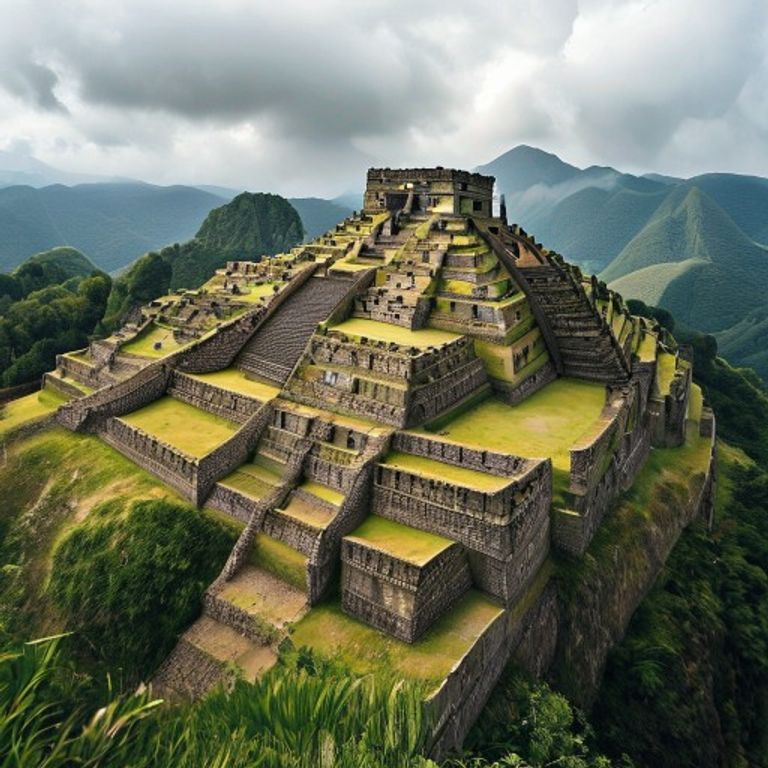
An ancient and formidable Inca fortress in Peru displays gigantic stone blocks fitted with such impeccable precision that engineers still debate the construction methods today.
⚠️ Research elaborated with the aid of Deep Research is subject to referential ambiguity.
🖥️Clean HTML code using a proprietary tool.
👥 Research by Guilherme Felipe, Curation by Sílvio Lôbo
The Enigma of Sacsayhuamán: Architecture, War, and the Silent Legacy of the Incas
High in the Peruvian Andes, where the thin air whispers ancient secrets, stands one of the most impressive and enigmatic works of human engineering: the fortress of Sacsayhuamán, on the outskirts of Cusco. More than a testament to the grandeur of the Inca Empire, the site has become the stage for a mystery that echoes through the centuries, involving the Spanish conquest and the subsequent, and often brutal, assimilation of an empire. This article delves into the depths of this enigma, separating proven facts from speculations surrounding the use and fate of Sacsayhuamán during one of the most turbulent periods in South American history.
1. The Context and the Incident: Where, When, and How the Mystery Began
The mystery of Sacsayhuamán does not refer to a single "incident" in the modern police sense, but rather to a complex of events and a historical interpretation that remains open to heated debate. The fortress of Sacsayhuamán, a massive complex of megalithic stones, was built by the Incas for defensive and ceremonial purposes. Its architecture, marked by massive stone blocks, some weighing over a hundred tons, arranged with astonishing precision without the use of mortar, is already a marvel that challenges contemporary knowledge. The "incident" that triggers the mystery, however, is intrinsically linked to the arrival of the Spanish conquistadors in 1533 and the conflicts that followed.
After the capture and execution of Atahualpa, the last Inca emperor, Cusco became a focus of resistance and, at the same time, a prize coveted by the Spanish. Sacsayhuamán, with its imposing walls and strategic location, emerged as a crucial point in the battles for hegemony. The mystery lies in the uncertainty about what exactly happened to the fortress and its Inca defenders during and after the early years of the conquest, and how this monumental structure came to be used and, in part, dismantled by the Spanish themselves.
2. Timeline of Events
A chronological reconstruction, based on historical accounts and archaeological evidence, illuminates the main milestones of the turbulent period at Sacsayhuamán:
- 15th Century - Early 16th Century: Construction of Sacsayhuamán by the Incas. The fortress, with its cyclopean walls and complex defensive systems, is an unprecedented feat of engineering.
- 1533: Arrival of the Spanish conquistadors led by Francisco Pizarro in Cusco. The city is sacked, and the Inca emperor Atahualpa is captured and later executed.
- 1536: The great Inca rebellion led by Manco Inca Yupanqui against the Spanish. Sacsayhuamán becomes one of the main strongholds of Inca resistance.
- 1536-1537: The siege of Cusco. One of the most brutal and decisive confrontations took place in and around the walls of Sacsayhuamán. Historical accounts indicate that the Incas used the fortress as a base of operations, launching fierce attacks against the Spanish forces.
- Post-Conquest Period: Accounts and archaeological evidence suggest that the Spanish, upon taking control, began to reuse the stones from Sacsayhuamán to build their own structures in Cusco, including churches and palaces. Many of the smaller stones and even some of the massive blocks are believed to have been dismantled and transported to the colonial city center.
- Subsequent Centuries: The original structure of Sacsayhuamán suffers natural erosion and is partially neglected, although its grandeur remains evident.
3. Main Theories
The interpretation of events at Sacsayhuamán has generated a myriad of theories, ranging from rational explanations to more exotic hypotheses.
3.1. Scientific and Archaeological Hypotheses
- Strategic Military Use and Armed Conflict: This is the predominant and best-documented theory. Sacsayhuamán served as an essential military fortress for the Incas during the resistance. The conflicts were intense, with the Incas defending themselves bravely and the Spanish fighting to conquer the region. Accounts from chroniclers like Pedro Pizarro and Garcilaso de la Vega describe the ferocity of the battles. It is believed that part of the destruction and dismantling occurred during these battles or in the process of demobilizing the Inca defense.
- Dismantling for Colonial Construction: Once under Spanish control, the need for building materials to erect the new colonial city of Cusco led to the partial dismantling of Sacsayhuamán. The stones, especially the smaller and more easily transportable ones, were repurposed for the construction of churches, convents, and Spanish residences, such as the Cusco Cathedral and the Archbishop's Palace. This theory is corroborated by archaeological evidence showing Sacsayhuamán blocks incorporated into colonial structures.
- Original Purpose of the Fortress: There is ongoing debate about the exact purpose of Sacsayhuamán. While its defensive function is clear, some archaeologists speculate about its ceremonial and astronomical role, given the precision of its alignment with celestial events.
3.2. Alternative and Speculative Theories
- Unknown Advanced Technology: The precision and size of the blocks at Sacsayhuamán lead some to speculate about the use of advanced, possibly non-terrestrial, technologies for cutting, transporting, and setting the stones. This theory ignores the vast evidence of Inca engineering and organization.
- Secret Chambers and Lost Treasures: The grandeur of the structure has fueled legends of secret underground chambers, containing Inca treasures or ancestral knowledge. Rumors of expeditions in search of these supposed chambers persist to this day, but without concrete findings to validate these narratives.
- Natural Disasters or Cataclysmic Events: Although less prominent, some remote theories suggest that catastrophic natural events could have altered the landscape of Sacsayhuamán. However, archaeological evidence points to human action, both in construction and dismantling.
4. Controversies and Blind Spots
The case of Sacsayhuamán is full of controversies and informational gaps, largely due to the fragmentary nature of historical records and the way the conquest was documented.
- Destruction of Inca Records: The Spanish conquest was marked by the systematic destruction of Inca codices, records, and other forms of documentation. This left a significant void in the detailed understanding of the events.
- Interpretation of Chroniclers: The accounts of the Spanish chroniclers, while valuable, are inherently biased by the victors' perspective. They describe the ferocity of the battles, but the details about what exactly happened to the structure and its inhabitants in the aftermath are often vague or focused on Spanish triumphs.
- Quantification of Dismantling: The exact extent of Sacsayhuamán's dismantling for colonial construction is still a subject of debate. Estimates vary on how many blocks were removed and where exactly they went.
- Lack of Modern Forensic Investigations: Compared to modern criminal cases, the "investigations" into what happened at Sacsayhuamán were limited by the tools and methodologies available at different times. Modern archaeology has advanced in understanding the site, but the nature of the conflicts and the fate of many involved remain nebulous.
- Missing or Underestimated Evidence: Could there be remnants of battles, tunnels, or chambers that have been overlooked or misinterpreted over time? Ongoing archaeological research may bring new perspectives, but the scale of the site and the historical events may have obscured or destroyed crucial evidence.
5. Curiosities and Legacy
The legacy of Sacsayhuamán transcends mere military or architectural history. The site continues to fascinate archaeologists, historians, and the general public, fueling a mystery that, while largely explained by historical events, still holds the allure of the inexplicable.
- Cultural Impact: Sacsayhuamán is one of Peru's most visited archaeological sites and a UNESCO World Heritage Site. Its impressiveness evokes admiration for human capacity to build on a grand scale and the power of the Inca civilization.
- The Persistent Mystery: Despite rational explanations for Inca engineering and conflicts with the Spanish, the magnificence of the construction and the gaps in historical records keep a sense of mystery alive. The question of how the Incas erected such structures, even with technological advancements, still resonates.
- Current Status: The case of Sacsayhuamán is not a "closed case" in a judicial sense, but rather a field of continuous study. Archaeology and history continue to unravel the secrets of the site, but a complete interpretation of the events and the resolution of all doubts may never be fully achieved. The site is a silent testament to a glorious past, bloody battles, and the resilience of a culture that, despite conquest, left an eternal mark on the landscape and human memory.



