


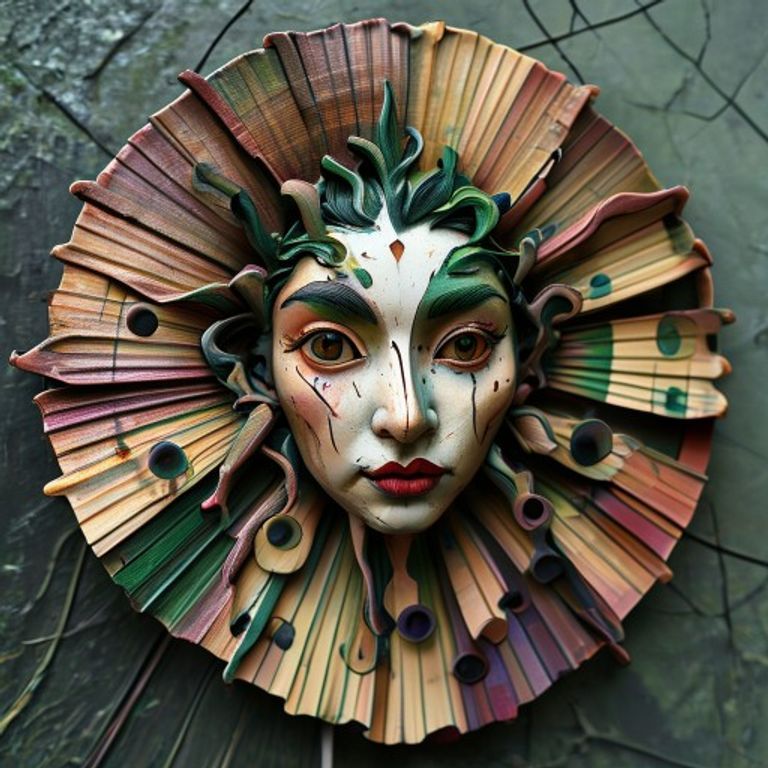
Nineteenth-century Japanese texts describe the bizarre encounter of fishermen with a foreign-looking woman who arrived ashore in a hollow, disc-shaped vessel.
⚠️ Research conducted with the assistance of Deep Research may be subject to referential ambiguity.
🖥️Clean HTML code using a proprietary tool.
👥 Research by Guilherme Felipe, Curation by Sílvio Lôbo
The Enigma of Utsuro-bune: The Unknown Navigator Who Haunted Feudal Japan
In 1803, on the salty breezes of the coast of Hitachi, Japan, a singular event disturbed the routine of a peaceful fishing village. A strange vessel, described as peculiar and unknown, emerged on the horizon, carrying with it an enigmatic crew member whose origins and intentions would forever remain shrouded in mystery. The Case of Utsuro-bune, or "hollow boat," as it is translated, has transcended time, fueling debates and speculations about its true nature, from prosaic explanations to otherworldly visions.
The Context and the Incident: An Unexpected Encounter
The incident occurred on the coast of Hitachi province (modern-day Ibaraki Prefecture) in February 1803. Historical accounts, notably compiled in texts such as the Hyōryūkishi (Records of Shipwrecks) and the Utsuro-bune no Monogatari (The Tale of the Hollow Boat), describe the discovery of a strange vessel adrift. Local residents, accustomed to traditional Japanese boats, were perplexed by the ship's design and materials. It was made of an unknown material, possibly glass or a smooth, translucent metal, and had an unusual shape, with no visible oars or sails. Inside, they found a young, beautiful woman, dressed in exotic clothing and holding an elaborate box, which the fishermen hesitated to open.
Timeline of Events: A Fragmented Narrative
The chronological reconstruction of the events, based on existing accounts, presents the following milestones:
- Early February 1803: Fishermen from the Hitachi region spot a strange object floating at sea.
- Landing of the Vessel: The ship is brought ashore by a storm or current.
- Discovery of the Occupant: Locals discover the presence of a young woman inside the vessel.
- Initial Interaction: The woman appears unable to communicate verbally with the locals, perhaps due to an unknown language or fear. She displays a peaceful but reserved demeanor.
- The Mysterious Box: The woman vigorously protects an adorned rectangular box, which the locals fear to open.
- Intervention of Authorities: Local authorities, after observing the situation and being unable to identify the origin of the vessel or the woman, decide, according to some accounts, to send her back to sea to avoid conflicts or administrative problems. Other versions suggest she was allowed to leave voluntarily.
- Disappearance: The vessel and its occupant disappear over the horizon without a trace.
Main Theories: Deciphering the Enigma
Over the centuries, numerous theories have attempted to explain the origin and meaning of the Utsuro-bune incident. They range from the most skeptical to the most fantastic:
Scientific and Police Theories (Most Probable Hypotheses):
- Foreign Shipwreck: The most conventional hypothesis suggests that the vessel was the remnant of a shipwreck from a non-Japanese craft. The woman could be a survivor of a Western ship or from another Asian culture, carried by currents to the Japanese coast. The box would be a valuable or sacred personal item. The lack of communication would be due to a language barrier.
- Refugee or Fugitive: The woman might have fled some form of persecution or adverse situation in her homeland, using a peculiar vessel to escape. The box could contain evidence or valuable belongings.
- Theatrical or Folkloric Presentation: Some interpretations suggest that the incident might have been a kind of performance or cultural presentation, with the vessel being an elaborate set and the woman a participant. However, the lack of records of such an event in other regions weakens this theory.
Alternative and Paranormal Theories:
- Extraterrestrial Visit: The unusual design of the vessel, unknown materials, and the presence of a mysterious figure have led some to speculate about a visit from beings from another planet. The woman would be an alien, and the box a technological artifact or a communication device. The lack of spoken language would be a characteristic of her species.
- Time Travel: Another more fantastic theory proposes that Utsuro-bune represented a form of temporal transport, and the woman a traveler from the future or a distant past, unable to communicate due to temporal differences.
- Supernatural or Divine Entity: In a more mystical context, the woman could be interpreted as a spiritual entity, a sea goddess, or a spirit, whose appearance would have a prophetic or symbolic meaning for the community.
Controversies and Blind Spots: The Gaps in the Investigation
The fragmented nature and lack of precise details in some of the historical accounts create significant blind spots in the Case of Utsuro-bune:
- Description of the Vessel: Descriptions of the Utsuro-bune vary, raising questions about the accuracy of the observations. The "glass" or "translucent metal" material is particularly intriguing and does not align with the naval technologies known at the time.
- The Box: The contents of the mysterious box were never revealed, making it one of the biggest focal points of speculation. Its protection by the woman suggests a high personal or practical value.
- The Woman's Fate: The end of the narrative is obscure. The versions about her being sent back to sea or leaving voluntarily leave open what happened to the mysterious traveler and her vessel.
- Absence of Physical Evidence: There are no records that the vessel or any artifacts were preserved for analysis. This absence of solid physical evidence makes it difficult to validate any theory.
- Conflicting Testimonies: Although the accounts coincide on many points, the absence of a formal investigation with firsthand collected testimonies allows for the interpretation and distortion of facts over time.
Curiosities and Legacy: A Legend That Persists
The Case of Utsuro-bune has transcended its origin as a simple incident to become a cultural icon in Japan, often associated with artistic representations, tales, and even discussions about ufology and unsolved mysteries.
- Cultural Inspiration: The mystery has inspired countless works of fiction, art, and media, solidifying the image of Utsuro-bune as a symbol of the unknown and the inexplicable.
- Modern Phenomenon: The case gained new life with the advent of the internet, where mystery and conspiracy theory enthusiasts continue to debate and research its possible solutions.
- Current Status: The case remains unresolved and, due to its historical nature and the absence of new evidence, it is unlikely to be officially reopened by law enforcement or scientific bodies. However, its power to fascinate and its ability to stimulate the imagination ensure that the enigma of Utsuro-bune will continue to be explored and revisited for generations.



