


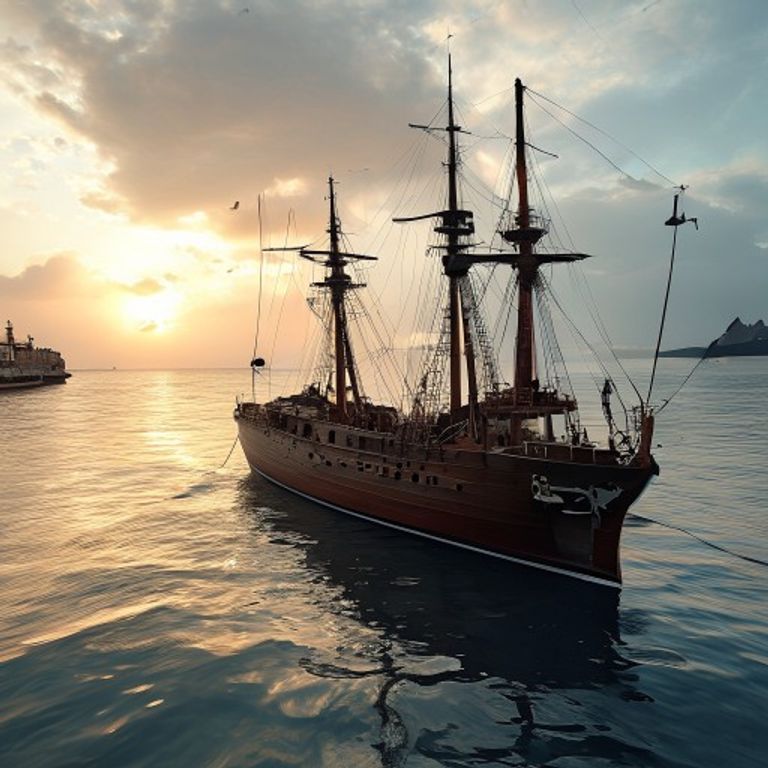
A legendary English schooner was reportedly found frozen in the Arctic in the eighteenth century, with the captain still holding his pen as he wrote in the ship's log.
⚠️ Research elaborated with the aid of Deep Research is subject to referential ambiguity.
🖥️Clean HTML code using a proprietary tool.
👥 Research by Guilherme Felipe, Curation by Sílvio Lôbo
The Frozen Enigma: Unraveling the Case of the Octavius Ship
In the annals of maritime mysteries, few cases intrigue and defy logic like that of the Octavius Ship. A ghost of ice and silence, its story is a chilling tale of disappearance, speculation, and the eternal search for answers in the frigid waters of the Arctic. As an investigative journalist with years dedicated to unearthing hidden truths, I have delved into the depths of this enigma, separating the thin thread of fact from the dense fog of legend.
The Context and the Incident: A Ghost Ship in the Icy Sea
The year 1775 is the date most frequently associated with the disappearance of the Octavius, a British merchant ship. The context is the era of great voyages and explorations, when the dream of shorter sea routes to the East, especially the Northwest Passage, consumed the attention of sailors and sponsors. It is in this scenario of ambition and danger that the Octavius, under the command of Captain Hunt, set sail with the mission to explore uncharted waters in the far north.
The incident itself manifested not as an abrupt event, but as a sepulchral silence. The ship never returned to its home port, nor has there been any news of contact after its departure. The mystery began to take on dramatic contours years later, when, in 1799, the whaling ship "Nancy", sailing in waters near the Arctic, spotted a drifting vessel. Extreme weather conditions made approach difficult, but what the observers glimpsed was something that defied comprehension: a ship immersed in ice, with torn sails and an appearance of abandonment frozen in time.
Timeline of Events: Echoes of a Shipwreck
- 18th Century (exact departure date uncertain, but estimated at 1775): The Octavius Ship, a British merchant vessel, departs on an expedition to explore the Northwest Passage.
- 1775-1799: Period of silence. The Octavius disappears without a trace.
- 1799: The whaling ship "Nancy", under the command of Captain Grover, spots a drifting schooner, covered in ice, in Arctic waters. Initial descriptions suggest it is the Octavius.
- Details of the discovery (reported later): The "Nancy" reportedly managed to approach and send an boarding party. What they found was a desolate scene: the crew frozen in their positions, as if life had been suddenly interrupted. Captain Hunt was reportedly found sitting at his desk, quill in hand, as if writing a report. The ship was intact, but frozen in the ice, with sails partially hoisted.
- 19th and 20th Centuries: The case becomes an urban legend and one of the great maritime mysteries, with various expeditions and theoretical expeditions attempting to solve the enigma.
- Recent Years: The lack of concrete physical evidence and the legendary nature of the account keep the case open, generating new speculation.
Main Theories: Unraveling the Multiple Paths of the Mystery
The elusive nature of the Octavius Ship has given rise to a myriad of theories, each attempting to fill the gaps left by the absence of definitive proof. Separating the factual from the speculative is the core of this investigation.
Scientific and Police Theories (Most Probable)
- The Rapid Climatic Disaster Hypothesis: This is the most rational and widely accepted explanation. The Octavius could have been caught by a severe and unexpected ice storm. The rapid freezing of the waters and the formation of a massive ice sheet would have trapped the ship, killing the crew by hypothermia or suffocation due to lack of adequate air supply in a hermetic and icy environment. The scene described by the crew of the "Nancy" – a frozen crew – would fit this scenario. Captain Hunt, writing at his desk, could have been recording the last moments before succumbing to the cold.
- The Starvation and Scurvy Hypothesis: On a prolonged expedition in remote waters, the depletion of food supplies and the lack of vitamin C (causing scurvy) could have gradually weakened and decimated the crew. The ship, unable to navigate, would have drifted until engulfed by ice.
- The Toxic Gas Hypothesis (Less Probable, but Possible): In certain conditions of confinement in cold environments, the decomposition of organic matter (such as food scraps) could, theoretically, generate toxic gases in dangerous concentrations. However, this theory is less supported by direct evidence and would require very specific conditions.
Alternative, Conspiracy, or Paranormal Theories
- Theories of Sea Creatures or Unexplained Natural Phenomena: Some speculations, although devoid of any scientific basis, suggest that unknown sea creatures or anomalous natural phenomena in the Arctic could have been responsible for the ship's fate. These theories often rely on primal fear of the unknown and the hostile vastness of the Arctic.
- Theories of Smuggling or Piracy: Could the Octavius have been involved in illicit activities, attracting the attention of pirates or falling victim to an internal mutiny related to a valuable cargo? The silence after its disappearance could be a deliberate attempt to cover up such events.
- Paranormal and Ghost Theories: The image of the ship found frozen, with its crew in their final positions, fueled the folklore of ghost ships. Theories involving hauntings, curses, or interdimensional portals are recurrent in discussions about the Octavius, but lack any verifiable foundation. The legendary "Flying Dutchman" is an example of how stories of cursed ships capture the imagination.
Controversies and Blind Spots: The Cracks in the Narrative
The credibility of the case is often questioned due to flaws in the original narrative and the scarcity of irrefutable evidence. The main blind spot lies in the very description of what was found on the Octavius.
- The Source of the Account: The most detailed account of the encounter with the Octavius comes from the diary of Captain Grover of the "Nancy". However, the original diary was lost or never widely published. The information that circulates is largely second-hand or based on later accounts.
- Confirmation of the Ship's Identity: Although the description matches what would be expected of the Octavius, there is no absolute confirmation of the identity of the ship found. Could it have been another ship lost under similar circumstances?
- The Integrity of the Scene: If the crew of the "Nancy" actually boarded the ship, why did they not bring back any objects, records, or evidence that could corroborate the events? The narrative suggests that the ship was left adrift again, an unusual act for experienced sailors faced with such a significant discovery.
- Absence of Comprehensive Official Records: The lack of detailed official reports from the Octavius's original expedition and subsequent investigation (if any thorough one occurred) makes comparison and verification difficult. Maritime archives from that era may have been lost or damaged.
- The Non-Existent Material Proof: The absence of any trace of the Octavius or its crew, who would have been frozen and possibly preserved by the ice, is a crucial point. If the ship was found, and if the crew was intact, where are the remains? The final fate of the ship and its occupants remains a tangible and painful mystery.
Curiosities and Legacy: A Persistent Ghost
The Case of the Octavius Ship has transcended simple maritime curiosity to become a cultural icon, fueling popular imagination and inspiring countless works of fiction.
- Literary and Cinematic Inspiration: The story of the Octavius has been frequently retold in books, short stories, and even film adaptations, exploring the various theories and the inherent suspense of the disappearance. The image of a ship frozen in time, with its crew eternally guarding their own tragedy, is a powerful narrative trope.
- A Symbol of the Arctic's Vastness and Danger: The case personifies the inherent dangers of exploring extreme and inhospitable regions. The Arctic, with its relentless beauty and ability to freeze life in an instant, serves as a dark and intimidating backdrop for this mystery.
- Current Status: The case of the Octavius Ship remains, for all intents and purposes, an unsolved mystery. There is no conclusive evidence to prove or disprove the theories, and no modern search effort has resulted in the definitive discovery of the ship or a concrete solution to its disappearance. It resides in the realm of "what if," a frozen ghost waiting to be finally confronted or embraced as an unforgettable legend.
As science advances and technology allows us to explore the globe's farthest reaches, the Octavius Ship continues to remind us of the fragility of human life in the face of nature's forces and the mysteries that still lie hidden in the depths of our planet. A suspended enigma, a frozen echo of a forgotten tragedy, awaiting, perhaps forever, its ultimate revelation.



