


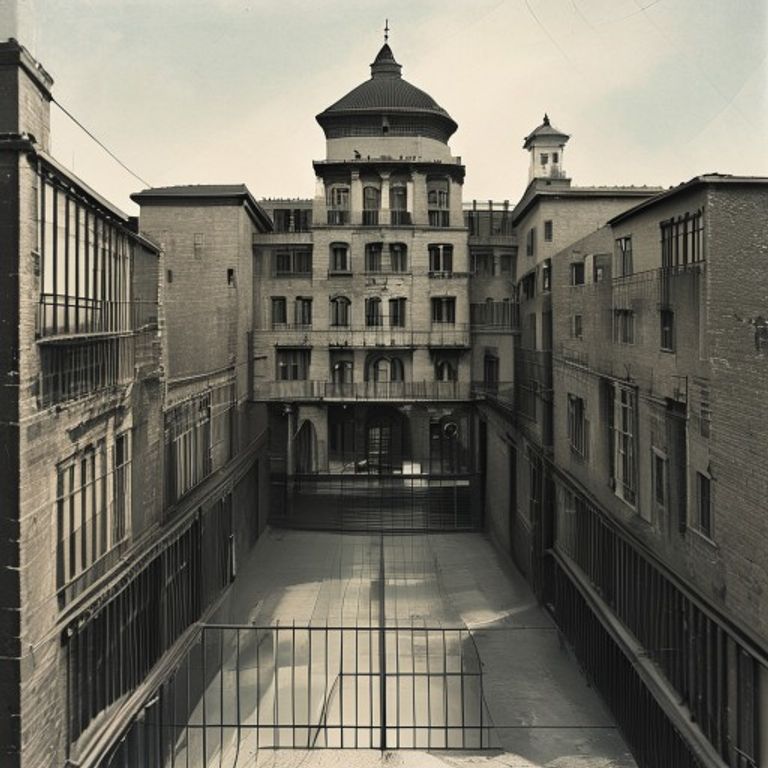
Three extremely dangerous prisoners orchestrated a complex escape from a maximum-security island prison and were never seen again.
⚠️ Research elaborated with the assistance of Deep Research is subject to referential ambiguity.
🖥️Clean HTML code using a proprietary tool.
👥 Research by Guilherme Felipe, Curation by Sílvio Lôbo
The Alcatraz Enigma: An Escape That Defies Time
Alcatraz Island, imposing and somber amidst the icy waters of San Francisco Bay, was for decades synonymous with indomitability. A maximum-security penitentiary, from which it was said that "no one escaped." A statement that, on June 11, 1962, would be brutally challenged by three men. The escape of Frank Morris, John Anglin, and Allen Anglin transcended concrete bars and became one of the most persistent and fascinating mysteries in American criminal history.
How did these inmates, considered the most dangerous and slippery in America, manage to vanish from an impenetrable fortress? The answer, to this day, remains elusive, shrouded in theories, speculation, and a trail of clues that defy a definitive conclusion. This article delves deep into the details of the escape, the subsequent investigations, and the various hypotheses attempting to unravel one of Alcatraz's greatest enigmas.
1. The Context and the Incident: The Beginning of a Mystery
Alcatraz, officially known as United States Penitentiary, Alcatraz Island, operated between 1934 and 1963. Its reputation as "The Rock" was well-deserved: thick walls, rigorous routines, and the constant threat of the turbulent, cold bay waters served as insurmountable barriers. Security was considered almost absolute.
On the night of June 11, 1962, after months of meticulous planning, Frank Morris and brothers John and Allen Anglin executed their audacious escape. Using tunnels patiently dug with improvised tools, such as spoons and a modified vacuum cleaner motor, they managed to exit their cells and head towards the exterior of the island. The starting point: the workshop, where they had access to materials and a life rhythm that allowed them to operate without raising immediate suspicion. The destination: freedom, or so they hoped.
2. Timeline of Crucial Events
- Late 1961 - Early 1962: Preparations for the escape begin. Morris and the Anglins secretly work in their cells, using rudimentary tools to enlarge ventilation openings.
- March 1962: The inmates construct realistic dummy heads using a mixture of soap, toilet paper, and human hair, painted with real paints. These were placed on their beds to simulate they were still sleeping during night rounds.
- June 11, 1962, around 9:30 PM: The first guard rounds notice the prisoners' absence. The discovery of the escape triggers a massive search.
- June 12, 1962: Details of the escape are released to the public. A large-scale search operation is initiated, involving the FBI, Coast Guard, and local police.
- June 14, 1962: A life vest and a bag of belongings belonging to the Anglins are found near Angel Island, about 5 km off the coast of San Francisco.
- Following Decades: Various "clues" and alleged sightings of the escapees emerge, but none are conclusively confirmed. The official investigation is closed without a resolution.
3. The Main Theories: Unraveling the Possibilities
The success of the escape and the absence of confirmed bodies have opened a range of theories, each with its own logic and degree of plausibility:
Official and Most Probable Theories
- Drowning: The theory most accepted by authorities at the time. The strong currents and icy waters of the bay could have prevented the escapees from reaching the shore, leading to their drowning. The discovery of the life vest reinforces this hypothesis. However, the absence of bodies remained a point of questioning.
- Survival and Successful Escape: This theory suggests that the three managed to cross the bay, possibly with the help of an improvised raft (built from raincoats), and reached dry land, disappearing thereafter. The lack of evidence of a shipwreck and reports of later sightings fuel this possibility.
Alternative and Conspiracy Theories
- External Help: The possibility of accomplices on the outside facilitating the escape, whether with transportation, information, or resources. The complexity of the operation suggests a plan that could have benefited from external support.
- Deal with the FBI or other agencies: A more conspiratorial theory suggests that the escapees might have made a deal with intelligence agencies to disappear, in exchange for information or cooperation. The lack of a relentless search and the subsequent declassification of some documents could lend themselves to such speculation.
- Died at Sea and their bodies were never found: This is a variation of the drowning theory, but with a greater focus on the possibility that ocean currents carried the bodies away from the search area or into the open ocean.
Paranormal and Supernatural Theories
- Although less prevalent in official reports, rumors and speculations about inexplicable phenomena at Alcatraz have always existed. However, there is no concrete evidence or credible accounts to support paranormal theories for the escape in question.
4. Controversies and Blind Spots in the Investigations
The official investigation, although extensive, was marked by gaps and inconsistencies that continue to fuel the mystery:
- Search Efficiency: Critics point out that the initial search, while massive, may have been less effective than it should have been, given the magnitude of the event. Reports of sightings and possible footprints on the shore were, in some cases, quickly dismissed.
- Ignored or Lost Evidence: There are reports that some collected evidence, such as fragments of the raft, was handled negligently or simply disappeared from the archives. The lack of a complete forensic trace makes it difficult to validate some clues.
- Conflicting Testimonies: Testimonies from other inmates and prison staff, collected over the years, presented different perspectives on the routine, preparation, and characteristics of the escapees, creating a confusing picture.
- The Refusal to Believe in Survival: The Alcatraz administration and the FBI always had a strong reluctance to accept the possibility of survival and a successful escape. This initial stance may have influenced the direction of the investigations.
- Declassified Documents: The recent declassification of some FBI documents on the case revealed information that, while not solving the mystery, adds layers of complexity, such as the discovery of a family photograph of the Anglins that suggests they might have survived.
5. Curiosities and Legacy: The Alcatraz Myth Endures
The 1962 escape cemented Alcatraz's myth as a place of impossible challenges. The case has inspired books, films, and documentaries, perpetuating the image of Frank Morris and the Anglin brothers as the "men who fooled the rock."
The current status of the case is "closed" by federal authorities, who continue to consider drowning as the most probable hypothesis. However, the FBI maintains records related to the case, and the door for a formal reopening, although unlikely, is not completely closed should new concrete evidence emerge. The absence of bodies and the numerous investigative gaps ensure that the Alcatraz escape remains one of history's most intriguing and discussed enigmas, a testament to human ingenuity and the persistence of mysteries that time seems unable to dissipate.



