


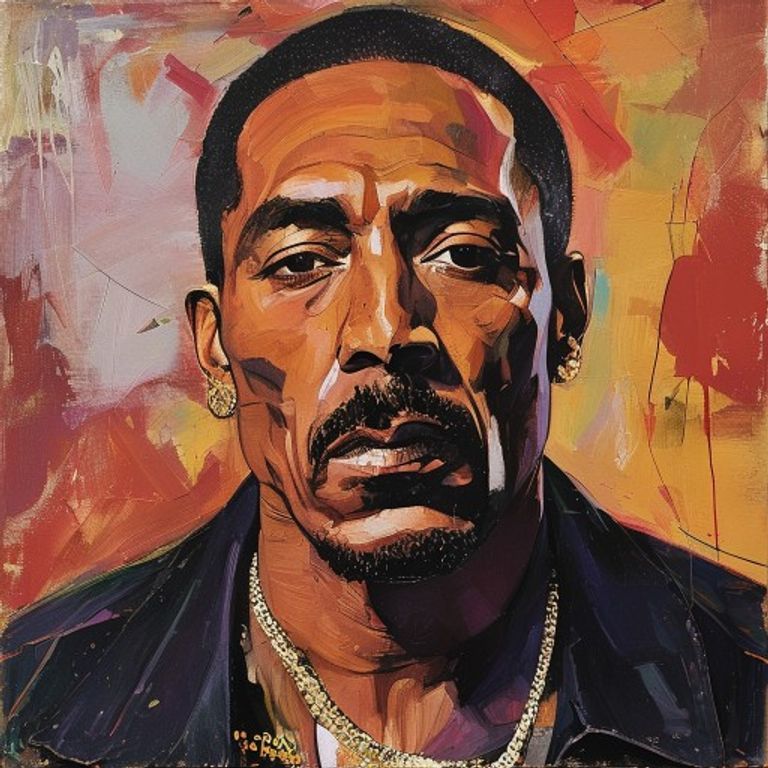
One of the greatest and most influential rappers in history was murdered in Las Vegas during a shooting whose true masterminds were never brought to justice.
⚠️ Research elaborated with the aid of Deep Research is subject to referential ambiguity.
🖥️Clean HTML code using a proprietary tool.
👥 Research by Guilherme Felipe, Curation by Sílvio Lôbo
The Tupac Shakur Case: A Premature End and a Legacy of Questions
On September 7, 1996, the hip-hop music world lost one of its brightest and most controversial icons: Tupac Shakur. A brutal shooting in Las Vegas prematurely ended the rapper's life, leaving behind not only an invaluable musical legacy but also one of the most persistent mysteries of recent history. More than two decades later, the full truth about who ordered and who carried out Tupac's murder remains elusive, fueling a myriad of theories and a perpetual debate.
1. The Context and the Incident: Where, When, and How the Mystery Began
The night of September 7, 1996, was fraught with tension. Tupac Shakur, accompanied by his producer and head of Death Row Records, Suge Knight, was in Las Vegas to watch a boxing match between Mike Tyson and Bruce Selick. After the event, the two headed towards a nightclub owned by Knight, aboard a black BMW 7 Series.
Around 11:15 PM local time, a four-door white Cadillac with several people inside pulled up alongside Knight's BMW at a busy intersection on Flamingo Road. Witnesses reported that the occupants of the Cadillac provoked the men inside the BMW. Then, one of the Cadillac's occupants opened fire, firing multiple shots at the vehicle. Tupac Shakur, sitting in the passenger seat, was hit by four bullets: two in the chest, one in the arm, and one in the thigh. Suge Knight sustained minor head injuries.
Despite the severity of his injuries, Tupac was still conscious and, according to reports, tried to alert about the attackers' identities. He was rushed to the University Medical Center, where he fought for his life for six days. On September 13, 1996, Tupac Shakur passed away due to internal bleeding caused by the gunshots, being pronounced dead at 4:03 PM.
2. Timeline of Events
- September 7, 1996, evening: Tupac Shakur and Suge Knight attend Mike Tyson's boxing match in Las Vegas.
- September 7, 1996, 11:15 PM: Knight's BMW is approached by a white Cadillac on Flamingo Road. Shots are fired at the vehicle.
- September 7, 1996, evening: Tupac Shakur is taken to the University Medical Center.
- September 13, 1996, 4:03 PM: Tupac Shakur dies at the hospital.
- September 1996 onwards: Start of police investigations and proliferation of theories.
- 2008: Detective Russell Poole, one of the original investigators of the case, publishes his findings and theories.
- 2018: The documentary "Assassination of a Hip-Hop Legend" revives the case, raising new questions.
- 2023: Duane "Keffe D" Davis, a long-time gang associate, claims in interviews and a documentary that his nephew, Orlando "Baby Lane" Anderson, was the shooter. Las Vegas police identify him as a "person of interest" in the case in 2023, and subsequently arrest him in September 2023 in connection with the murder.
3. Main Theories
The murder of Tupac Shakur has generated a diverse range of theories, from those most grounded in police investigations to the most speculative.
Police and Evidence-Based Theories
- The Role of Orlando "Baby Lane" Anderson and the Southside Crips Gang: This theory, which gained traction with the statements of Duane "Keffe D" Davis, points to Orlando Anderson as the shooter. Davis claims the shooting was retaliation for an attack by Tupac and his entourage on Anderson at a Las Vegas nightclub hours before the murder. The logic here is gang revenge, a common motive in violent crimes. Las Vegas police confirmed in 2023 that Keffe D is a person of interest and arrested him in connection with Tupac's murder, and later in connection with Biggie Smalls'.
- East Coast Retaliation / Rivalry with Notorious B.I.G.: Given the intense conflict between Tupac and Christopher Wallace, aka Notorious B.I.G. (also known as Biggie Smalls), and their respective record labels (Death Row Records and Bad Boy Records), many speculated that Tupac's murder could have been ordered by Biggie's crew or figures associated with Bad Boy Records. This theory is based on the well-known heated rivalry that marked the hip-hop scene at the time. However, police investigations and statements from people close to Biggie have not confirmed this hypothesis.
- The Role of Suge Knight and Death Row Records: Some theories suggest that Suge Knight, then head of Death Row Records, may have had some involvement, either directly or indirectly. The motives could vary, from internal disputes within the label to an attempt to get rid of an increasingly problematic and costly artist. Knight has always denied any involvement.
Alternative and Conspiracy Theories
- Tupac Faked His Own Death: This is one of the most widespread and persistent theories. Proponents argue that Tupac, tired of the violence and pressure of fame, orchestrated his own death to escape the world around him. The "evidence" presented generally includes "suspicious" appearances at later events, lyrics that supposedly foreshadowed his escape, and the lack of a "definitive" body at his funeral. The logic here is based on a desire for redemption or a new life. However, there is no concrete evidence to support this claim, and the official autopsy confirmed his death.
- Involvement of Federal Agents or the CIA: Some more extreme conspiracy theories suggest that government agencies might have had an interest in silencing Tupac due to his politically charged lyrical content and his influence over youth. The allegation is that the government saw Tupac as a potential threat to social order. This theory lacks any documentary or testimonial basis.
Paranormal Theories
- While less common and without any scientific basis, paranormal theories occasionally arise, suggesting supernatural events or premonitions as unrecognized causes or contributing factors to his death. These are generally dismissed in serious analyses.
4. Controversies and Blind Spots
The investigation into the murder of Tupac Shakur has been marked by inconsistencies and criticisms.
- Slowness and Lack of Conclusion by the Police: The official investigation, conducted by the Las Vegas Metropolitan Police Department (LVMPD), has been criticized for its slowness and lack of definitive conclusions for many years.
- Evidence Lost or Not Properly Collected: Early reports suggested that important evidence may have been lost or not properly collected at the crime scenes, hindering the investigators' work.
- Conflicting Testimonies: Various testimonies were collected, and some presented inconsistencies, making it difficult for investigators to discern the truth.
- The Lack of a Main Suspect for Years: For nearly three decades, the police did not name a main suspect or act conclusively, fueling speculation and frustration. The arrest of Keffe D in 2023 changes this dynamic, but the investigation is still ongoing to determine the extent of his responsibility and that of others involved.
- Suge Knight's Silence: Despite being the person in the car with Tupac at the time of the attack, Suge Knight's testimony has been evasive in many respects, and he faced his own legal charges related to the shooting, which may have influenced his behavior.
5. Curiosities and Legacy
The cultural impact of Tupac Shakur's death is immeasurable.
- Musical Legacy: His music, marked by poetic, socially conscious, and violently honest lyrics, continues to resonate with new generations of listeners. Posthumous albums continued to be released, keeping his presence alive in the music scene.
- Cultural Icon: Tupac transcended music to become a cultural icon, admired for his authenticity, his passion, and his struggle against adversity. His image and words continue to inspire and provoke debate.
- The Ongoing Debate: The Tupac Shakur case has become a case study in unsolved mysteries, fueling documentaries, books, and online discussions. The search for the truth has become almost as much a part of his legacy as his music.
- Current Status: With the arrest of Duane "Keffe D" Davis in 2023 and his subsequent indictment for murder in connection with Tupac's death, the case has gained new momentum. Justice, if it comes, may be closer than ever, but the trial promises to be long and challenging, with the full truth still in the process of being unveiled.
The Tupac Shakur case remains a somber reminder of a turbulent era in hip-hop and a testament to the enduring power of an artist who lived intensely and died tragically, leaving a trail of mystery that the world is still trying to unravel.



