


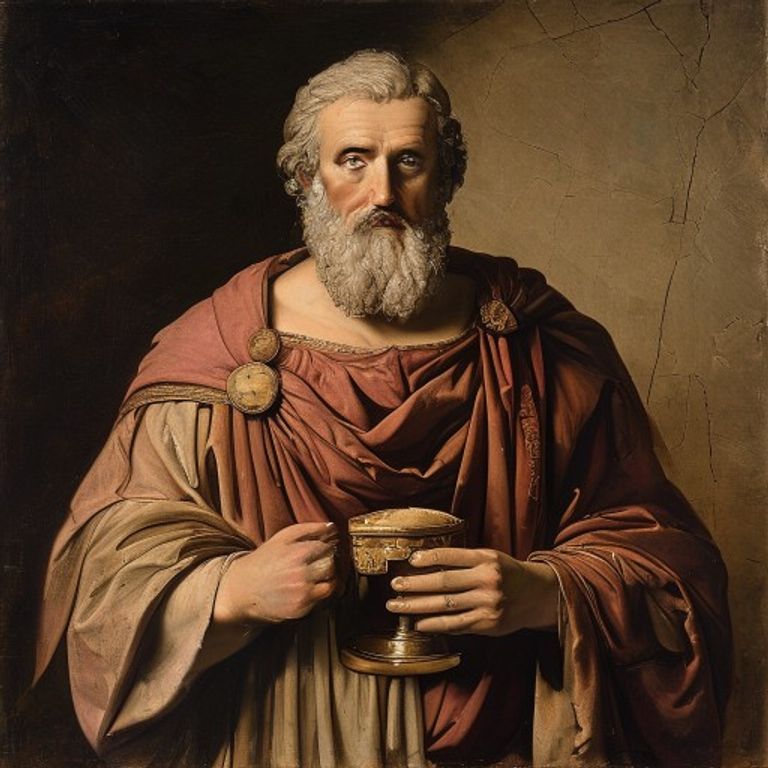
The religious and political figure from Juazeiro do Norte who became a symbol of popular faith following the alleged miracle of the host turning into blood.
⚠️ Research conducted with the aid of Deep Research is subject to referential ambiguity.
🖥️ Clean HTML code using a proprietary tool.
👥 Research by Guilherme Felipe, Curation by Sílvio Lôbo
The Enigma of Juazeiro: Unraveling the "Miracle" and the Shadow of Padre Cícero
In the heart of the Brazilian Northeast, in Juazeiro do Norte, Ceará, lies one of the country's most persistent and culturally ingrained mysteries: the so-called "Miracle of Padre Cícero." What represents divine intervention for thousands of faithful is, for others, a chapter of controversy and unanswered questions. This article delves into the facts, speculations, and shadows surrounding this phenomenon, seeking to shed light on an event that transcends religion and enters the fields of history, psychology, and the very nature of faith.
1. The Context and the Incident: Where, When, and How the Mystery Began
The stage for the mystery is the small, arid city of Juazeiro do Norte. The protagonist, Padre Cícero Romão Batista, was a charismatic and controversial figure who, in the late 19th and early 20th centuries, became a spiritual and political leader of immense influence. The "miracle" that gave rise to the enigma occurred in 1889, in the context of an event that shocked the community and sparked a series of interpretations.
According to popular accounts and the oral tradition that became established, the consecrated host that Padre Cícero was distributing to the faithful during a communion service allegedly turned into blood in the mouth of an elderly woman named Mecinha de Lúcia. This event, witnessed by many, marked the beginning of the devotion to Padre Cícero as a man with supernatural powers and served as the catalyst for the development of Juazeiro as a pilgrimage center.
2. Timeline of Key Events
- 1889: The incident of the bloody host in the mouth of Mecinha de Lúcia. This event is considered the starting point of the "miracle."
- Late 19th and Early 20th Century: Padre Cícero consolidates his spiritual and political influence, attracting thousands of devotees to Juazeiro. The city begins to develop around his figure.
- 1934: Death of Padre Cícero. His figure gains even more legendary status after his passing.
- Subsequent Decades: Juazeiro do Norte establishes itself as one of the largest centers of religious pilgrimage in Brazil, driven by the devotion to Padre Cícero.
- 21st Century: The "Miracle" continues to be celebrated by thousands, but it is also the subject of critical analysis and questioning.
3. Main Theories: From Science to Faith
The enigma of the bloody host allows for a range of interpretations, each with its own logic and basis of argumentation.
Scientific and Psychological Theories
- Physiological and Psychosomatic Phenomenon: One of the most accepted explanations from a scientific perspective involves the possibility of a psychosomatic phenomenon. The state of religious fervor, expectation, and collective suggestion could have led Mecinha de Lúcia to experience a physical manifestation. The presence of blood could be explained by natural causes, such as gingival or oral hemorrhage, amplified by the belief in the supernatural. It is believed that the mind, under strong emotional and spiritual influence, can manifest physiological reactions.
- Optical Illusion or Deception: In an environment of large crowds and poor lighting, it is possible that an optical illusion occurred. The context of intense devotion could have led observers to interpret a reflection, a stain, or a detail of the host as blood, especially if the belief was already established.
- Deliberate Fraud: Although less common in popular analyses, the possibility of a deliberate action to create the miracle cannot be completely ruled out. However, the absence of concrete evidence of an organized conspiracy and the spontaneous nature of the reported event make this hypothesis more speculative.
Religious and Paranormal Theories
- Divine or Paranormal Intervention: For the vast majority of devotees, the event is unequivocal proof of the holiness and special powers of Padre Cícero. The host turning into blood is seen as a divine sign, a manifestation of Christ's presence through his servant. The logic here lies in faith and the belief in miracles as supernatural occurrences that transcend natural explanations.
- Manifestation of Spiritual Energy: A more esoteric line of thought could consider the host as a conductor of spiritual energy, which, under the powerful influence of the Priest and collective devotion, manifested in a visible and tangible way.
4. Controversies and Blind Spots
The formal investigation of the "Miracle of Padre Cícero" was, at best, limited and influenced by popular fervor and emerging religious authority. What should have been a careful examination quickly became a seal of authenticity for the belief.
- Lack of Immediate Scientific Expertise: There are no reliable records of a medical or scientific examination performed immediately after the incident to analyze the nature of the substance that appeared to be blood. The absence of samples, laboratory analyses, and the lack of a detailed forensic record constitute one of the biggest blind spots of the case.
- Circumstantial Testimonies Motivated by Faith: The testimonies that support the miracle come largely from faithful who were already predisposed to believe in something extraordinary. Social pressure and the influence of Padre Cícero himself may have shaped or even distorted perceptions.
- Scarce Official Documentation: Although there are historical records from the time, the official documentation detailing the initial investigation of the event is scarce. Most of what is known about the incident derives from oral accounts, chronicles, and later religious publications, which may have been influenced by the already established narrative.
- The Silence of the Official Church: The Catholic Church, at the time, imposed sanctions on Padre Cícero, removing him from clerical duties. Although this was justified by other reasons (such as political involvement and the controversy over the holiness of his figure), the "miracle" itself was never officially endorsed or condemned by the Holy See in a conclusive manner, leaving a zone of ambiguity.
5. Curiosities and Legacy
The "Miracle of Padre Cícero" transcended the isolated event and became a pillar of the cultural and religious identity of Juazeiro do Norte and the Northeast. The legacy is undeniable:
- Juazeiro as a Pilgrimage Center: The alleged miracle transformed Juazeiro do Norte into one of the most important religious pilgrimage destinations in Brazil, attracting millions of devotees annually.
- The Figure of Padre Cícero: Padre Cícero is a complex figure, revered as a popular saint by many, but whose official canonization by the Catholic Church is still a subject of debate. His image, stamped on thousands of objects, is a cultural icon.
- The Power of Belief: The case demonstrates the immense power of faith and collective belief in shaping narratives and sustaining religious and cultural movements.
- Current Status: The "Miracle of Padre Cícero" is not a case to be "reopened" in a police or judicial sense, as it was never formally investigated as a crime. However, it remains a subject of study and debate in various fields, from anthropology and sociology to psychology and religious studies. The controversy over its authenticity coexists peacefully with the unwavering faith of millions of people. The enigma, in its essence, lies in the complex interaction between the natural and the supernatural, the human mind, and the power of devotion.



