


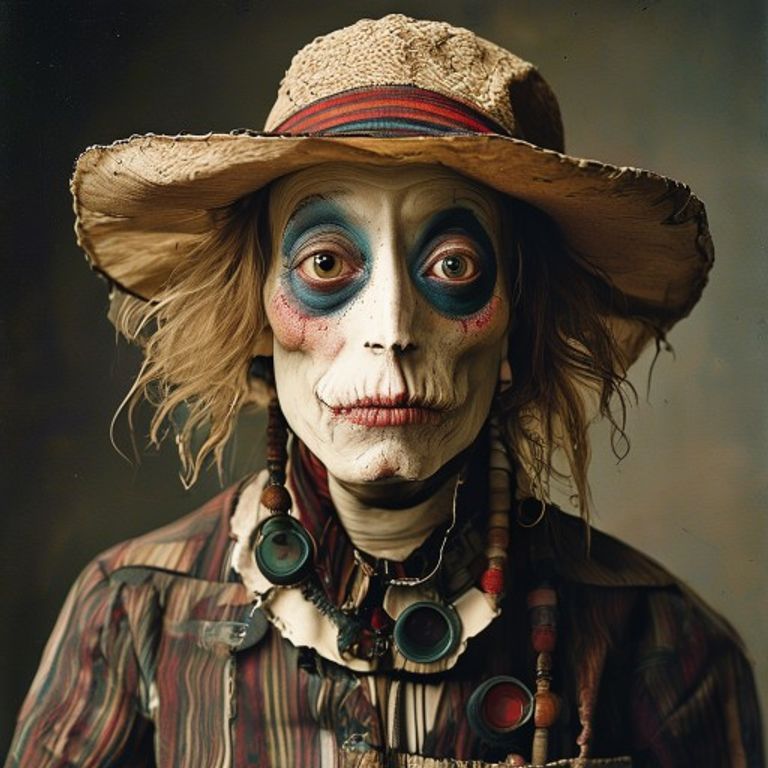
A twentieth-century toy from Florida that allegedly caused paranormal events and misfortunes for its owners, becoming a subject of study and urban legends about possessed objects.
⚠️ Research conducted with the aid of Deep Research is subject to referential ambiguity.
🖥️ Clean HTML code using a proprietary tool.
👥 Research by Guilherme Felipe, Curation by Sílvio Lôbo
The Case of Robert the Doll: An Enigma That Haunts Florida
By [Your Name], Senior Investigative Journalist
Amidst the sunny smiles and the idyllic aura that often surrounds Florida, a dark and persistent mystery hangs over the city of Key West, casting long and disturbing shadows over an innocent-looking artifact: Robert, a doll about three feet tall, with a piercing gaze and a history shrouded in whispers and inexplicable events.
1. The Context and the Incident: Where, When, and How the Mystery Began
The story of Robert is intertwined with the Otto family, residents of 24 Duval Street, Key West. The doll was supposedly given to Robert Eugene Otto, a young grandson of the Ottos, around 1904. The exact origin of the doll is murky; some accounts suggest it was made by a local artisan, while others point to a possible acquisition at an auction or during the travels of the boy's grandfather, a renowned city physician.
From an early age, the doll seemed to possess a peculiar presence. According to family testimonies, Robert Eugene Otto would spend hours talking to Robert, to whom he attributed personality traits and even spoke on behalf of. The initial narrative of strange events, which would mark the doll forever, began to emerge during the boy's childhood.
2. Timeline of Events
- Early 20th Century (approx. 1904): The doll Robert is acquired and presented to Robert Eugene Otto.
- Childhood of Robert Eugene Otto: Reports of conversations with the doll, which supposedly responded. Incidents involving objects moving on their own and strange noises in the house. The Otto family maids claimed to have seen the doll move on its own and heard laughter coming from the room where Robert was kept.
- Later Years: Robert Eugene Otto becomes a well-known artist. Robert remains in the house, eventually being moved to the attic after his parents' death.
- 1970s: After the death of Robert Eugene Otto, the house is sold. The new owner discovers Robert in the attic and donates him to the Fort East Martello Museum in Key West.
- Contemporary Period: Robert becomes a central attraction at the museum, drawing visitors from all over the world, many of whom report anomalous experiences when interacting with the doll.
3. Main Theories
The case of Robert attracts a diverse range of explanations, spanning from the rational to the supernatural.
3.1. Rational and Psychological Hypotheses
- Childhood Suggestion and Imagination: The most mundane theory points to the powerful imagination of a child. Robert Eugene Otto's association with the doll would have led to a "living" of the object, where he himself, unconsciously, created the events. Children often attribute life to toys.
- Environmental Explanations: The old house, with its architectural and material peculiarities, could generate noises and movements that, under the suggestion of the story, were interpreted as paranormal activity. Drafts, structural settling, and even small animals could be the cause of the "events."
- Psychokinetic Phenomena (Limited): Some researchers of psychic phenomena suggest the possibility of a rudimentary manifestation of psychokinesis, where a person's strong emotional or mental energy could, in rare and specific cases, influence objects. However, this theory lacks robust scientific evidence to be proven.
- Self-Suggestion and Placebo/Nocebo Effect: At the museum, Robert's fame may lead visitors to have experiences based on their expectations. Upon learning the history, they may be more prone to interpreting physical sensations, noises, or even a chill as being caused by the doll.
3.2. Alternative, Conspiracy, and Paranormal Theories
- Possession or Embodied Entity: The most popular and unsettling theory suggests that Robert is possessed by a spirit or entity. The origin of this entity is speculated: it could be the spirit of Robert Eugene Otto himself, an entity linked to the Otto family, or something older and more sinister associated with the doll since its manufacture. The presence of Robert Eugene Otto's personal items inside the doll (according to some reports, such as pieces of his clothing and hair) fuels this hypothesis.
- Curse or Negative Energies: Another perspective suggests that the doll carries a curse or is a channel for negative energies. This could stem from how it was created, the events it witnessed, or a ritual associated with it.
- Silencing Conspiracy: Although less prominent, there is a possibility that the Otto family or others may have, at some point, tried to hide or explain the events in a way that would not attract unwanted attention, perpetuating the mystery through silence or selected narratives.
4. Controversies and Blind Spots
The inherently anecdotal nature and the lack of concrete physical evidence to support the most extraordinary claims create fertile ground for controversy.
- Inconsistent Testimonies: The stories about the events involving Robert vary over time and between testimonies. What the Otto family maids reported may have been amplified or distorted over decades of storytelling.
- Lack of Independent Scientific Expertise: There has never been an independent and rigorous scientific investigation of the doll itself or the environment where it lived. The claims are largely based on personal accounts and the observation of subjective phenomena.
- "Missing" or Unfound Evidence: Although there are no official reports of crucial evidence being deliberately hidden, the absence of audio or video recordings of the alleged phenomena, in an era where technology was becoming more accessible, raises questions. The lack of detailed police reports on specific incidents also contributes to the ambiguity.
- Interpretation of Reports: What one person interprets as paranormal activity, another may see as coincidence, imagination, or even a deliberate attempt to scare. The line between fact and perception is thin.
5. Trivia and Legacy
The case of Robert has transcended local folklore to become a cultural phenomenon, attracting the attention of parapsychologists, the curious, and skeptics worldwide.
- The Original "Haunted Doll": Robert is frequently cited as one of the most famous and influential haunted dolls in the world, inspiring works of fiction, documentaries, and even other cases of supposedly possessed objects.
- The Tradition of Letters and Requests: Museum visitors are encouraged to write letters to Robert. Legend has it that if the letter is sincere, Robert may grant wishes, but he may also bring bad luck if the letter is disrespectful or dishonest.
- Current Status: Robert remains on permanent display at the Fort East Martello Museum. The museum maintains a cautious approach, presenting the doll's history with a tone of mystery, without confirming or denying the paranormal claims.
- Cultural Impact: The doll inspired the horror film "Robert the Doll" (2015) and its sequels, cementing his image in popular culture as a horror icon.
While science seeks tangible explanations, the mystery of Robert the doll continues to echo in Key West. Whether a creation of childhood imagination, a peculiar environmental phenomenon, or something genuinely supernatural, Robert's fixed gaze and enigmatic history ensure that he will forever remain one of Florida's most intriguing and frightening enigmas.



