


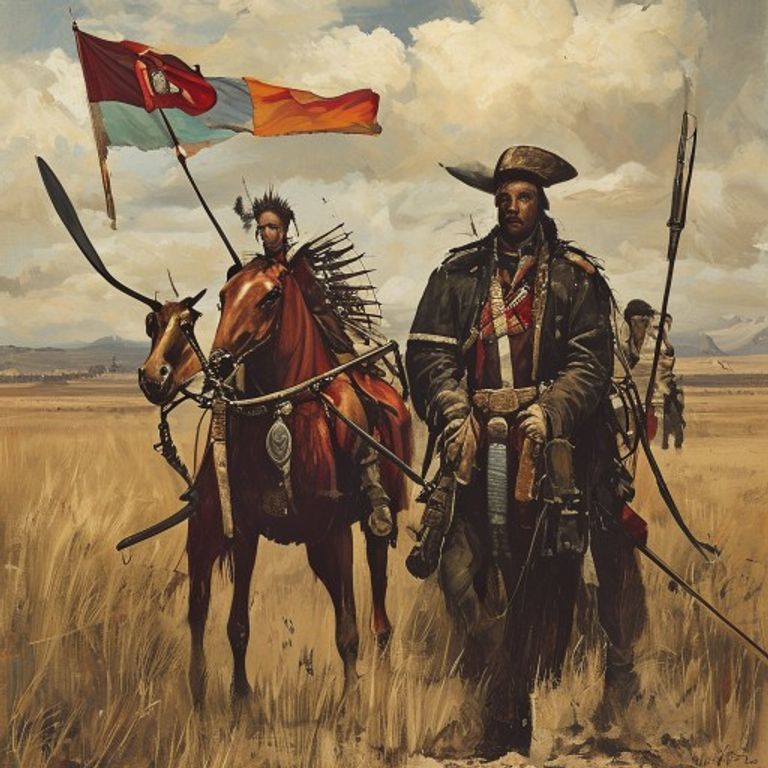
The 1876 confrontation where Native American tribes led by Crazy Horse and Sitting Bull defeated Custer's 7th Cavalry Regiment.
⚠️ Research prepared with the aid of Deep Research is subject to referential ambiguity.
🖥️ Clean HTML code using a proprietary tool.
👥 Research by Guilherme Felipe, Curation by Sílvio Lôbo
The Silent Echo of Little Bighorn: An Investigation in Search of Truth
In the heart of the vast American plains, where the wind whispers ancient secrets and the sun reveals and conceals immutable landscapes, lies a stage of tragedy and mystery: the Little Bighorn Battlefield. What should have been a decisive victory for the United States Army turned into one of the darkest and most enduring enigmas in American history. On June 25 and 26, 1876, a force led by Lieutenant Colonel George Armstrong Custer was annihilated by a coalition of Native American tribes, in a confrontation that still echoes today, fueling debates and speculation about what really happened on that fateful day.
1. The Context and the Incident: Where, When, and How the Mystery Began
The incident occurred in June 1876, in a valley near the Little Bighorn River, in the present-day state of Montana. The tension between the United States government and the Lakota Sioux, Northern Cheyenne, and Arapaho tribes had been worsening for years, exacerbated by the relentless search for gold in the Black Hills, sacred territory for the natives, and by the pressure for them to abandon their lands and take refuge in reservations. Then-President Ulysses S. Grant had issued an ultimatum for all tribes to return to the reservations by the end of May of that year.
The 7th Cavalry Regiment, under the command of the charismatic but controversial George Armstrong Custer, was tasked with locating and forcing the submission of the tribes that refused to comply. Believing he had found a large native encampment, Custer, impulsively and against the advice of some of his officers, decided to attack. What followed was a complete disaster. The American forces were divided and crushed by a significantly larger number of native warriors, led by prominent figures such as Sitting Bull and Crazy Horse. The integrity of Custer's force was obliterated, and the fate of Custer himself became the epicenter of the enigma.
2. Timeline of Events: A Chronological Reconstruction of Key Facts
The exact reconstruction of events is hindered by fragmented testimonies and the chaotic nature of the confrontation. However, the main milestones are widely accepted:
- June 25, 1876, early afternoon: The 7th Cavalry Regiment approaches the Little Bighorn River. Custer divides his troops into three columns: one under the command of Major Marcus Reno, another under Captain Frederick Benteen, and his own, with approximately 210 men.
- June 25, 1876, around 3:00 PM: Reno's column advances against the native camp from the south side. He and his men are quickly repelled by the warriors and forced to retreat to a defensive position on a hill (now known as Reno Hill).
- June 25, 1876, during the afternoon: Benteen's column, which was supposed to reinforce Reno, is diverted by Custer toward the north. Later reports indicate that Benteen and his men heard gunfire coming from Custer's direction but remained isolated, largely due to Custer's orders to join him in the advance.
- June 25, 1876, late afternoon: Custer's "last stand," known as Custer Hill, is reached by the native warriors. The complete annihilation of his force is the cloudiest point, with conflicting reports about the exact unfolding of the final moments.
- June 26, 1876: The native tribes attack the defensive position of Reno and Benteen on Reno Hill but are eventually forced to retreat due to the arrival of Army reinforcements, led by General Alfred Terry.
3. Main Theories: Possible Explanations for Custer's Fall
The annihilation of Custer's force gave rise to a myriad of theories, ranging from pragmatic military explanations to more fantastic speculations. Rigorous analysis of these theories is crucial to separate fact from fiction.
Military and Historical Theories (Most Likely):
- Custer's Tactical Miscalculation: This is the prevailing theory. It is believed that Custer overestimated the weakness of the enemy and underestimated the size and organization of the native camp. He allegedly, on impulse, divided his forces inappropriately, sending Reno on a failed frontal attack and leaving Benteen in an isolated position, while he himself headed for a confrontation with the bulk of the native force.
- Failure in Communication and Coordination: The division of troops and the lack of effective communication between Custer, Reno, and Benteen were crucial factors. Confused or misinterpreted orders may have led to the inability to coordinate an effective attack or a tactical retreat.
- Underestimation of Native Fighting Capability: The American Army, in many cases, underestimated the bravery, tactics, and fighting capacity of the native tribes, especially when motivated by the defense of their lands and way of life.
- Troop Fatigue and Demoralization: The American troops had been on campaign for weeks under difficult conditions, which may have affected their performance.
Alternative and Conspiracy Theories:
- Custer's Abandonment Theory: Some historians speculate that Custer may have attempted a tactical retreat to regroup but was discovered and surrounded before he could do so. Another strand suggests he may have intentionally separated from part of his troops to conduct reconnaissance but got lost or was ambushed.
- Government or Military Conspiracy: A less popular theory suggests that Custer was deliberately sacrificed to discredit the general or to prevent him from becoming a prominent political figure. However, there is no concrete evidence to support this hypothesis.
- External Influence or Innovative Native Tactics: Although the tactical capacity of the tribes is recognized, some theories suggest a level of organization or strategy that could have been influenced by external leaders or was innovative for the time, beyond what was expected.
Paranormal Theories:
- Supernatural Phenomena: As with many tragic historical events, there are reports and speculations about apparitions, omens, or supernatural influences that allegedly preceded or accompanied the battle. These theories lack any scientific or evidentiary basis and fall into the realm of folklore.
4. Controversies and Blind Spots: Cracks in the Official Narrative
The post-battle investigation, conducted by the Army itself, was marked by controversies and blind spots that fuel the mystery to this day:
- Biased Official Reports: Initial reports, such as that of General Terry, tended to glorify the bravery of the soldiers and paint Custer as a tragic hero. Criticism of Custer's leadership was, in many cases, minimized.
- Conflicting Testimonies: The few American survivors, mainly from Reno's column, presented divergent testimonies about the events, which is expected in a situation of extreme stress and confusion, but makes precise reconstruction difficult.
- Ignorance of Native Evidence: Initially, the perspectives and accounts of the native tribes were largely disregarded or marginalized in official investigations. For a long time, history was told primarily from the perspective of the victors.
- Missing or Uncollected Evidence: The difficulty in recovering all bodies and artifacts from the battlefield, amidst the extent of the area and the conditions, led to the loss of potential evidence. The nature of Custer's remains, in particular, generated discussions about his identity and the manner of his death.
- The "Mystery" of Custer's Death: Accounts of Custer's death are varied. Some indicate he was hit by rifle bullets, others by arrows. The way his body was found, or what remained of it, has been the subject of much speculation, with some suggesting he may have been one of the last to fall, fighting bravely to the end, while others imagine a faster and less heroic end.
5. Curiosities and Legacy: The Immortal Echo of the "Last Stand"
The Case of the Battle of the Little Bighorn transcended the battlefield to become a cultural icon:
- Custer's "Last Stand": The image of Custer and his men fighting to the last man against an overwhelming enemy became an archetype of the "last stand" in American culture, inspiring countless books, films, paintings, and songs.
- Romanticized Vision vs. Historical Reality: For a long time, the figure of Custer was romanticized as a tragic hero. However, more recent research and a more critical analysis of his career have revealed a more controversial side, including questionable tactics and an impulsive temperament.
- The Native Legacy: The battle is seen by native tribes as a monumental victory and a symbol of resistance. The recognition and inclusion of their perspectives have been an ongoing and fundamental effort for a more complete understanding of the event.
- Current Status: The case remains a topic of academic study and debate. Although the general timeline and tactical factors are well established, the exact details of the final moments of Custer's force continue to generate interest and speculation. The site of the battle is today a National Historic Site, preserved to remember both the military tragedy and the importance of native history and culture. There has been no formal "reopening" of the case in a police sense, but historical and archaeological research continues to uncover new layers of understanding, without, however, completely eliminating the veil of mystery that hangs over the annihilation of the 7th Cavalry Regiment in the Little Bighorn valley.



