


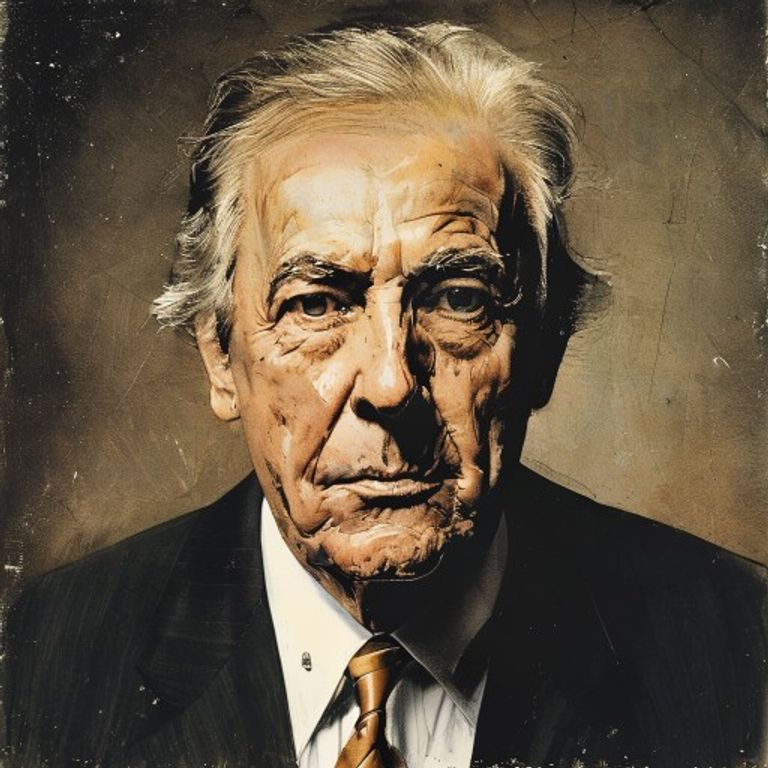
The heir to the Rockefeller fortune who vanished in New Guinea in 1961 after his boat capsized; theories range from drowning to the possibility that he was captured by local tribes practicing ritual cannibalism.
⚠️ Research conducted with the aid of Deep Research is subject to referential ambiguity.
🖥️ Clean HTML code using a proprietary tool.
👥 Research by Guilherme Felipe, Curation by Sílvio Lôbo
The Enigma of Michael Rockefeller: The Disappearance That Silenced New Guinea
The disappearance of Michael Rockefeller in 1961, in the remote and still little-explored Dutch New Guinea, remains one of the most intriguing mysteries of the 20th century. An heir to one of the wealthiest and most influential families in the United States, an up-and-coming anthropologist with ambitious intellectual goals, he evaporated without leaving concrete traces, fueling a mosaic of theories ranging from natural tragedy to tribal barbarism and, for the more daring, something much darker.
1. The Context and the Incident: Where, When, and How the Mystery Began
Michael Clark Rockefeller, born in 1938, was the youngest son of oil tycoon Nelson Rockefeller, the future Vice President of the United States. Possessing a sharp intelligence and a passion for anthropology, Michael was determined to conduct an in-depth study of the cultural practices of the Asmat, a group of headhunters who inhabited the dense and inhospitable jungle of the Asmat region, in present-day Indonesia.
In 1961, Rockefeller embarked on his second expedition to New Guinea. The primary goal was to collect cultural artifacts for the Museum of Primitive Art in New York, founded by his father. The expedition, consisting of Michael, a Dutch anthropologist named René Wassing, and a team of local guides and porters, established a camp in Agats, the main settlement of the Asmat.
On November 17, 1961, Michael and René set out in a motorized canoe to explore a tributary river in search of a specific group of Asmat carvings. Due to a navigation error and an unfavorable tide, the vessel capsized about 20 miles from the coast. Michael Rockefeller, in an attempt to reach land and seek help, decided to swim toward the shore, carrying a kerosene canister and a small first-aid kit. René Wassing remained with the capsized canoe, which was eventually rescued hours later. Michael Rockefeller, however, disappeared.
2. Timeline of Events
- 1961: Michael Rockefeller begins his second expedition to New Guinea.
- November 17, 1961: Michael Rockefeller and René Wassing depart in a motorized canoe.
- November 17, 1961 (Afternoon): The canoe capsizes due to the tide and a navigation error.
- November 17, 1961 (Late Afternoon): Michael Rockefeller decides to swim toward the coast to seek help.
- November 17, 1961 (Night): René Wassing is rescued by a Dutch vessel.
- November 18, 1961: Official search for Michael Rockefeller begins, led by Dutch colonial authorities. Several aircraft and boats scour the area without success.
- 1961-1962: Official searches continue for weeks, involving military, police, and volunteers, but no trace of Michael Rockefeller is found.
- Subsequent Decades: Various unofficial expeditions and native accounts circulate, fueling speculation about Rockefeller's fate.
3. The Main Theories
The disappearance of Michael Rockefeller gave rise to a range of theories, from the most plausible to the most fantastic. The lack of concrete evidence allows each hypothesis to maintain its strength:
a) Accident and Natural Death Theories
- Wild Animal Attack: The region is known for the presence of saltwater crocodiles, sharks, and other dangerous creatures. A strong ocean current could have carried the body into the open sea, making recovery impossible.
- Exhaustion and Drowning: Swimming long distances in unknown waters under adverse conditions can lead to exhaustion and subsequent drowning.
- Fatigue and Hypothermia: Even in a tropical climate, long periods in the water can lead to hypothermia, compromising survival capacity.
Logic: These theories are based on the harshness of the environment and human vulnerability. The relentless nature of the jungle and the ocean is an undeniable factor.
b) Theories of a Fatal Encounter with the Asmat
- Ritualistic Murder/Cannibalism: This is perhaps the most widespread and shocking theory. The Asmat were known for their headhunting practices and, in some contexts, for cannibalistic rituals. The hypothesis is that Michael Rockefeller, while trying to approach an isolated group or crossing territory considered sacred, was captured, killed, and possibly consumed. His body could have been distributed as part of a ritual.
- Misinterpretation and Defensive Attack: Another possibility is that upon encountering an Asmat group, the natives interpreted him as a threat or an invading spirit, reacting violently.
Logic: Based on anthropological reports about Asmat practices at the time. Michael's attempt to study and collect artifacts from a culture considered "savage" by many fueled the idea that he himself had become a victim of their traditions.
c) Conspiracy and External Intervention Theories
- Silencing by Family/Political Interests: Speculations suggest that the Rockefeller family, to avoid public embarrassment or protect interests, might have orchestrated a cover-up, suggesting a disappearance to avoid exposing something that could tarnish their name.
- Involvement of Other Powers: In a Cold War context, more conspiratorial theories suggest the involvement of rival powers, although there is a lack of any concrete evidence to support such a hypothesis.
Logic: The extreme wealth and influence of the Rockefeller family, combined with the inexplicable nature of the disappearance, open space for theories involving hidden agendas and information manipulation.
d) Paranormal and Supernatural Theories
- Intervention by Unknown Forces: Some more mystical schools of thought suggest that Rockefeller may have been a victim of inexplicable phenomena, such as mysterious disappearances linked to "portals" or supernatural entities, although there is no factual basis for such claims.
Logic: These theories usually arise in cases where conventional explanations fail, resorting to the inexplicable as a last resort.
4. Controversies and Blind Spots
The official investigation, although initial and apparently exhaustive, presented several flaws and left a trail of controversy:
- Confidential Asmat Information: Reports from the time indicate that Dutch colonial authorities already had knowledge of certain tribal practices that could be relevant, but which were not widely disclosed or taken into account in the initial investigations. The very nature of Rockefeller's expedition, in search of artifacts, may have led to imprudent contact with sensitive tribes.
- Ambiguous Testimony from René Wassing: René Wassing, the only direct witness to the moment of the disappearance, provided testimony that, at times, was seen as vague or hesitant by some investigators. His narrative about the events leading to the capsizing of the canoe and Rockefeller's decision to swim was crucial, but the lack of detail or the impossibility of independent confirmation left room for doubt.
- Difficulty of Access and Communication: The remote location of the Asmat region, the difficulty of communication, and the mutual distrust between Western explorers and local tribes created an extremely challenging investigative environment. Information collected from the natives was often filtered and interpreted through a cultural bias.
- Ignored or Lost Clues: Over the years, sporadic reports have emerged about possible sightings of Rockefeller or artifacts that could belong to him. However, the lack of centralized coordination and the difficulty in verifying this information led to many leads being ignored or lost to time.
- Reconstruction of the Canoe: The capsized canoe was recovered, but its detailed analysis to determine exactly what led to the accident was limited by the circumstances of the time and the priority of finding Rockefeller.
5. Curiosities and Legacy
The case of Michael Rockefeller transcended the realm of news and became an icon of mystery and human exploration at its limits.
- The Book by Mazo de la Roche: Canadian writer Mazo de la Roche wrote the book "Whiteoak Harvest" (1962), which, according to some sources, was based on Rockefeller's disappearance, although it is not a documentary work.
- The Documentary "The Vanishing of Michael Rockefeller": In 2007, a documentary of the same title was released, which re-examined the case, interviewing people involved and exploring the different theories.
- The Family's Relentless Search: The Rockefeller family never stopped believing that Michael might have survived or that his whereabouts could be discovered. Over the decades, they continued to offer rewards and fund unofficial expeditions, demonstrating an unusual dedication in search of answers.
- Current Status: The case of Michael Rockefeller is still considered an unsolved mystery by the authorities. Although official searches ceased long ago, the enigma persists in the popular imagination and in the field of cold case investigation. No body has been recovered, no definitive confession has been made, and no irrefutable evidence points to a single fate. The Asmat jungle continues to keep its secrets.
The disappearance of Michael Rockefeller serves as a somber reminder of the fragility of human life in the face of the wild and the enigmas that remain insoluble, challenging rational explanations and inviting eternal speculation.



