


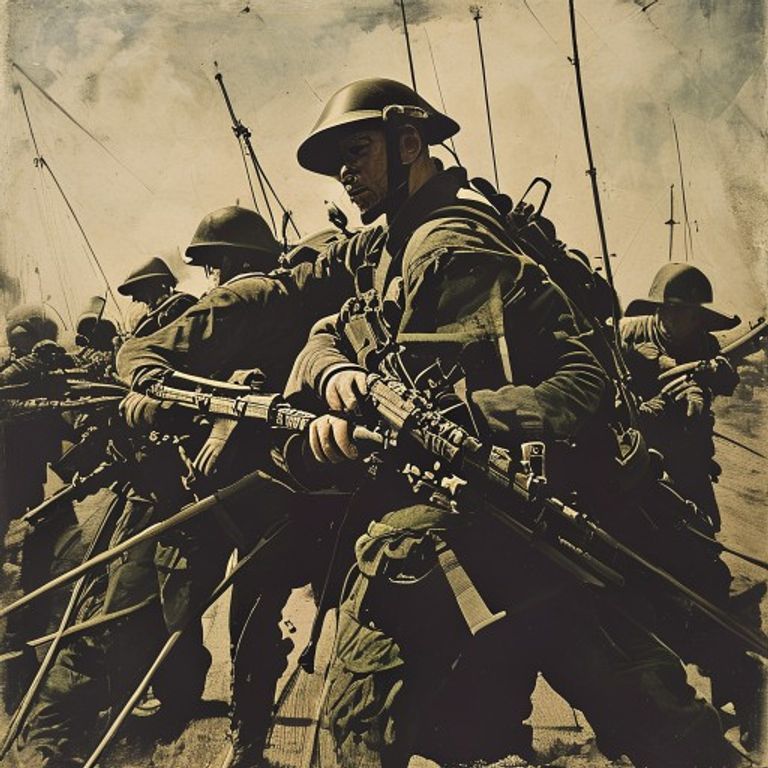
The intense 1945 combat between American and Japanese forces on a volcanic island, immortalized by the photograph of soldiers raising the flag on Mount Suribachi.
⚠️ Research conducted with the aid of Deep Research is subject to referential ambiguity.
🖥️ Clean HTML code using a proprietary tool.
👥 Research by Guilherme Felipe, Curation by Sílvio Lôbo
The Silence of the Sand: Unraveling the Enigma of the Battle of Iwo Jima
The island of Iwo Jima, a dormant volcano in the Pacific, became the stage for one of the most brutal clashes of World War II. However, amidst the roar of cannons and the echo of gunfire, a mystery emerges that, decades later, still defies logic and official explanation: the "Iwo Jima Battle Case." This article aims to delve into the depths of this enigma, separating the factual from the speculative with the analytical rigor that the investigation of unsolved cases demands.
1. The Context and the Incident: Where, When, and How the Mystery Began
The story that fuels the mystery of Iwo Jima does not refer to a single unique event, but rather to a conjunction of circumstances and inexplicable disappearances that occurred during the fierce battle for control of the island, which lasted from February 19 to March 26, 1945. American forces fought against an incredibly determined Japanese garrison that had turned the small island into an impenetrable fortress. It was in this scenario of despair and carnage that the first reports of anomalous behaviors and disappearances that did not fit traditional war narratives began to emerge.
The central incident, although diffuse, revolves around specific units, particularly those operating in tunnels and caves under Mount Suribachi. Sparse but persistent reports of soldiers who disappeared without a trace, or who emerged from clashes in a state of deep shock, speaking of "shadows" or "presences" that were not Japanese enemies, began to circulate—initially confined to the whispers of the trenches, but gradually gaining notoriety in post-battle reports and veterans' memoirs.
2. Timeline of Events
Reconstructing a precise timeline for the mysterious elements of Iwo Jima is a challenge, given the fragmentary and often confusing nature of the reports. However, we can trace relevant milestones:
- February 19, 1945: Start of the American landing on Iwo Jima. Japanese resistance is immediately fierce.
- February-March 1945: Intensification of combat, especially around Mount Suribachi. Americans begin to encounter the Japanese tunnel network.
- Undetermined Date (during the battle): The first reports emerge of inexplicable disappearances of American soldiers in specific areas, mainly in proximity to tunnels and during night operations. Some survivors report experiences of disorientation and panic without apparent cause in the midst of combat.
- February 23, 1945: The iconic flag-raising on Mount Suribachi. A moment of triumph, but one that does not erase the shadows that loomed over the island.
- March 26, 1945: Official end of the battle, with the declaration of American victory. Casualties are devastating on both sides.
- Post-War Years: Veterans begin to share their most disturbing experiences in interviews and publications. Some of these reports mention events that transcend conventional military explanation.
- Declassification of Files (Variable Period): The release of military documents, although extensive, rarely addresses the stranger reports directly, maintaining focus on strategies and casualty numbers.
3. The Main Theories
The veil of mystery surrounding Iwo Jima has given rise to a myriad of theories, some grounded in scientific logic, others floating in the realm of speculation.
3.1. Scientific and Forensic Hypotheses (Probable)
- Psychological Effects of War: The most accepted and pragmatically defensible theory. Extreme stress, sleep deprivation, constant fear, exposure to violence, and the claustrophobia of the tunnels may have led to hallucinations, delusions, and severe psychological breakdowns. Reports of "shadows" or "presences" could be manifestations of Post-Traumatic Stress Disorder (PTSD) in its most acute stages, or even combat psychosis. Disappearances could be the result of disorientation amidst the chaos, falling into unknown chasms in the tunnels, or being victims of friendly fire in poor visibility conditions.
- Unknown Japanese Traps and Defenses: The Japanese were masters of guerrilla tactics and defensive engineering. It is plausible that there were undocumented traps in the tunnels, or unstable zones that collapsed during combat, resulting in disappearances. The dense volcanic fog and low-light conditions in the tunnels could also create optical illusions and hinder orientation, leading to fatal accidents.
- Camouflage and Ambush Tactics: The ability to camouflage and operate in secrecy was crucial for the Japanese defenders. Soldiers isolated or on patrol could have been ambushed so efficiently that they left no traces, disappearing into the lunar landscape and the island's underground network.
3.2. Alternative, Conspiracy, or Paranormal Theories (Speculative)
- Unusual Geological or Atmospheric Phenomena: Iwo Jima is a volcanic island. Some speculate whether geological anomalies, such as the sudden release of volcanic gases that affect perception, or rare atmospheric phenomena (such as magnetic variations or gas bubbles that create illusions), could have played a role. This theory lacks concrete evidence and direct scientific support for the period.
- Paranormal or Psychic Experiences: Reports of "presences" and "shadows" fuel theories about the possibility of paranormal activity. The intensity of suffering and death on the island could, theoretically, have left "psychic marks." Inexplicable disappearances could be interpreted as abductions by unidentified entities or teleportation phenomena, although these are hypotheses without any verifiable empirical basis.
- Secret Military Experiments (Conspiracy Theory): A strand of conspiracy theory suggests that both sides could have been involved in secret experiments (perhaps with new weapons or technologies), the results of which would then be hidden. The disappearances and strange behavior of some soldiers would be side effects of these experiments. This theory is highly speculative and not supported by any concrete proof in declassified files.
4. Controversies and Blind Spots
The official investigation into the Battle of Iwo Jima, focused on military strategy and territorial control, left significant gaps regarding the more enigmatic aspects.
- Incomplete or Destroyed Records: The chaotic nature of the battle, the destruction caused by bombings, and the rapid succession of events hindered the collection and preservation of all records. It is likely that many testimonies and detailed reports on specific incidents have been lost forever.
- Hesitation to Report the Inexplicable: Soldiers who experienced bizarre events may have hesitated to report them for fear of being ridiculed, considered mentally unstable, or punished. The military environment, especially in wartime, tends to discourage what falls outside the norm.
- Focus on Military Victory: The priority of commanders and military historians was to document the success of the campaign and the tactics employed. Reports of anomalies that could not be easily explained or that could undermine the narrative of heroism and control were, in many cases, disregarded or minimized.
- Insufficient or Impossible Forensics: Given the nature of the disappearances (often in areas of difficult access or under enemy fire), detailed forensic investigations were, in most cases, impossible to conduct at the time of the events.
- Conflicting Testimonies: When testimonies about strange events emerged, they were frequently vague, fragmented, or contradictory, making their validation and the construction of a coherent narrative difficult.
5. Curiosities and Legacy
The "Iwo Jima Battle Case," despite not being a "case" formally reopened or closed by military authorities, persists in the collective imagination and in the research of inexplicable phenomena.
- Cultural Impact: The Battle of Iwo Jima is an enduring symbol of the human cost of war. The mystery, in turn, adds a layer of fascination and apprehension, fueling books, documentaries, and discussions about the limits of our understanding in extreme situations.
- The Power of Narrative: The absence of definitive explanations allows various narratives to coexist. For some, the island remains a place haunted by suffering. For others, it is a testament to human resilience and the cruelty of war, with the inexplicable elements being merely a manifestation of stress and chaos.
- Current Status: The "Iwo Jima Battle Case" does not have an official status of pending investigation. However, its enigmatic nature ensures that it continues to be a subject of study by historians, psychologists, and mystery enthusiasts. The absence of new concrete evidence has solidified psychological and environmental theories as the most likely, but the silence of the sand of Iwo Jima still holds its secrets.
While official reports focus on strategies and numbers, the echo of the disappearances and anomalous experiences on Iwo Jima reminds us that, even in meticulously documented conflicts, the veil of the unknown can persist, challenging our certainties and inviting us to question the limits of reality under extreme pressure.



