


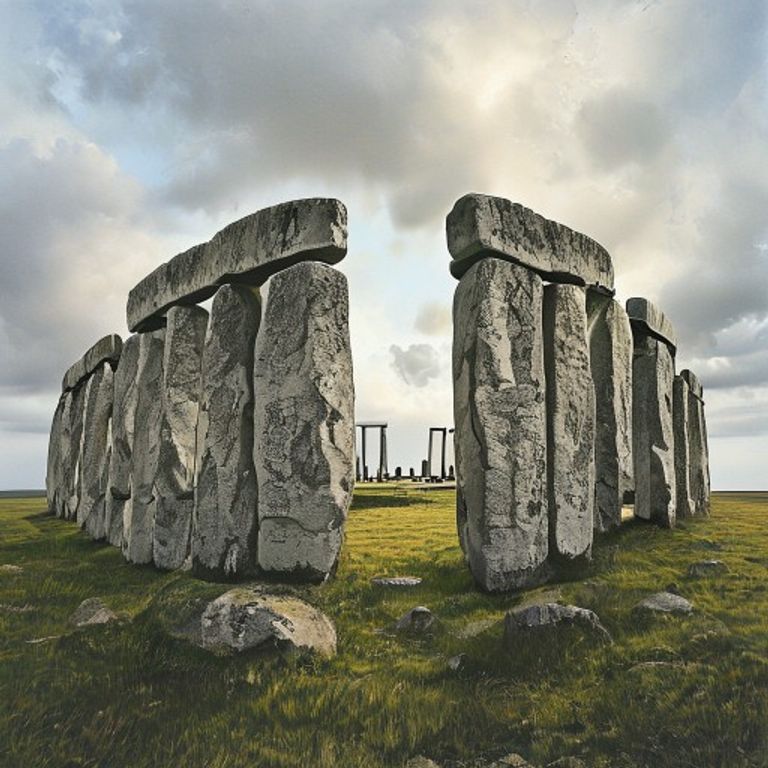
A circle of megalithic stones erected in England over four thousand years ago; although its astronomical purpose is recognized, the logistics of transporting the stones from hundreds of kilometers away still spark debate.
⚠️ Research conducted with the aid of Deep Research is subject to referential ambiguity.
🖥️ Clean HTML code using a proprietary tool.
👥 Research by Guilherme Felipe, Curation by Sílvio Lôbo
The ETERNAL Enigma of Stonehenge: An Investigation into the Inexplicable
By [Your Name/Senior Investigator Pseudonym]
Amidst the rolling plains of Salisbury Plain, in Wiltshire, England, stands a circle of stones that defies time and human understanding: Stonehenge. More than a mere archaeological vestige, this megalithic monument is a portal to mystery, a stage for countless speculations, and the epicenter of a case that, for many, has never been truly solved. It is not a crime in the traditional sense, but a deconstruction of established narratives, a historical puzzle whose pieces seem to dance in a perpetual state of uncertainty.
1. The Context and the Incident: Where, When, and How the Mystery Began
The mystery of Stonehenge did not begin with a single shocking event, but rather with the very existence and construction of this monumental site. Dated from approximately 3100 B.C. to 1600 B.C., Stonehenge is a silent witness to long-vanished civilizations. The fundamental question that has haunted archaeologists, historians, and the curious for centuries is: who built it, why did they build it, and how was a society without advanced technology capable of transporting and erecting stones weighing tons, some originating from hundreds of kilometers away?
The "incident" that triggers this investigation is the very magnitude of the feat, the lack of written records explaining its origins and purposes, and the countless interpretations that have emerged over the millennia, some based on scarce evidence, others purely speculative. The mystery lies in the gap between what we see today and the lost knowledge of its builders.
2. Timeline of Events (Known and Inferred)
- c. 3100 B.C.: Initial construction of the circular ditch and embankment, and possibly the planting of the first wooden stones (now lost).
- c. 2600 B.C.: Assembly of the famous bluestone circles, transported from the Preseli Hills region in Pembrokeshire, Wales (hundreds of kilometers away).
- c. 2500 B.C.: Installation of the imposing sarsen stones, including the lintels, forming the iconic trilithons.
- c. 2400 - 1600 B.C.: Various phases of alterations and additions, including the Aubrey holes, and possibly the creation of the posthole rows.
- Roman Period and Middle Ages: Stonehenge becomes a site of fascination and legend, with the first theories about its origin beginning to emerge.
- 17th Century: John Aubrey, an English antiquarian, proposes that Stonehenge was a Druid temple.
- 18th Century: William Stukeley, another antiquarian, also associates Stonehenge with the Druids, popularizing the idea.
- 19th and 20th Centuries: Beginning of scientific archaeological research, with excavations and geological analyses attempting to unravel the secrets of its construction.
- 21st Century: Ongoing research with new technologies, including geophysics and radiocarbon dating, refining our understanding but without unlocking all the mysteries.
3. The Main Theories: A Mosaic of Hypotheses
Explanations for Stonehenge range from scientific rigor to pure fantasy. It is crucial to separate hypotheses based on evidence from mere speculation:
- Scientific and Archaeological Theories (Evidence-Based):
- Astronomical Observatory and Calendar: The most widely accepted theory is that Stonehenge served as a complex astronomical observatory. The orientation of the stones in relation to the solstices and equinoxes is undeniable. The Summer Solstice Alignment Line (aligned with the sunrise on the longest day of the year) is a crucial point. It is believed that the builders used the monument to predict important astronomical events for agriculture and rituals.
- Religious and Ceremonial Temple: The presence of human bones and artifacts in excavations suggests that Stonehenge was a site for religious rituals, burials, and possibly pilgrimages. The exact nature of these rituals, however, remains obscure.
- Healing Center: The "healing stones" theory gains strength with the discovery that some of the bluestones emit high-frequency energy and that a small number of individuals buried at the site showed signs of severe injuries. Some scholars speculate that sick or injured people traveled to Stonehenge in search of healing.
- Symbol of Unity and Power: The monumentality and complexity of the construction may have served as a meeting point for different tribes or as a demonstration of power and social organization, uniting peoples in a grand community project.
- Alternative and Speculative Theories:
- Druid Temple: Popularized by John Aubrey and William Stukeley, this theory suggests that Stonehenge was built by the Druids. However, the chronology is a significant obstacle, as the Druids flourished long after the main construction of Stonehenge.
- Construction by Giants or Magical Beings: Popular legends and myths attribute the construction to supernatural forces. While lacking factual basis, these narratives reflect the fascination with the magnitude of the feat.
- Conspiracy and Paranormal Theories:
- Ancient Aliens: A popular theory in pop culture suggests that extraterrestrials were responsible for the construction or for transmitting technological knowledge to humans. There is no scientific evidence to support this hypothesis.
- Atlanteans or Lost Civilizations: Similar to the alien theory, it posits the intervention of advanced, vanished civilizations, such as Atlantis, to build Stonehenge.
4. Controversies and Blind Spots: The Gaps in the Investigation
The investigation into Stonehenge is marked by significant gaps and blind spots that fuel speculation:
- The Logistics of Transporting the Bluestones: Although the theory that the bluestones were transported by water on rafts is increasingly accepted, the exact details and the route taken are still subject to intense debate. The ingenuity required to move stone blocks weighing up to 4 tons over hundreds of kilometers, using rudimentary tools, remains impressive and, to some extent, unexplained.
- The Absence of Written Records: The biggest gap is the lack of any written record from the peoples who built Stonehenge. Without this primary source, all interpretations are inferences based on material evidence.
- Exact Purpose of the Rituals: Although evidence of rituals and burials exists, the precise nature of these ceremonies, their meanings, and the practitioners remain largely unknown.
- The Identity of the Builders: Attribution to a single culture or period is complex, given the long history of construction and modification of the site.
- Lost or Underestimated Evidence: Over the centuries, the site has been explored, vandalized, and misinterpreted. It is possible that crucial evidence was lost or discarded by earlier investigators who did not understand its value. Reports from old excavations, such as those by William Flinders Petrie, while pioneering, may contain observations that were underestimated at the time.
5. Curiosities and Legacy: Cultural Impact and Current Status
The cultural impact of Stonehenge is immeasurable:
- Cultural Icon: Stonehenge is one of the most recognizable prehistoric landmarks in the world, a symbol of England, and an enduring testament to human ingenuity.
- Inspiration for Myth and Fiction: It has inspired countless books, films, songs, and theories, fueling the popular imagination about ancient civilizations and mystery.
- Tourism and Preservation: It attracts millions of visitors annually, creating significant challenges for the preservation of the site. Managing tourist flow and protecting the structures are constant concerns.
- Current Status: Stonehenge continues to be a site of active research. New technologies and archaeological approaches are constantly being applied, refining our understanding, but the aura of mystery remains. The site is a UNESCO World Heritage site and is managed by English Heritage. Although there is no "reopened case" in the criminal sense, scientific investigation into its secrets is perpetually ongoing, an incessant search for answers in one of the oldest enigmas on Earth.
The case of Stonehenge has no end, only a continuous unfolding of new questions. It is a reminder that, even in our modern and seemingly demystified world, there are still depths of mystery waiting to be unveiled, enigmas that transcend time and human understanding, echoing through the millennia.



