


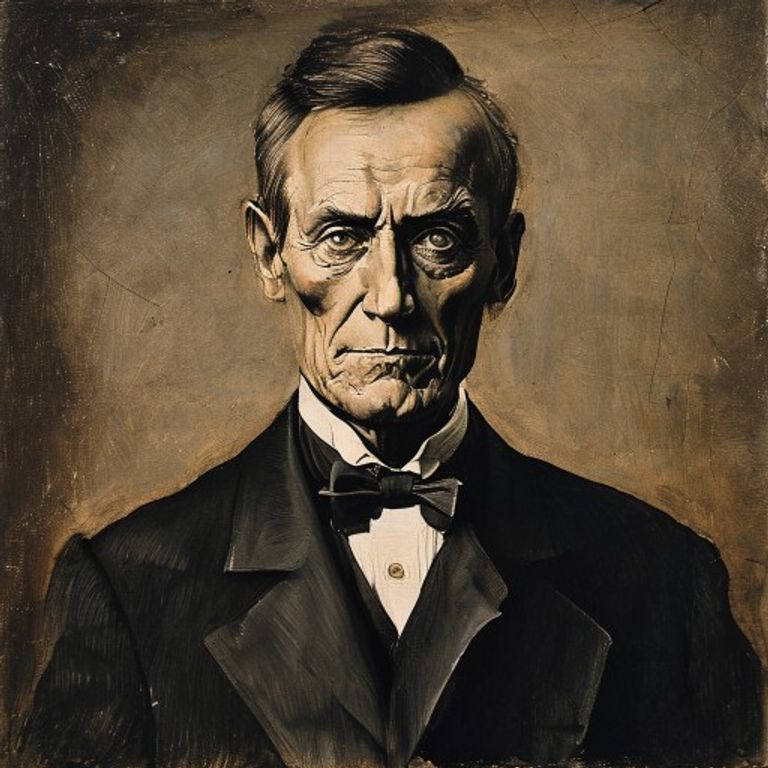
The attack committed by John Wilkes Booth in a theater in 1865 that claimed the life of the president who abolished slavery and won the American Civil War.
⚠️ Research prepared with the aid of Deep Research is subject to referential ambiguity.
🖥️ Clean HTML code using a proprietary tool.
👥 Research by Guilherme Felipe, Curation by Sílvio Lôbo
The Assassination of Abraham Lincoln: The Shadow of an Unfinished Mystery
On April 14, 1865, Ford's Theatre in Washington D.C. became the stage for one of the most tragic and divisive events in American history. President Abraham Lincoln, fresh from a victory in the Civil War and envisioning a future of reunification, was cowardly assassinated. However, more than a century and a half later, the exact circumstances and the full ramifications of this tragedy continue to spark debate, fueling theories that range from the concrete to the fantastic. This is a deep dive into the facts, the gaps, and the theories surrounding the case that shook a nation.
1. The Context and the Incident: Where, When, and How the Mystery Began
Lincoln's assassination occurred at a time of extreme volatility in the United States. The Civil War had ended just days earlier with the surrender of Confederate General Robert E. Lee. The nation, exhausted and divided, was seeking healing and reconstruction. Abraham Lincoln, known for his conciliatory approach and his Reconstruction plan, was the central figure in this process. On the night of the attack, Lincoln and his wife, Mary Todd Lincoln, were attending the play "Our American Cousin" at Ford's Theatre. The house was full, and the mood was one of celebration.
Around 10:15 PM, as laughter echoed through the audience, John Wilkes Booth, a famous actor and Confederate sympathizer, entered the presidential box. With macabre precision, he fired a single bullet from his Derringer pistol into the back of Lincoln's head. The projectile lodged deeply, causing fatal wounds. Amidst the chaos that followed, Booth jumped from the box to the stage, breaking his leg, but managing to escape while shouting: "Sic semper tyrannis!" (Thus always to tyrants!). The country, which had just celebrated the end of a bloody war, was plunged into national mourning and overwhelming bewilderment.
2. Timeline of Events
- April 14, 1865, evening: President Abraham Lincoln and First Lady Mary Todd Lincoln attend the play "Our American Cousin" at Ford's Theatre.
- Approximately 10:15 PM: John Wilkes Booth enters the presidential box and shoots Lincoln in the head.
- Immediately after the shot: Booth jumps from the box, breaks his leg, and flees the theater.
- April 14, 1865, early morning: Lincoln is taken to a nearby house, the Petersen House, where he remains in critical condition.
- April 15, 1865, 7:22 AM: President Abraham Lincoln passes away.
- April 15, 1865 onwards: An intense manhunt begins for John Wilkes Booth and his accomplices.
- April 26, 1865: John Wilkes Booth is found and killed by soldiers in a barn in Caroline County, Virginia.
- July 1865: The remaining conspirators are tried, and four are sentenced to death by hanging: Mary Surratt, Lewis Powell, George Atzerodt, and David Herold.
3. The Main Theories
Lincoln's assassination, due to its magnitude and historical context, has generated various theories, some more grounded in evidence, others navigating the waters of speculation and misinformation.
Conspiracy and Alternative Theories
- The Expanded Confederate Conspiracy: The theory most accepted by the official investigation is that John Wilkes Booth acted in concert with a group of Confederate sympathizers who planned not only to kill Lincoln but also Vice President Andrew Johnson and Secretary of State William Seward, in a desperate attempt to destabilize the Union government and potentially restart the war. Subsequent trials and the execution of conspirators seem to corroborate this line, although some question the extent of the involvement and the identity of all those involved. War Department reports from the time detail the investigation and identification process of the accomplices.
- Official Involvement: A line of speculation suggests that figures within the Union government itself, or even military personnel, could have had knowledge of or facilitated Booth's plan. This theory is based on rumors and the perception that the official investigation might have been convenient to cover up certain truths. However, concrete evidence to support this hypothesis robustly is lacking.
- The Lone Gunman Hypothesis (more remote): Although widely dismissed by the official investigation, there is a theoretical possibility that Booth acted alone, inspired by political and personal fervor. However, Booth's escape and the subsequent capture and execution of other individuals linked to him make this hypothesis less plausible.
- Paranormal and Mystical Theories (highly speculative): In less academic circles, theories have emerged that associate the assassination with supernatural forces, premonitions, or even influences from secret societies with hidden agendas. These theories lack any empirical basis and deviate drastically from historical and forensic analysis.
Scientific and Police Approaches (Proven Facts)
The police and military investigation of the time, documented in official reports and testimonies from key witnesses such as Major Henry Rathbone (who was in the box and tried to stop Booth), identified John Wilkes Booth as the perpetrator of the shot. Ballistic analysis of the time, although rudimentary by modern standards, confirmed that the projectile that killed Lincoln was compatible with Booth's pistol. The extensive manhunt and the subsequent trial of the accomplices form the backbone of the official narrative of the event.
4. Controversies and Blind Spots
Although the official investigation was extensive, some gaps and controversies persist, fueling distrust and interest in new interpretations.
- Booth's Escape: The way Booth managed to plan and execute the assassination in a public place, and his subsequent escape for so many days, raises questions about possible support networks that may not have been fully uncovered.
- Lost or Ignored Evidence: There are reports that some crucial evidence may have been lost over time or that certain clues were ignored due to the urgency and political fervor of the time.
- Conflicting Testimonies: As in any complex investigation, there were conflicting testimonies from witnesses, which is common, but which, in the absence of other evidence, can generate uncertainties.
- The Nature of the Conspiracy: Although the existence of a conspiracy was proven, the full extent of each individual's involvement and the possibility of other participants who were never identified remain areas of debate. Reports of interrogations and partial confessions of accomplices offer fragments, but not a complete picture.
5. Curiosities and Legacy
The assassination of Abraham Lincoln was not just a crime, but an event that shaped the collective memory of the United States and continues to resonate in various cultural spheres.
- Cultural Impact: Lincoln's death marked the end of a chapter of hope for many and plunged the country into a period of uncertainty and instability during Reconstruction. Lincoln's figure became a martyr, and his assassination, a national trauma.
- The Petersen House: The modest house where Lincoln spent his final hours became a site of pilgrimage and is today a museum, preserving the environment of the time and the memory of the event.
- Historiographical Legacy: The Lincoln case is the subject of continuous study by historians, who revisit archives, analyze declassified documents, and debate interpretations of the event. The lack of a single "perfect crime" in terms of total resolution keeps the case alive in academia.
- Current Status: The Abraham Lincoln assassination case is, from a legal standpoint, closed. The main individuals involved were tried and punished. However, from a historical and investigative standpoint, the case remains "open" in the minds of many researchers and enthusiasts, with new perspectives and analyses emerging periodically, always seeking to fill the gaps left by history and the original investigation. The mystery surrounding who else knew, who else planned, and what might have been if Lincoln had lived, will continue to intrigue for generations.



