


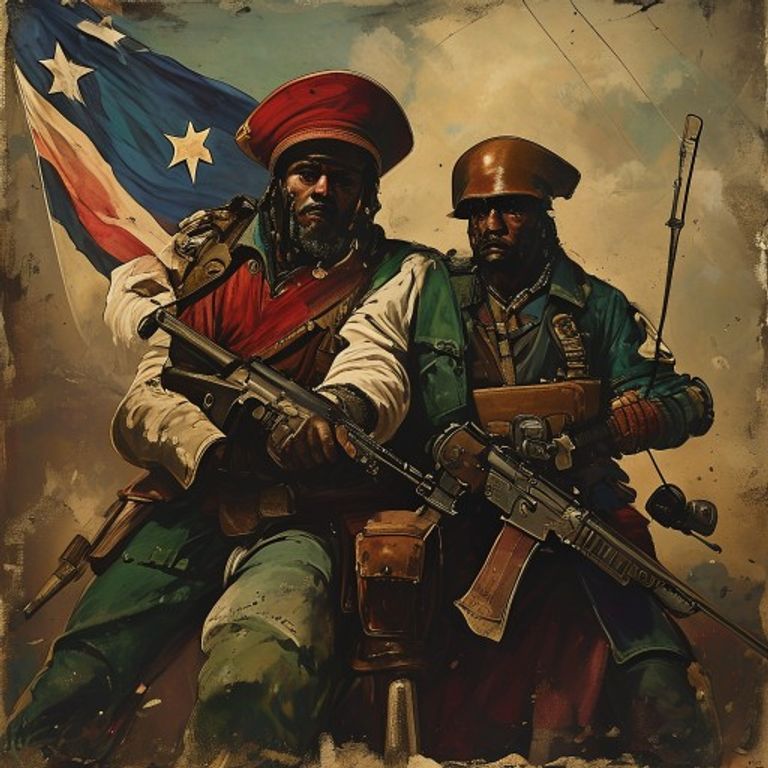
The clashes that occurred in Pernambuco in the seventeenth century where Luso-Brazilian troops defeated the Dutch invaders, a landmark in the formation of the Brazilian Army.
⚠️ Research conducted with the aid of Deep Research is subject to referential ambiguity.
🖥️ Clean HTML code using a proprietary tool.
👥 Research by Guilherme Felipe, Curation by Sílvio Lôbo
The Enigma of the Battle of Guararapes: A Conflict of Legends and Realities
History, in its most intricate weave, sometimes presents us with narratives where the thin line between documented fact and forged legend becomes indistinguishable. In the heart of what we now know as colonial Brazil, an epic conflict unfolded, shaping the future of a nation. However, what lies in the shadows of this monumental confrontation, especially surrounding the Battle of Guararapes, transcends mere military narrative and enters the realm of mystery, where echoes of forgotten strategies and the very nature of the victory are questioned.
1. The Context and the Incident: Where, When, and How the Mystery Began
The setting for our investigation is the Brazilian Northeast, specifically the captaincy of Pernambuco, during the 17th century. In 1645, the region was under the yoke of the Dutch West India Company (WIC), which had established significant dominance, particularly in sugar production. However, discontent with Dutch administration, coupled with a growing nationalist and religious sentiment, culminated in a popular revolt known as the Pernambucan Insurrection.
The "incident" that gives rise to the mystery is not a single, isolated event, but rather the very unfolding of the battles and the silence or ambiguity that hang over certain crucial aspects of these confrontations. The Battle of Guararapes, in its various phases (the First Battle, on May 26, 1648, and the Second Battle, on August 6, 1649), is frequently portrayed as the decisive turning point in the expulsion of the Dutch. However, the tactical details, the exact number of combatants, the deep motivations behind certain decisions, and the true magnitude of the "miracle" of the Luso-Brazilian victory are objects of debate and, in some respects, a persistent enigma. The mystery lies in the difficulty of unraveling the complexity of guerrilla warfare, the diversity of the combatants, and the narratives that, over time, were shaped to serve nationalist purposes, sometimes obscuring historical nuances.
2. Timeline of Events
A chronological reconstruction, focusing on the events that culminated in and surrounded the Battle of Guararapes, reveals the escalation of the conflict and the main milestones:
- 1630-1645: Period of Dutch rule in Pernambuco, marked by intermittent conflicts and economic exploitation.
- 1645: Beginning of the Pernambucan Insurrection, with the uprising of local populations against Dutch rule.
- 1645-1647: Various skirmishes and smaller-scale battles, with both sides gaining and losing ground. The resistance gains strength.
- May 26, 1648: First Battle of Guararapes. Luso-Brazilian forces, led by figures such as Filipe de Melo and André Vidal de Negreiros, face the Dutch army. Historical accounts describe a hard-fought victory, with high casualty counts for both sides. The Brazilian resistance is crucial.
- August 1648 - June 1649: Period of siege and smaller battles around Recife, where the Dutch had entrenched themselves. Hunger and disease begin to affect the besieged troops.
- August 6, 1649: Second Battle of Guararapes. Once again, Luso-Brazilian forces, under the command of João Fernandes Vieira and with the participation of iconic figures such as Henrique Dias (leader of free blacks and mulattoes) and Filipe Camarão (indigenous leader), achieve a decisive victory. This battle is considered the culmination of the Dutch expulsion.
- 1654: Definitive surrender of Dutch forces in Recife, marking the end of Dutch rule in Pernambuco and, effectively, in Brazil.
3. Main Theories
The mystery surrounding the Battle of Guararapes is not about a crime per se, but about the interpretation and filling of gaps in history. The theories revolve around the "truth" behind the victory and specific events:
- Theory of Tactical and Motivational Superiority (Official/Scientific History): This is the predominant and widely accepted narrative. It argues that the Luso-Brazilian victory was the result of effective leadership, the local combatants' knowledge of the terrain, the masterfully employed guerrilla warfare, and, crucially, the motivation and unity among the different ethnicities (Portuguese, indigenous, black, and mulatto) fighting for their land and freedom. The heroism of leaders like Filipe Camarão and Henrique Dias is highlighted as a determining factor. This theory is supported by military documents of the time, chroniclers' accounts, and modern historical analyses.
- Theory of Dutch Fatigue and Attrition (Military/Economic History): A complementary line of reasoning suggests that, although Brazilian bravery was undeniable, the long period of conflict, the logistical difficulty in maintaining their positions in Brazil, internal rivalries in Europe, and the high cost of occupation also contributed significantly to the weakening of Dutch forces. The Battle of Guararapes would then be the final straw, a decisive blow to an already weakened and unmotivated army. This perspective is supported by analyses of WIC financial reports and the political situation in Europe.
- Theory of the "Miracle" or Divine Intervention (Religious/Popular Perspective): In times of religious fervor, it was common to attribute victories to divine intervention. Popular narratives and some accounts of the time may have been influenced by the belief that God intervened to help the "defenders of the Catholic faith" against the Dutch Protestants. Although not a "scientific" theory, it is a valid interpretation of the cultural impact and mentality of the era.
- Theory of Nationalist Falsification or Exaggeration (Critical/Contemporary History): A more skeptical perspective argues that the heroic narrative of the Battle of Guararapes may have been constructed and exaggerated over time to foster a sense of national identity and glorify the resistance. The difficulty in corroborating all details with independent sources and the tendency to romanticize historical figures may have led to an idealization of the battle and its protagonists. This theory points to the need for a more rigorous analysis of primary sources and the contextualization of their production.
- Theory of Conspiracy or Information Manipulation (Paranormal/Conspiratorial - Less Likely): Although there is no concrete evidence to support this in the context of the Battle of Guararapes, in historical cases with gaps, the possibility of conspiracy theories always arises. These could postulate that crucial information was suppressed, secret agreements were made, or events were orchestrated to benefit certain groups. However, for this specific case, this line of speculation lacks any solid factual basis and resides more in the field of fiction.
4. Controversies and Blind Spots
The greatest controversy surrounding the Battle of Guararapes lies in the difficulty of obtaining a complete and indisputable picture of the events. Blind spots include:
- Number of Combatants: The exact numbers of soldiers on both sides are widely debated. Reports from the time may have exaggerated numbers to glorify the victory or minimize losses. The heterogeneity of the Luso-Brazilian forces (composed of regular soldiers, militias, indigenous people, and freed blacks) makes counting even more complex.
- Detailed Strategies: While the guerrilla warfare tactic and knowledge of the terrain are recognized, the specific details of tactical movements, battle plans, and real-time decision-making are often based on interpretations and few detailed accounts.
- Role of Certain Leaders: Although figures like Filipe Camarão and Henrique Dias are celebrated, the exact extent of their influence and autonomy over their troops, and the complex command dynamics with European leaders, are still subjects of study. The declassification and continuous analysis of archives, both Brazilian and Dutch, may shed new light on these issues.
- Disappearance of Evidence: As with many ancient conflicts, it is possible that original documents, tactical maps, or field diaries have been lost over time due to fires, negligence, or intentional destruction. The absence of certain evidence can fuel speculation.
- Contradictory Accounts: Chroniclers from both sides tended to present the narrative in a way that favored their own interests. Reconciling contradictory accounts, which describe the same battle in divergent ways, is a constant challenge for historians.
5. Curiosities and Legacy
The Battle of Guararapes transcends the military field, becoming a powerful national symbol.
- Symbol of National Unity: The participation of different ethnicities in the fight against the invader is one of the most celebrated aspects of the event, often cited as one of the first examples of Brazilian national unity.
- Legendary Heroes: The figures of Filipe Camarão, Henrique Dias, and André Vidal de Negreiros became national heroes, personifying the bravery and resistance of the Brazilian people. Their stories, filled with remarkable feats, were immortalized in literary and artistic works.
- Cultural Impact: The Battle of Guararapes inspired countless works of art, poems, books, and even the creation of the Brazilian National Anthem, which refers to the "spear of your hand" and the "land in sight." The site of the battle, in Pernambuco, is today an important historical and tourist site.
- Current Status: The case of the Battle of Guararapes is not a "case to be reopened" in a forensic sense, as it is a historical event. However, historical research into its nuances and the reinterpretation of its events remain active. Historians and researchers are constantly seeking new sources and approaches to deepen the understanding of this crucial period of Brazilian history. The mystery is not in a crime to be solved, but in the relentless search for the complete and multifaceted historical truth.
Ultimately, the Battle of Guararapes remains an indelible landmark in the history of Brazil. The "mystery" that surrounds it is not the absence of an outcome, but the intrinsic complexity of an event that involved courage, strategy, sacrifice, and the multiple voices of a people in formation. The lines between historical fact and legend, between military strategy and popular heroism, continue to be unraveled, chapter by chapter, by the tireless work of historians and researchers, always in search of a deeper and more authentic understanding of the past.



