


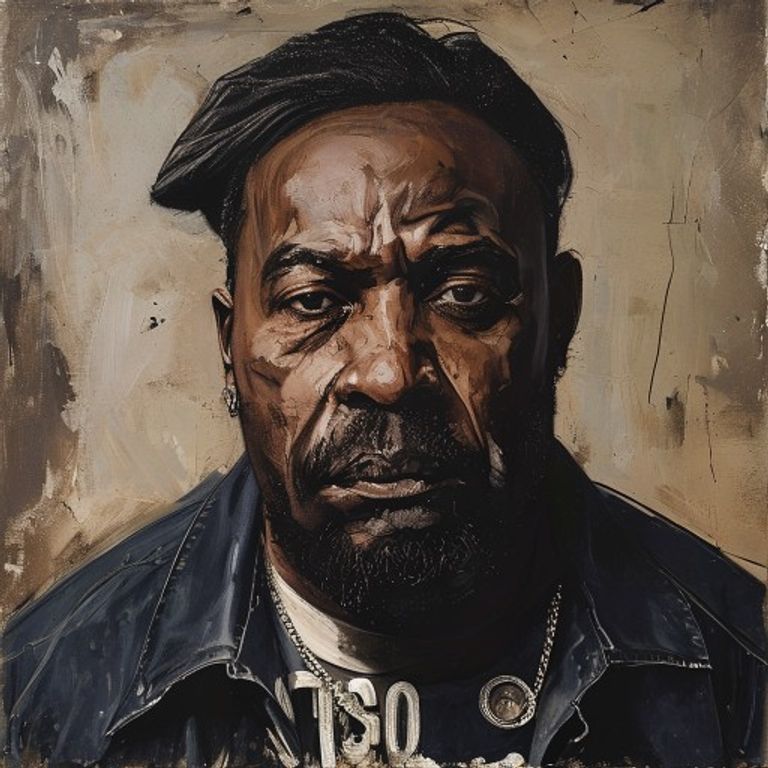
The 1997 murder of Christopher Wallace in Los Angeles, viewed as retaliation for Tupac's death, in a case that exposed the violence within the hip hop industry.
⚠️ Research conducted with the aid of Deep Research is subject to referential ambiguity.
🖥️ Clean HTML code using a proprietary tool.
👥 Research by Guilherme Felipe, Curation by Sílvio Lôbo
The Murder of The Notorious B.I.G.: A Mystery That Haunts Hip-Hop
On March 9, 1997, Los Angeles became the stage for a crime that would shake the foundations of hip-hop: the brutal murder of Christopher Wallace, better known as The Notorious B.I.G. or simply Biggie. The rising star, an East Coast icon and declared rival of the West Coast rap scene, was gunned down in broad daylight in an episode that has since become one of the greatest unsolved mysteries in American popular music.
Biggie's death was not just the loss of a talented artist; it was the culmination of a fierce rivalry between the East and West coasts of the United States, a conflict fueled by the media and territorial disputes within the music industry. The case raised questions about artist safety, police corruption, and the difficulty of solving crimes involving public figures and a complex underworld.
Timeline of Events
Reconstructing the facts surrounding the death of The Notorious B.I.G. is crucial to understanding the complexity of the case. The moments leading up to and following the murder are starting points for various theories and investigations.
- March 6, 1997: Biggie arrives in Los Angeles to promote his album "Life After Death" and participate in a photo shoot for Vibe magazine. He stays at the Renaissance Hotel.
- March 8, 1997: The rapper attends a party after filming a music video, where he is seen interacting with various artists and industry members.
- March 9, 1997, approximately 12:30 AM: Biggie leaves the party at the Petersen Automotive Museum, accompanied by his security and manager. He is in a Chevrolet Suburban SUV.
- March 9, 1997, approximately 12:45 AM: Biggie's vehicle stops at a red light at the corner of Wilshire Boulevard and Fairfax Avenue, about 100 meters from the museum. A black Chevrolet Impala with a man at the wheel pulls up alongside.
- March 9, 1997, approximately 12:46 AM: The occupant of the black Impala exits the vehicle, approaches Biggie's SUV, and fires multiple shots at the rapper.
- March 9, 1997, approximately 1:15 AM: Christopher Wallace, The Notorious B.I.G., is declared dead at Cedars-Sinai Medical Center.
- March 1997 onwards: The beginning of a complex police investigation, marked by difficulties, conflicting leads, and the lack of a concrete suspect.
Main Theories
Over the years, several theories have emerged to try to explain who was the mastermind and the perpetrator of the murder of The Notorious B.I.G. The complexity of the case and the nature of the music industry at the time opened the door to speculation ranging from plausible explanations to elaborate conspiracy theories.
Theories Related to East-West Rivalry and Gangs
- The Ex-Cop and Revenge Theory: One of the most persistent theories points to David Mack, a former Los Angeles police officer and member of the Crips gang. Mack allegedly acted in retaliation for the death of Tupac Shakur, the West Coast rapper murdered months earlier in September 1996. The theory holds that Biggie was involved, directly or indirectly, in Tupac's death, and that Mack, linked to Shakur and Los Angeles gangs, carried out the revenge. Police reports suggest Mack's connection to Tupac's death, but his direct link to Biggie's murder has never been conclusively proven.
- The "Stolen Licks" Revenge Theory: Another angle within the rivalry is the accusation that Biggie had "stolen" beats and musical ideas from West Coast artists. This would be a motivation, albeit a weaker one, for an orchestrated attack. However, the gravity of the crime suggests deeper motivations than simple musical disagreements.
- The Gangster and Internal Rivalries Theory: The involvement of gangs and underworld figures in the music industry at the time is undeniable. The possibility of an attack orchestrated by rival gangs, with the goal of destabilizing the dominance of Biggie or his label, Bad Boy Records, is a hypothesis considered by authorities. However, identifying specific perpetrators within this context has proven extremely difficult.
Conspiracy Theories and Police Involvement
- The LAPD Connection Theory: This is perhaps the most controversial and widely circulated theory. It suggests that corrupt LAPD officers were involved in the murder, whether as masterminds, executors, or facilitators. The theory gains traction due to reports that police officers were present at the scene of the party from which Biggie left, and that the official investigation was flawed or deliberately obstructed. The link of David Mack, an ex-cop, to the case fuels this line of reasoning. A documentary titled "Biggie: I Got a Story to Tell" (Netflix, 2021) explores this possibility, interviewing people close to Biggie and former police officers.
- The Marion "Suge" Knight and Death Row Records Involvement Theory: Suge Knight, the powerful head of Death Row Records, a rival West Coast label and home to Tupac Shakur, is frequently pointed to as a possible mastermind. The rivalry between Knight and Sean "Diddy" Combs, head of Bad Boy Records and Biggie's mentor, was notorious. The theory suggests that Knight ordered the murder to avenge Tupac and harm Bad Boy. However, there is a lack of concrete evidence directly linking Knight to the execution.
Alternative Theories (Less Likely, but Present in Popular Culture)
- Paranormal or "Cursed" Theories: Although not based on concrete evidence, some discussions in popular culture touch on the idea of a "curse" that fell upon those involved in the East-West rivalry. This line of thought is purely speculative and lacks investigative foundation.
Controversies and Blind Spots
The investigation into the murder of The Notorious B.I.G. is full of gaps, inconsistencies, and criticisms that fuel the mystery to this day. The credibility of the authorities and the effectiveness of the investigation have been questioned on several occasions.
- Ignored Leads and Conflicting Testimonies: Reports from eyewitnesses and members of Biggie's team indicate that the car that executed him was a black Chevrolet Impala. However, the description of the vehicle and its occupant varied between testimonies. The lack of an arrest in the act and the difficulty in tracking the vehicle amidst the heavy Los Angeles traffic contributed to the lack of progress.
- Suspects and Police Implication: The figure of David Mack, an ex-cop involved with gangs, is central to many theories. However, despite being convicted of other crimes and investigated for his possible involvement, he was never formally charged with Biggie's murder. Declassified reports in later years suggested the possible participation of other corrupt officers, raising serious doubts about the impartiality of the initial investigation.
- The "Russell Poole Report": Detective Russell Poole, who led the LAPD investigation in its early years, concluded that corrupt officers were involved in the murder and that there was a conspiracy to cover up the truth. His theory pointed to the involvement of David Mack and other officers associated with the Crips gang. However, Poole was forced to retire prematurely, and his conclusions were met with skepticism and internal resistance.
- Limited Forensic Evidence: The amount of physical evidence recovered at the crime scene, compared to the magnitude of the event, has always been a point of questioning. The lack of clear fingerprints or other robust material evidence made it difficult to identify the shooter.
- The Weapon and Tracking Difficulty: The weapon used in the crime, a semi-automatic pistol, possibly a Smith & Wesson .40 S&W, was never recovered. This lack of weapon tracking adds another layer of difficulty to the investigation.
Trivia and Legacy
The murder of The Notorious B.I.G. transcended the world of crime and became a cultural phenomenon, impacting the music industry, cinema, and how unsolved cases are perceived.
- The Final Album "Life After Death": Released just 16 days after his death, "Life After Death" became a massive success and a posthumous testament to Biggie's talent. The album solidified his legacy as one of the greatest rappers of all time.
- Films and Documentaries: The case inspired several films, such as "Notorious" (2009), which portrays his life and death, and countless documentaries that seek to unravel the mystery, fueling the debate and keeping the case alive in the public memory. "Biggie: I Got a Story to Tell" is a recent example that reignited interest.
- Impact on Hip-Hop Culture: Biggie's death, along with that of Tupac Shakur, marked the end of an era of intense and violent rivalry in hip-hop. The event sparked reflections on violence in lyrics, the influence of the media, and the complex relationships between music, gangs, and the entertainment industry.
- Current Status of the Case: Despite being officially closed by the Los Angeles Police Department (LAPD) in 2005, with no suspect formally charged for Biggie's murder, the case continues to be a subject of interest and new unofficial investigations. The possibility of reopening the case always looms, especially with the emergence of new information or testimonies. The search for truth and justice for Christopher Wallace remains an open chapter in the history of hip-hop.



