


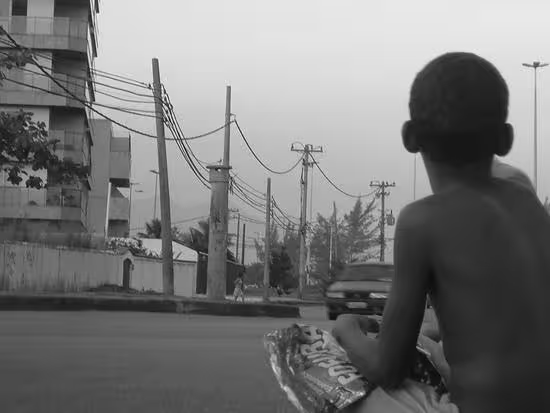
We need to discuss the role of children in our society and not see them as co-responsible for the family's sustenance, which is a task for adults. The problem of child labor, although quite complex, must be seen as a perversion of the child's role in society. This phenomenon is not exclusive to the modern world, but it was believed that it would be eradicated due to labor conquests that imposed legislation guaranteeing more humane labor relations.
__ In feudal society, children performed a direct productive role ("adult-like"), as soon as they surpassed the period of high mortality. In bourgeois society, they transform into someone who demands care and schooling for future performance. This idea of childhood is, therefore, historically determined by the modification of society's organizational forms. This mode of organization establishes different social classes within which the child's role is different.
__ The 1st World War and the new economic depression affected the thinking of the time, bringing into question the meaning of difference, the child's role in society, the prevention of diseases and disabilities, priorities in health and social security services, etc. In the USA, it was at this time that special education teacher training began in universities, the first associations of disabled people were formed (1934), the first journal on disabled children was published (1935) – Exceptional Children, concern grew about early identification, making the education of the disabled as close as possible to normal, and discussions arose about education in special schools versus integration into regular schools, etc.
__ Meanwhile, economic globalization and the IT revolution have significantly altered the world of work, increasing demand for services, temporary jobs requiring flexible labor, and part-time work. This precariousness of labor relations facilitates early entry into the job market.
__ In addition to these issues, it is important to note that according to DIEESE research, most children claim to enjoy working and do not want to stop, families believe it is good for professionalization, and employers in the market reinforce this notion, circumventing the law and the rights of children and adolescents. It can be said that we have invisible labor, carried out by needy children, which society does not see as harmful.
__ Children say they like to work, state they don't have much motivation for studies, and that school isn't interesting. The reflection of this is seen in high repetition rates, around 60% to 70%, contrasting with official rates of around 20% per year, which shows that school repetition is higher among working children, in addition to the age/grade gap.
__ Although few children express a desire not to work to study and have free time, according to the research, the majority dream of university and another profession. DIEESE also points out that child labor, besides being a survival strategy, is also a form of social insertion for families. Society and families accept the myth that work is part of learning and fulfills the prior experience requirement so often demanded in the formal job market. Thus, child labor is seen in a natural and often desirable way.
__ Society must be focused on these issues, investing in the formation of its members. We assume that through such pedagogical practice, family, school, and community can become formative agents, improving the quality of children's lives, integrating them into social relations beneficially. Always remembering that integrating does not mean ignoring specificities, but favoring them in daily exercises. (Sílvo Lobo)
(The image/photo that illustrates this article was found via Google on Laiane Jociene's blog, but the authorship could not be determined)
⚠️ Research conducted with the assistance of Deep Research may be subject to referential ambiguity.
🖥️ Clean HTML code using proprietary tools.
👥 Research by Guilherme Felipe, Curation by Sílvio Lôbo
The Child's Role in Society: An In-depth Analysis and Its Complexities
Children, in their essence, represent the future of any society. However, their position and role within the social structure are themes that, while seemingly self-evident, prove to be profoundly complex and constantly redefined. An in-depth analysis of this topic, through research and dissertations, unveils not only their intrinsic importance but also the cultural, historical, and psychological nuances that shape their lived experiences and their collective impact.
1. The Child as a Subject of Rights and Needs
Historically, the conception of children has varied drastically. In many eras, they were seen as miniature adults, with little autonomy and great dependence, whose needs were secondary to maintaining family or social order. However, the 20th century marked a paradigm shift with the recognition of children as subjects of rights, individuals with specific developmental, protection, and participation needs. The Universal Declaration of the Rights of the Child (1959) and, later, the UN Convention on the Rights of the Child (1989) are milestones that solidify this new perspective, emphasizing that children are not merely objects of care but active agents in the construction of their own lives and, by extension, of society.
A curious point that may cause bewilderment lies in the persistence of utilitarian views of children in some cultures, where their contribution to work, even if child labor, is seen as essential for family survival. This starkly contrasts with ideals of universal protection and education, raising ethical and social questions about the homogenization of concepts in such a diverse world.
2. Development and Socialization: Pillars of Human Formation
The child's role in society is intrinsically linked to their process of development and socialization. It is in childhood that the cognitive, emotional, social, and moral foundations that will shape the adult individual are established. Interactions with family, school, peers, and the community are fundamental for the internalization of social norms, values, and behaviors. Society, in turn, has the crucial role of providing an environment conducive to this development, ensuring access to quality education, health, leisure, and safety.
An aspect that generates strangeness is how different societies define and value childhood phases. What is considered typical childhood behavior in one culture may be seen as premature or inappropriate in another. The very concept of "play," which is vital for development, can be viewed with skepticism or as a waste of time in contexts where early productivity is overvalued. Research on the topic reveals how the cultural lens can distort the universal perception of children's needs.
3. The Child as an Agent of Social Transformation
Far from being a passive recipient, a child possesses an intrinsic potential to influence and transform society. Through their curiosity, creativity, and vision devoid of established prejudices, children can challenge social norms, introduce new perspectives, and drive change. Their ability to adapt and innovate is a fundamental engine for progress.
A curious point that can cause strangeness is the observation of how children, in certain contexts, can mobilize adults for social causes. Campaigns led by children for a cleaner planet, for example, gain global momentum and resonance. This demonstrates that a child's influence is not limited to their immediate circle but can have a significant reach, challenging the traditional notion that the power of action resides exclusively with adults.
4. Challenges and Vulnerabilities of Contemporary Childhood
Despite legal and theoretical advances, the reality for many children around the world is still marked by significant vulnerabilities and challenges. Poverty, violence, exploitation, lack of access to education and health, and the impacts of environmental crises and armed conflicts directly affect their development and well-being, limiting their role in society.
It is at this point that research and dissertations frequently bring to light data that cause profound strangeness: the persistence of practices such as child marriage, child trafficking, or large-scale child labor, even in a world that proclaims itself a defender of human rights. The dichotomy between the discourse of child protection and the reality experienced by millions of children is one of the most disturbing aspects and fuels the continuous need for research and action.
5. The Child in the Digital Age and Its Impacts
The rise of the digital age has introduced new dimensions to the child's role in society. Early exposure to technology, the internet, and social media shapes their forms of communication, learning, and socialization. While this opens doors to new educational and interactive opportunities, it also exposes children to risks such as cyberbullying, disinformation, and online exploitation.
What causes strangeness is the speed with which digital native children acquire technological skills, often surpassing adults, and how this familiarity with the virtual world can, in some cases, obscure the importance of physical interactions and the development of socio-emotional skills in the real world. The dissociation between the online "self" and the offline "self," and how this affects the child's perception of themselves and their place in the world, is a field of constantly expanding research.
Conclusion
In summary, the role of children in society is multifaceted, evolving, and of utmost importance. They are simultaneously recipients of care and education, agents in the process of formation, and potential transformers. Academic research and dissertations on the subject continue to unveil the complexities inherent in childhood, revealing advancements, but also persistent challenges and points that cause bewilderment in the face of universal ideals. Therefore, a deep understanding of children is an imperative for building a more just, equitable, and future-ready society.



